
 E-Paper



Bhajan Clubbing: Where Gen Z’s spiritual meets divine for a clean high
Somewhere between a temple and a nightclub, India's Gen Z has built its spiritual sanctuary. It's called Bhajan Clubbing. Medha Shri explores the trend

 Prefer HTon Google


When you think of a night club, what do you imagine? Perhaps, dimmed lights, a heavy bass, and youngsters headbanging. You are close to the picture. Just replace the high-energy disco tracks with bhajans!
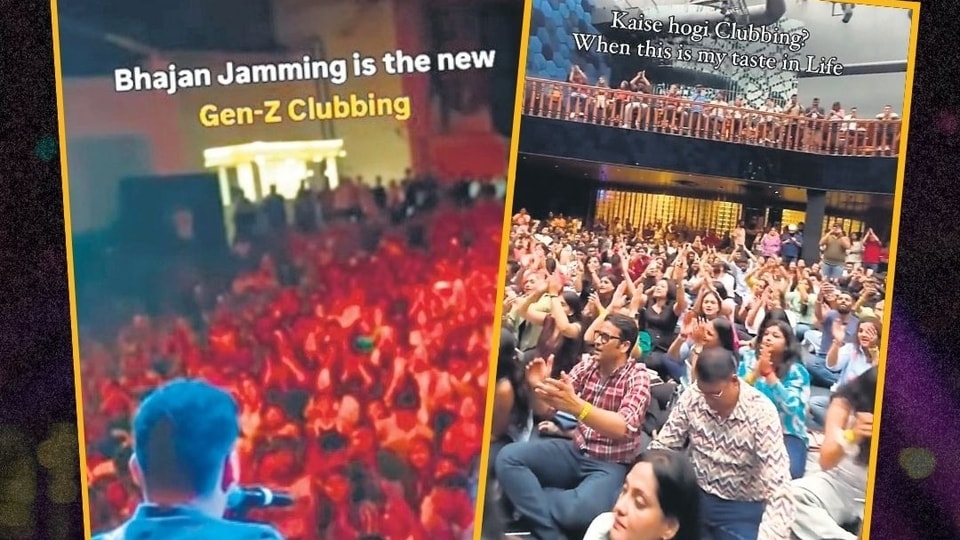
Welcome to Bhajan Clubbing!
The term sounds paradoxical, for bhajans, considered as the devotional songs of collective surrender, collide with the hedonism of the nightclub. But in these gatherings, paradox becomes poetry. The chants and beats coexist without contradiction.
Across India’s cities, Bhajan Clubbing is redefining what clubbing and spirituality look and feel like for Gen Z.
“You have to attend one to know one!,” says Abhinav Sharma, an IT trainee with an MNC who went bhajan Clubbing recently, adding, “We were about 80-100 people jamming together. We sang songs like Rama Rama Ratte Ratte Biti Re Umariya, Ram Ram Jai Sita Ram, Shri Krishna Govind Hare Murari. It was electric. I could feel the beats in my bones. And it was not religious at all. It was just us singing and dancing to some spiritual songs. It was such a happy high!”
A search for meaning
Psychologist Poonam Sharma attributes the trend to Gen Z’s desire to connect in real life and also leaning on spirituality to find their inner compass. “Gen Z is truly a digital generation and it appears to be experiencing a kind of existential fatigue. I meet so many youngsters who display a longing for proximity and real-life connections. Many are now finding their safe haven in spirituality. They are also rebels, like all generations at that age are, so bhajan clubbing is not just their clean rave but also rebellion.”

Dr Sakshi Sharma, professor at Jawaharlal Nehru University (JNU), dubs it as “postmodern pilgrimage”. She says, “Earlier, spirituality was tied to ritual and geography. Now, it is tied to experience and community… In the postmodern condition, spirituality has fragmented and redefined itself. Bhajan Clubbing is that recalibration. An act of cultural synthesis and a longing to feel something stronger.”
Performers ride the wave
The growing popularity of Bhajan Clubbing has created an unprecedented demand for spiritual music, prompting performers to cut out dedicated live sets for it.
Suresh Prajapat, whose band was the first runner-up of India’s Got Talent’s Season 8, says, “Earlier, I would slip in a few high-energy bhajans between Bollywood tracks. Now the audience insists on bhajans so much so that we’ve created an entirely spiritual set. Young people love it, and it’s heartening to see them find joy in it.”

Sibling duo Prachi Aggarwal and Raghav Agarwal, aged 22 and 25, know as BackstageSiblings, went viral for a bhajan reel, share a similar story. “At our first concert, there were barely 50 people. Recently, we sold out a ticketed show for 1,700 people that mostly,” says Prachi.
The response has been so overwhelming that both siblings quit their jobs to meet the growing demand for their performances.

“We both had full-time jobs and we are into investment banking and finance. However, we both quit our jobs some four months back and took to performing bhajan parties full-time. We have performed in Delhi, Pune, even in Dubai," says Raghav.
Hangover without a high
Even clubs are adapting. “We are particular that there is no alcohol and only vegetarian food at our bhajan jamming sessions. Although clubs make money out of alcohol, they are agree because the demand strong. These maybe spiritual and not religious jamming sessions, but I and the audience love the discipline,” shares Suresh.
Gen Z loves it, parents stan it!
“After all the Diwali parties, I wanted something calmer and cleaner. So I went for Bhajan Clubbing. The energy was electric. Everyone was on a clean high. I had goosebumps. Later I posted about my experience and so many millennials and Gen Z asked me about it. It was so amazing! I call it a spiritual rave,” shares vlogger Deepti Bajaj.

“My friends and I are on a detox. We are into the ‘clean vibes and life’ era at the moment. So, no alcohol but still getting a happy high through music is very appealing. And then connecting spiritually with like-minded people is totally awesome,” says Madhvi Gupta, a 22-year-old, who even took her parents bhajan clubbing.
“I totally dragged my parents to it and they were very amused and happy with it. It’s the kind of clubbing that parents approve, ” says Madhvi, who also attended a few baithaks or home concerts.
Spiritual not religious
Almost everyone who attends these events says that it is a spiritual high and not necessarily religious. "Findings from various studies such as Pew’s, show Gen Z is increasingly leaning towards spirituality over organised religion. So, the trend of Bhajan Clubbing is in line with that. And then, there is the longing for connection, for this is also the loneliest generation," says Dr Sakshi.
That longing has given rise to the subculture called Bhajan Clubbing. In a world numbed by virtual hashtags, shrinking attention spans and popcorn brains, Bhajan Clubbing offers a counterpoint.
Science talk
- Studies on group singing in the UK and Europe show that synchronized singing increases oxytocin, the bonding hormone, which enhances trust and emotional closeness.
- A 2023 Bond University study found that just 12 minutes of group chanting reduces cortisol (also called the stress hormone), and increases feelings of social connection.
- MRI studies from India have shown that chanting “Om” creates theta wave brain activity which is associated with relaxation, meditation and emotional regulation.


