
 E-Paper



Seats in 3rd row, patka 'refusal' at Prez event: Republic Day sees Congress-BJP war over 'protocol', Rahul at its centre
Friction began during the morning parade over seating arrangements for Rahul Gandhi and Mallikarjun Kharge; extended into ‘At Home’ event in evening

 Prefer HTon Google


The Republic Day celebrations on Monday saw a showcase of India's defence prowess to the world, but were also marked by a spat at home — between the ruling Bharatiya Janata Party (BJP) and the main opposition party Congress over seating arrangements and protocol.
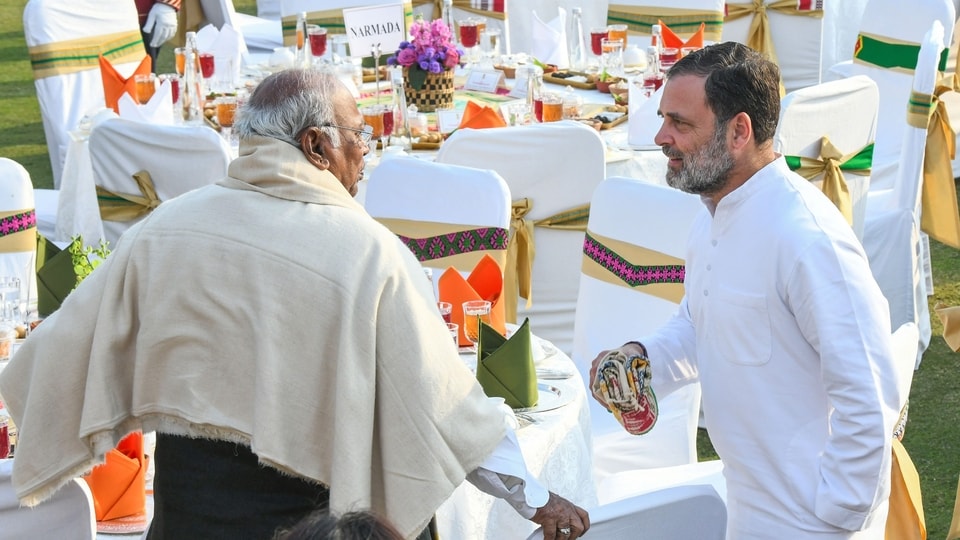
It was centred around two incidents, alleged and otherwise — the seating of opposition leaders Rahul Gandhi and Mallikarjun Kharge during the parade at Kartavya Path, and then Rahul's not wearing a traditional garment during the President's ‘At Home’ reception.
Seating arrangement turn bone of contention
The friction began during the morning parade when images emerged of the Leader of the Opposition in the Lok Sabha, Rahul Gandhi, and Congress President Mallikarjun Kharge, who is Leader of the Opposition in the Rajya Sabha, seated in the third row.
Sharing a picture of the leaders, Congress general secretary Randeep Surjewala asked on social media, “Does such treatment of the leader of the opposition in the country meet the standards of any decorum, tradition, and protocol?” Surjewala added that "in a democracy, differences will persist, but this treatment meted out to Shri Rahul Gandhi is unacceptable".
Congress MP Vivek Tankha described the situation as “sheer lack of protocol and grace”, arguing that “making them sit in the back rows is not an insult to them but to the nation”.
He said he did not recall similar treatment being meted out to former opposition leaders like Sushma Swaraj and Arun Jaitley of the BJP.
The BJP defended the seating arrangement by citing official guidelines. BJP national spokesperson Shehzad Poonawala said, “Seating is decided by a set format - Warrant or Table of Precedence.” He observed that “one can see even senior cabinet ministers around or even behind Rahul Gandhi but none of them made it an issue”. Poonawala accused the Congress of putting “entitlement and ego, parivar and position above people”.
Row extends, this time over attire
The confrontation stretched into the evening ‘At Home’ reception at Rashtrapati Bhavan.
The BJP accused Rahul Gandhi of “disrespecting the culture and people of North-East” by “choosing not to wear patka”, or Assamese gamosa, a traditional scarf. The party claimed he refused a request by President Droupadi Murmu.
Senior BJP leader and Assam CM Himanta Biswa Sarma, known for his almost daily digs at his former party Congress, commented too: “In an act that was deeply insensitive and insulting to the people of the entire North East, Mr. Gandhi chose not to wear the traditional patka, a symbol of the region's rich cultural heritage.”
The Congress rejected the accusations, with MP Manickam Tagore sharing a photograph of Union defence minister Rajnath Singh to counter the BJP’s narrative, saying he did not wear it either. Tagore said the BJP must “stop dragging the Hon'ble President into your cheap politics”.
Reports citing unnamed sources also said that Kharge chose to leave the At Home early, along with Rahul Gandhi, and the latter did not greet PM Narendra Modi.
(inputs from ANI, PTI)


