
 E-Paper



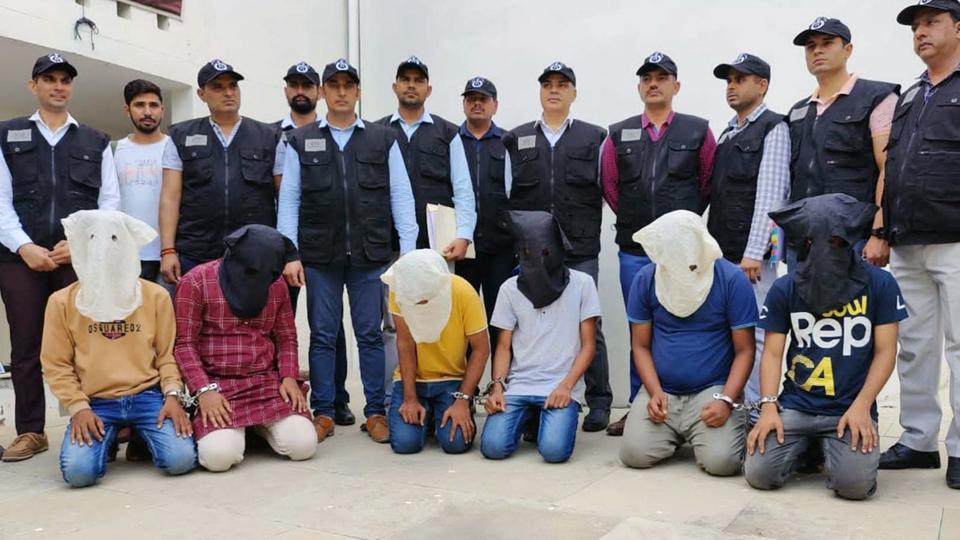
6 with links to Pakistan, West Asia arrested: Haryana police
“Four Haryana MLAs, who had received death threats and extortion calls from multiple phone numbers between June 24 and June 28, were traced to the countries in West Asia (the Middle East),” said Satheesh Balan, deputy inspector general of the STF.

 Prefer HTon Google


The special task force (STF) of the Haryana Police has arrested six people for allegedly giving death threats and extortion calls to legislators from the state and neighbouring Punjab, a senior officer said on Sunday, adding the accused were members of a criminal gang with links with fraudsters in Pakistan and West Asian countries.
“Four Haryana MLAs, who had received death threats and extortion calls from multiple phone numbers between June 24 and June 28, were traced to the countries in West Asia (the Middle East),” said Satheesh Balan, deputy inspector general of the STF.
Technical analysis of these cellphone numbers confirmed that they were registered in the West Asian countries and were being operated from Pakistan, Balan told reporters at the STF’s headquarters in Bondsi. “The gang had also called three politicians of Punjab and demanded protection money of ₹5 lakh.”
Two members of the gang Dulesh Alam, a native of Bihar, and Badre Alam, hailing from Uttar Pradesh, were arrested from Mumbai. The other four — Amit Yadav, Saddiq Anwar, Sanoj Kumar, Kash Alam — all natives of Bihar, were arrested from the state’s Muzaffarpur district, the DIG said.
Following interrogation of the accused arrested from Mumbai and Bihar after tracing their hideouts during a two-week long operation involving central agencies, the STF said there were approximately 10 Pakistani residents through whom the threats and extortion calls were routed.
The accused used to make voice over internet protocol (VoIP) calls to their targets to demand protection money, Balan said. “They used to pose as members of infamous local gangs and send audio recording threatening with local dialect. If they are calling someone in Maharashtra they used their local accent and if in Punjab they spoke in Punjabi.”
Police have recovered their voice recordings, WhatsApp messages and call details to establish their involvement in the crime. Fifty five ATM cards, 24 mobile phones, 56 SIM cards, 22 passbooks and cheque books, ₹3.97 lakh, an SUV (Tata Punch), three diaries and a register were also recovered from the accused, the DIG added.
After the legislators received the threats, police registered first information reports and Haryana director general of police (DGP) PK Agrawal handed over the investigation to the STF.
The task force, aided by central agencies, conducted a technical analysis of mobile phone numbers and IP addresses. “Five separate teams worked on the technical analysis. The STF crafted a plan through which its team started receiving these threat and extortion calls,” Balan said.
The STF asked for account numbers to complete transactions with the extortionists. To track these account numbers, two teams conducted raids in Mumbai and Muzaffarpur in Bihar.
The STF was headed by superintendent of police Sumit Kuhar and led by DSPs Sandeep Dhankhar and Surendra Kinha.
“During investigation, we came across with information of 10 Pakistani nationals through whom the threats and extortion calls were routed. The gang members used to lure people from the weaker section and pay them between ₹15,000 and ₹20,000 for opening bank accounts to carry out the gang’s transactions,” Kuhar said. “They had more than 1,000 bank accounts that were opened by genuine people and thousand with forged documents.”
These accused do not belong to any criminal gang or terrorist organization, said the DIG. “This is a gang of very sharp criminals who are involved in professional fraud, money laundering and have their members across Pakistan, Middle East (West Asia) and India,” Balan added.
The gang members running call centre from Pakistan and West Asian countries would entice victims in the guise of an entry into ‘Kaun Banega Crorepati’ or saying they have won lotteries or by extortion calls and would make them transfer the money to the account numbers given by Dulesh or Amit, he added.
The duo would then either withdraw the money through ATMs or transfer to the Indian accounts of their Pakistan-based gang members, Balan said, adding that “hawala mode was used the most by them”.
Police said they are trying to verify the number of people in the gang and the areas of their operation. “Our prime focus is on the operations of their Hawala money; how they are operating and who all are involved in money laundering,” said Balan. “The money they have collected is in crore and we will verify it from their bank accounts on Monday. Their bank accounts daily had inflow of at least ₹50,000 and we have only collected details of 50 accounts so far.”
The accused were produced before a court, which has sent them to eight-day police remand. The gang was active for the last many years, but since July 2021 it started making extortion calls to politicians, police said.


