E-Paper



8 Adivasi insurgent outfits ink peace deal with Centre
The Union and Assam governments on Thursday signed a peace accord with eight tribal insurgent outfits of the state, with Union home minister Amit Shah saying the Union government is working towards ending all border disputes in the northeast by 2024.


The Union and Assam governments on Thursday signed a peace accord with eight tribal insurgent outfits of the state, with Union home minister Amit Shah saying the Union government is working towards ending all border disputes in the northeast by 2024.
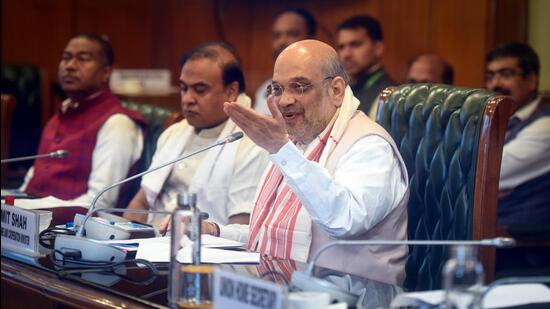
The development came 10 years after the Centre and the outfits signed a ceasefire agreement in 2012.
The signing ceremony held in the national capital was attended by Assam chief minister Himanta Biswa Sarma and senior officers of the state, Union home secretary Ajay Kumar Bhalla and Intelligence Bureau chief Tapan Deka.
The eight groups which are part of the tripartite peace accord are Birsa Commando Force (BCF), Adivasi Peoples’ Army (APA), All Adivasi National Liberation Army (AANLA), Adivasi Cobra Military of Assam (ACMA), Santhali Tiger Force (STF) and three splinter groups of BCF, ACMA and AANLA.
“This agreement will prove to be another important milestone in the direction of making North-East extremism free by 2025,” Shah said as he called the pact an important step for peace and development of Assam.
“1,182 youths from the state are giving up arms and joining the mainstream. It has been our continuous endeavour to establish peace in the region,” he said.
The pact will fulfil the political, economic and educational aspirations of the Adivasi community, most of whom are engaged in tea gardens in Assam, a statement released by the ministry of home affairs quoted him as saying.
“The agreement also provides for rehabilitation and resettlement of armed cadres and measures for welfare of the tea garden workers,” he said.
In 2012, the Centre signed a ceasefire agreement with the outfits but a peace deal that encompassed rehabilitation of the cadres and dealt with social and economic benefits to the Adivasi community was not inked.
The home minister announced a special development package of ₹1,000 crore ( ₹500 crore each by the Centre and Assam) over a period of five years for development of infrastructure in Adivasi-inhabited villages/areas.
“This is a momentous day and with this, peace in Assam will get a big impetus,” Sarma said.
“Now, a peace deal remains to be signed only with Dimasa terror outfits,” he added.
The home ministry has taken steps to develop the northeast by promoting and developing the rich culture of the region, settling all disputes, establishing peace and accelerating development to make the region peaceful and prosperous, the statement by the home ministry said.
The Union government has decided to resolve all border disputes between the north-eastern states and all disputes pertaining to armed groups by 2024, it added.
Currently, Meghalaya, Arunachal Pradesh, Mizoram and Nagaland are each having border disputes with Assam in the Northeast.
Shah said the Narendra Modi government “has a record that it has fulfilled 93 % of the promises made under all the agreements signed so far and as a result, peace has been restored in the entire Northeast, including Assam”.
The Centre has taken several steps in the last few years to bring peace in the region. They include removal of the Armed Forces Special Powers Act (Afspa) from large swathes – 23 districts and one police station area – in Nagaland, Assam and Manipur from April 1 this year.
In March this year, Sarma and his Meghalaya counterpart, Conrad Sangma, signed an agreement in the presence of Shah to end a 50-year-old boundary dispute between the two states. The long-standing land dispute erupted in 1972 when Meghalaya was carved out of Assam.
In September last year, the tripartite Karbi Anglong agreement was signed between the Centre, the Assam government and representatives of Karbi Anglong Autonomous Council to fulfil all the conditions for development of the Karbi people within the stipulated time.
Under this pact, more than 1,000 armed cadres surrendered and joined the mainstream.
The Centre also signed a peace accord with the National Democratic Front of Bodoland (NDFB) in January 2020.