
 E-Paper



A classroom and a nursery of new democracy
The village of Kalpa, then called Chini, went to the polls months ahead of the rest of the country because the remote village with roughly 60 families would get cut off by snowfall in early November.


The government primary high school in Himachal Pradesh’s Kalpa village is a charming three-room wooden structure ringed by the Kailash mountain ranges on one side and an ancient monastery on the other. Built by the British in 1890, the school is perched atop a small hill and its 67 students have to trudge through mounds of snow in winter up a cobbled path to reach the classroom.
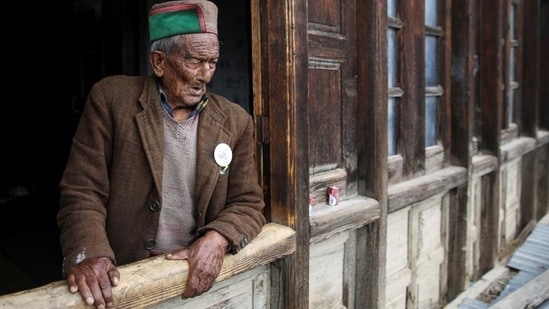
But this unassuming building hides a storied history. Its classroom functioned as India’s first polling booth on the morning of October 25, 1951, in the newly independent country’s first national elections. It is here that Shyam Saran Negi, now 105, cast the country’s first ballot at 6.30am – the ballot box installed at the far end of the room, the presiding officer sitting on the teacher’s table and stacks of ballot paper piled up in a corner.
“It was an unforgettable experience. It made me feel powerful because I realised the value of a vote,” said Negi, who has voted in 16 subsequent parliamentary elections.
The village of Kalpa, then called Chini, went to the polls months ahead of the rest of the country because the remote village with roughly 60 families would get cut off by snowfall in early November. India’s first election commissioner, Sukumar Sen, was aware of this problem. He was keen to finish polling before it became impossible for election officials to trek up for six days from Rampur city, roughly 100km away.
“Elections to these areas had to be arranged in a hurry before the snow-fall. It was just possible to complete the polling in these areas in time. Even then, it took about a week after the poll to transport the ballot boxes to the headquarters of the respective returning officers for the counting of votes,” Sen wrote in his election report.
Holding an election at 10,000 feet was only of the many daunting challenges before Sen, who took over as election commissioner in March 1950, days after India officially became a republic and adopted a groundbreaking new Constitution that declared, among other things, that the country’s government will be elected by universal adult franchise.
India had witnessed two previous elections, one in 1937 and another in 1946, but they had been conducted on restricted franchise, with roughly 20% of the adult population eligible to vote. Moreover, only 18% of the country was literate in 1951 – and the figure was in single digits in far-flung areas – and nowhere in the world had such a mammoth exercise been undertaken with so little prior experience.
Yet, by all measures, the inaugural elections, held over 68 phases and four months, was a success.
The Congress party won 364 of the 489 seats but opposition parties, independents and smaller groups garnered roughly half the cumulative votes. The introduction of symbols, indelible ink to prevent impersonation or double voting, and manufacture of ballot boxes, papers and seals on an industrial scale helped the exercise. The successful culmination of the election also belied the predictions of colonialists who warned that a large and poor country like India could never hold free and fair elections, or sustain democracy.
“In the true spirit of democracy, the Constituent Assembly unhesitatingly adopted the principle of adult suffrage with full knowledge of the difficulties involved. This was indeed an act of faith – faith in the common man of India and in his practical common sense. This decision launched a great and fateful experiment unique in the world in its stupendousness and complexities,” Sen wrote after the completion of the election.
Many things have changed in the past 70 years. The electorate has grown from 172 million to 911 million in 2019, the 68 phases have shrunk to seven, the turnout has swelled from 45% to 67% and the 489 seats in the first Lok Sabha polls have become 543.
Still, many things remain unchanged. The Indian election continues to be the largest democratic exercise in the world, held at last count by 12 million officials across one million polling booths. Most of all, the unprecedented enthusiasm of people who had never voted before in 1951 is reflected in each new generation.
“Even in a remote region like Kalpa, the elections were a festival that everyone wanted to participate in. It was a carnival, and it remains like that even today,” said VC Pharkha, former chief secretary of Himachal Pradesh.


