
 E-Paper



‘A player’s going to die’: Oppressive US Open heat underlines climate crisis repercussions on sport
Matches in its second week, meant to be a show of tennis skills, have turned into a test of heat tolerance and physical endurance

 Prefer HTon Google


On Wednesday, Daniil Medvedev sat still with an ice-wrapped towel on his head, looking like anything but a tennis player who had just entered the US Open semi-finals after a straight-sets quarter-final victory.
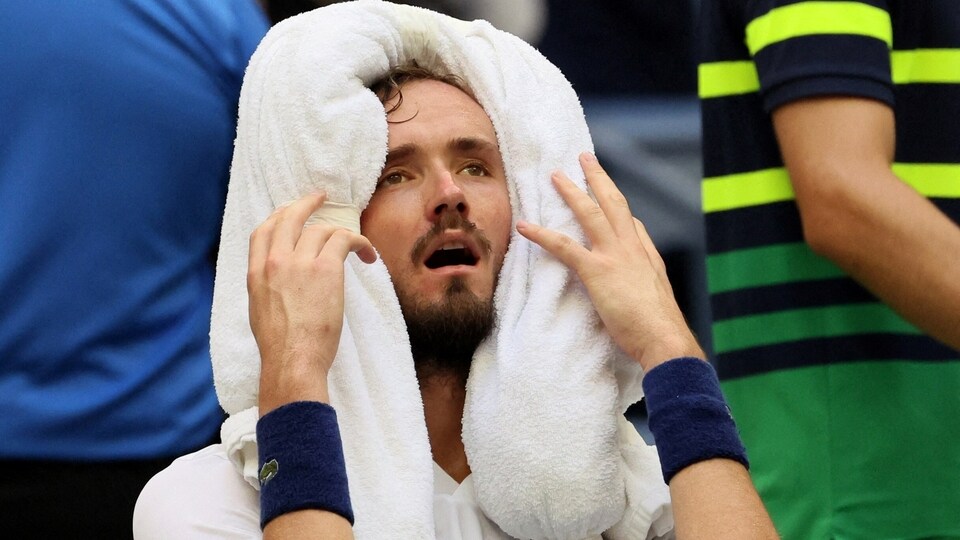
Minutes earlier, during the third set, an exasperated Medvedev walked across to fetch his towel between points, looked straight into the court-side camera and said, “One player (is) gonna die, and they’re gonna see.”
Extreme as his words may have been, it was matched by the weather at tennis’ season-ending Grand Slam.
Hours after Medvedev’s remark (and victory), the Copernicus Climate Change Service released data that showed that August 2023 was the hottest on record, just like July and June before it, making this summer the world’s hottest ever.
September may continue the trend.
It’s so hot and humid in New York that players have reached boiling point at the US Open. Matches in its second week, meant to be a show of tennis skills, have turned into a test of heat tolerance and physical endurance.
That’s what the all-Russian men’s singles quarter-final between Medvedev and Andrey Rublev was in Wednesday’s day session. The 6-4, 6-3, 6-4 match lasted 2 hours and 48 minutes — a relative sprint in Grand Slam terms — yet both players appeared to have run a marathon. Gasping for breath, Rublev keeled over, hands on his knees, after several points. Medvedev had his breathing checked by a doctor, and puffed on an inhaler during a changeover in the second set.
Temperatures have routinely crossed 32.2°C (90 degrees Fahrenheit), and humidity, exceeded 50%, in New York this week as the city experiences a heatwave. The high humidity immediately takes the so-called feels-like temperature to 35°C, but the on-court temperatures are likely even higher. The conditions, termed “brutal” by 2021 champion Medvedev, compelled the tournament organisers to enforce a heat policy from Tuesday until Sunday’s final. Under the new rule, the retractable roof on Arthur Ashe Stadium, US Open’s showpiece court, will remain partially closed. Meant to swing to work during rain, it now offers some respite from the sun.
Extreme weather, the result of climate change, has increasingly impacted sporting events across the globe. At the World Athletics Championships in Budapest last month, organisers were forced to move the women’s 5,000m heats to the evening due to excessive heat. A February 2022 article by the United Nations’ department of economic and social affairs, titled “Addressing Climate Change Through Sport,” claimed “approximately half of the former winter Olympic host cities will likely not be able to sponsor winter games by 2050 due to a lack of snow and ice in a warming world”.
Tennis hasn’t been spared either. In 2018, for the first time in its history, the US Open had to implement an extreme heat policy that allowed players longer breaks between sets. A 2023 study by Associated Press showed that maximum temperatures in the four Grand Slams collectively have risen by approximately 2.8°C (nearly 5°F) since 1988. Australian Open, the season-opening Slam in the summer Down Under, had the highest average spike (over 3.33°C or 6°F) in the period while the US Open (average rise 1.67°C; or 3°F) remained the hottest of the Slams in any given year.
It is clearly that this year. And the unrelenting heat has affected the quality of play as reflected in some lopsided quarter-final results, especially those in the day session (all four last-eight matches on Tuesday and Wednesday ended in straight sets).
At one point during his contest with Medvedev, all Rublev, an out-and-out baseliner, was looking to do was find winners or rush in to finish the points early. China’s Zheng Qinwen, who lost her quarter-final 6-1, 6-4 to Aryna Sabalenka before the Medvedev-Rublev match, said the rule-enforced roof closure that covered the court only partly in shadows bothered her.
Novak Djokovic, drenched in sweat after beating Taylor Fritz on Tuesday, also highlighted the “very humid conditions”. Medvedev said he “couldn’t see the ball anymore” at the end of the first set with Rublev, and gauged that his compatriot across the net looked “like he cannot run anymore”.
The world No 3 Russian acknowledged that there was no quick fix to this issue — “probably we cannot stop the tournament for four days” — but raised a question for the longer run. “The only thing that is a little bit, let’s call it dangerous, is that the question is: How far could we go?” he said.


