The Lok Sabha on Monday cleared a draft legislation on electoral reforms seeking to use Aadhaar numbers for identification and verification of voters, with the central government maintaining the process would weed out duplicate and fake voter IDs.
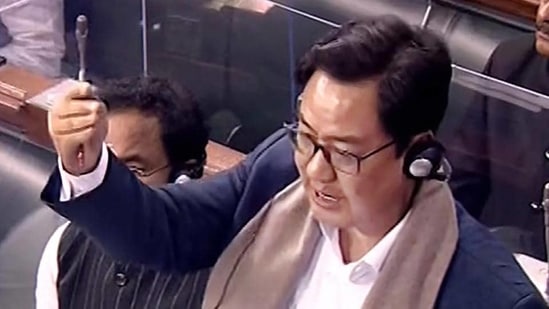
The Election Laws (Amendment) Bill 2021, piloted by law minister Kiren Rijiju, was passed by voice vote after a brief discussion during which some opposition members demanded that it be referred to a parliamentary panel.
Opposition members questioned the haste shown by the government in passing the bill, besides attempting to highlight the ambiguity of objective behind the move. The primary concerns of the opposition pertained to undue weightage being given to a proof of identity and residence such as Aadhaar in creation of electoral rolls, and a possible compromise of individual privacy if the voters’ lists are seeded into the Aadhaar’s ecosystem.
Also read | 'Giving vote to non-citizens': Shashi Tharoor on Election Laws (amendment) Bill
While the bill that seeks to amend the Representation of the People Act (RPA), 1950, is yet to receive an approval of Rajya Sabha, there are some legal nuances that surround the issue, even as the Centre and the Election Commission of India (ECI) have been on the same page on using Aadhaar to verify electoral rolls.
{{/usCountry}}While the bill that seeks to amend the Representation of the People Act (RPA), 1950, is yet to receive an approval of Rajya Sabha, there are some legal nuances that surround the issue, even as the Centre and the Election Commission of India (ECI) have been on the same page on using Aadhaar to verify electoral rolls.
{{/usCountry}}Changes proposed under the amendments
The 2021 amendment bill envisages major changes in Section 23 of RPA, which contains provisions for inclusion of names in electoral rolls and is directly related to Sections 15, 17 and 18 of the law.
Section 15 of RPA lays down that for every constituency there shall be an electoral roll, which shall be prepared in accordance with the provisions of this Act under the superintendence, direction and control of the election commission. Section 16 states that a person shall disqualified for registration in an electoral roll if he is not a citizen of India. Sections 17 holds that no person shall be entitled to be registered in the electoral roll for more than one constituency, whereas Section 18 categorically provides that no person shall be entitled to be registered in the electoral roll more than once.
Section 19 provides that every person who is not less than 18 years of age on the qualifying date and is ordinarily resident in a constituency shall be entitled to be registered in the electoral roll .
In Section 23, the amendment seeks to include new clauses authorising electoral registration officers to seek the Aadhaar numbers of people who want to register as voters “for the purpose of establishing identity”.
The officer may also require the Aadhaar number from people already included in the electoral roll “for the purposes of authentication of entries in electoral roll and to identify registration of name of the same person in the electoral roll of more than one constituency or more than once in the same constituency” in order to ensure compliance with Sections 17 and 18 of the RPA.
The modified law clarifies that no application for inclusion of name in the electoral roll shall be denied and no entries in the electoral roll shall be deleted for inability of an individual to furnish or intimate an Aadhaar number “due to such sufficient cause as may be prescribed” and the electoral registration officers may allow such individuals to produce such other documents.
The amendment proposed in Section 28 of RPA further makes it clear that the form and manner of intimation of Aadhaar number as well as the sufficient cause and furnishing of alternate documents to be provided in place of Aadhaar will become known when the central government makes rules in this regard and notifies the amendment in the official gazette.
The opposition, legal and political
During the introduction of the draft legislation, law minister Rijiju emphasised that the government attempted to remove a lacunae in the existing law since there is a need to weed out bogus voters from electoral rolls. He further said that the provision for linkage of Aadhaar number with Voter ID “would not be compulsory but only voluntary”. But some opposition MPs countered the Bill on the grounds of legislative competence and violation of fundamental and statutory rights of people.
Congress MP Shashi Tharoor pointed out that Aadhaar was only meant to be a proof of residence and not of citizenship. Further, he asked, when only citizens are allowed to vote then how linkage of Aadhaar and electoral rolls would serve the purpose of weeding our bogus voters.
Congress MP Manish Tewari also opposed the proposed amendments, arguing that the Supreme Court’s judgments in Puttaswamy (right to privacy) and Aadhaar do not allow the linkage of Aadhaar with Voter IDs. “Voting is a legal right. Therefore, this Bill is beyond the legislative competence of the Aadhaar Act,” he said.
On his part, All India Majlis-e-Ittehadul Muslimeen chief Asaduddin Owaisi maintained that the Bill will allow the government to profile and disenfranchise voters and end up violating principles of secret ballot and universal adult franchise in breach of Supreme Court rulings.
YSR Congress MP Lavu Devarayalu underscored that a similar seeding exercise carried out in Andhra Pradesh resulted in the disenfranchisement of 3 million voters. It may become a tool in the hands of the government to look into the voting habits of citizens, he said.
Other opposition members demanded that the Bill should be referred to a standing committee and that the haste shown by the government was suspect. Congress MP Adhir Ranjan Chowdhury said: “The Bill is being introduced today, taken up for consideration and passing today. What is the hurry? We have requested that it be referred to standing committee.” Nationalist Congress Party MP Supriya Sule also questioned the “tearing hurry” in passing the Bill, without allowing for detailed deliberation.
The law minister countered the objection by bringing to the House’s notice that a parliamentary standing committee had “unanimously” recommended these provisions and that linking Aadhaar with electoral rolls would reduce electoral malpractices. On the issue of possible breach of Supreme Court judgments, Rijiju held that all the conditions prescribed by the top court in the right to privacy judgment, including legitimate state interests and test of proportionality, are satisfied by the modified law.
Constitutional courts on issue of Aadhaar-Voter ID linkage
The chief legal objection to the government’s proposed amendment relates to a possible breach of the Supreme Court ruling in Puttaswamy’s case. In August 2017, a nine-judge bench of the Supreme Court passed a historic judgment affirming the constitutional right to privacy. It declared privacy to be an integral component of Part III of the Constitution of India, which lays down fundamental rights.
The Constitution bench, however, clarified that like most other fundamental rights, the right to privacy is not an absolute right and that subject to the satisfaction of certain tests and benchmarks, a person’s privacy interests can be overridden by competing state and individual interests. The judgment laid down certain elements of the judicial review standard to test validity of a law or an executive action on the anvil of the right to privacy.
The judgment held there should be existence of a law, which should seek to achieve a legitimate state aim in a democratic society. It added there should be a rational nexus between the objects and the means adopted to achieve them, besides ensuring that the extent of interference must be proportionate to its need while having procedural guarantees to check against the abuse of state interference.
The Election Commission started linking Aadhaar with Voter IDs in 2015 and completed the process for around 300 million people when the Supreme Court set about to examine the constitutionality of Aadhaar while clarifying that Aadhaar would be optional for availing of welfare schemes.
In 2018, a five-judge bench of the Supreme Court affirmed the constitutionality of the Aadhaar Act. It held that Aadhaar could be made mandatory to access any subsidy, benefit or service that were paid for by the consolidated fund of India. It also held that the mandatory linking of Aadhaar to the Permanent Account Number (PAN) used for income tax is legal since it neither violates right to privacy nor is discriminatory.
But the same judgment prohibited mandatory linking of a bank account to Aadhaar, holding “it does not meet the test of proportionality and is also violative of right to privacy of a person which extends to banking details”.
The Constitution bench also declared the government’s March 2017 circular unconstitutional as it sought to provide for compulsory linking of mobile number with Aadhaar, finding it “disproportionate and [an] unreasonable state compulsion”.
The Supreme Court, however, did not explicitly rule on whether Aadhaar could be linked to voter data because there was no such policy or law in force at that time.
Meanwhile, advocate and BJP leader Ashwini Upadhyay filed a public interest litigation in the Supreme Court in February 2018, seeking direction for linking of Aadhaar number with Voter IDs to curtail bogus votes and with property documents to crackdown on benami transactions and black money generation. When his petition came up for hearing on February 20 that year, the top court asked Upadhyay to wait till pronouncement of the verdict on pleas challenging the constitutional validity of Aadhaar scheme in terms of principles laid down in the right to privacy ruling of 2017.
In March 2019, the Supreme Court declined to entertain the PIL “at this stage”, asking Upadhyay to move ECI which would l pass a reasoned order on his plea. The court also gave Upadhyay the liberty to come back to the top court after the Commission decides.
As his representation to ECI remained pending, Upadhyay moved the Delhi high court in July 2019 for putting in place an Aadhaar-based election voting system while suggesting that e-voting system should use fingerprints and face biometrics. On July 16, 2019, the Delhi high court disposed of this petition while asking ECI to decide on the possibility of linking election identity cards with Aadhaar numbers in accordance with law.
Therefore, a direct ruling or observation by a constitutional court on linking of Aadhaar with Voter IDs is yet to come even as the constitution bench rulings in the right to privacy and Aadhaar case have laid down the ground rules for scrutinising a legal challenge of this nature.
However, these judgments have cited two previous rulings of the top court which may guide any future determination.
In Peoples Union for Civil Liberties (PUCL) & Another Vs Union of India, 2003, the Supreme Court declared that when there is a competition between the right to privacy of an individual and the right to information of the citizens, the former right has to be subordinated to the latter right as it serves the larger public interest.
In Lal Babu Hussein Vs Electoral Registration Officer and Others, 1995, the Supreme Court struck down the order of the electoral officer asking the residents of Mumbai and Delhi en masse to prove their identity as unconstitutional. It ruled that electoral officers must conform to the principles of natural justice where the name is to be entered on the rolls for the first time and also where the name already entered requires to be deleted.
“The issue would have to be decided after giving the concerned person a reasonable opportunity of being heard. If the opportunity of being heard before deletion of the name is to be a meaningful and purposive one, it goes without saying that the concerned person whose name is borne on the roll and is intended to be removed must be informed why a suspicion has arisen in regard to his status as a citizen of India so that he may be able to show that the basis for the suspicion is ill- founded,” the court held.