
 E-Paper



Afghan situation critical, evacuation priority: Jaishankar at all-party meet
External affairs minister S Jaishankar briefed the MPs on the latest developments in Afghanistan following the capture of the capital Kabul on August 15 after the collapse of the government of President Ashraf Ghani

 Prefer HTon Google


The government informed a meeting of parliamentary leaders of political parties that India’s immediate priorities in Afghanistan following the Taliban takeover were the evacuation of all Indian nationals and providing help to Afghan nationals in distress.
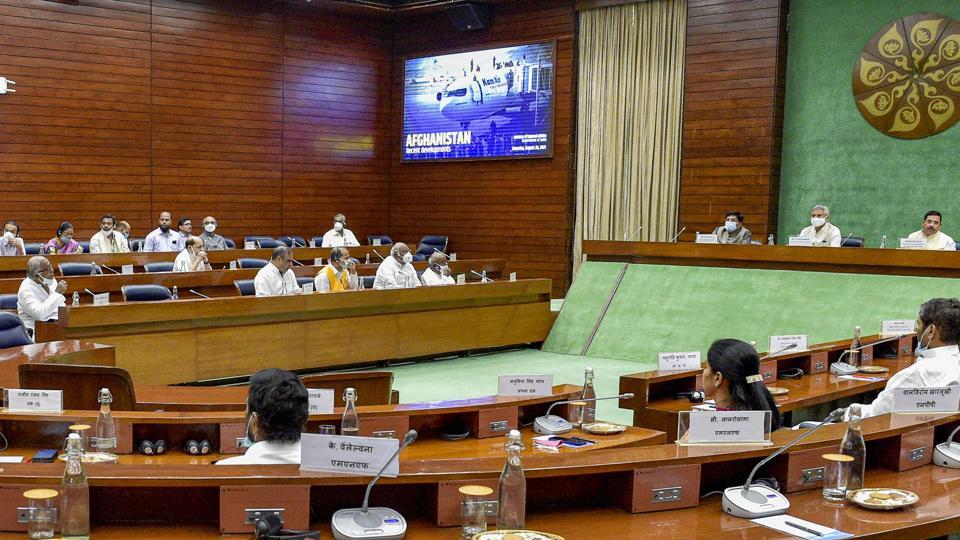
External affairs minister S Jaishankar briefed the MPs on the latest developments in Afghanistan following the capture of the capital Kabul on August 15 after the collapse of the government of President Ashraf Ghani.
Jaishankar told the lawmakers that India’s immediate priorities in the current circumstances included the evacuation of all Indian nationals, the safety of Indian diplomatic staff and providing assistance to Afghan nationals in distress, according to people familiar with the briefing.
In a string of tweets, Jaishankar said: “Our immediate concern and task is evacuation and long term interest is the friendship for the Afghan people.” He said the evacuation operations were carried out in “extremely difficult conditions especially at the airport”.
He added: “There is longstanding national sentiment on Afghanistan. Therefore there is national concern now at developments. We are gathered with a national spirit.”
Jaishankar tweeted that India’s “strong friendship with the people of Afghanistan is reflected in the more than 500 projects we have there. This friendship will continue to guide us.” He said that “India’s footprint and activities naturally keep in mind the ongoing changes” in Afghanistan.
The people cited above said India, which holds the rotating presidency of the UN Security Council for August, also chaired a special session on Afghanistan and made a statement at a session of the UN Human Rights Council in Geneva. Besides, India is involved in international coordination and humanitarian efforts in Afghanistan, Jaishankar told the MPs.
Also Read | ‘Pakistan our second home, there is peace in Afghanistan’: Taliban spokesperson
He further said India currently chairs UN 1988 sanctions committee, which oversees the designation and delisting of Taliban leaders, according to the people cited above.
The sanctions committee is expected to play a key role on the issue of extending a travel exemption for sanctioned top Taliban leaders such as Mullah Abdul Ghani Baradar in September.
Jaishankar also informed the MPs about pre-emptive measures taken by India since last year, when the Taliban launched a campaign of attacks and violence following the signing of a peace deal with the US in February 2020.
These pre-emptive measures included the withdrawal of India-based personnel from the consulates in Herat and Jalalabad in April 2020, the scaling down of personnel at the embassy in Kabul in June this year, the evacuation of personnel from the consulate in Kandahar during July 10-11, and from the consulate in Mazar-e-Sharif during August 10-11.
The Indian embassy issued a series of security advisories for Indian nationals on June 29, July 24, and August 10 and 12. The final advisories asked Indians to leave immediately and warned them about the discontinuation of commercial flights.
The external affairs ministry also set up a 24x7 special cell on Afghanistan and launched an e-visa system for Afghan nationals in distress.
The government has so far evacuated a total of 565 people, including 175 embassy personnel, 263 other Indian nationals, 112 Afghan nationals, including Hindus and Sikhs, and 15 nationals of third countries. The government also facilitated the evacuation of Indians by other agencies.
Among the challenges faced during the evacuation were frequent incidents of firing near Kabul airport and inside the city, multiple checkpoints set up by different groups, logistics and other issues at the airport, delays in obtaining landing permissions for aircraft and overflight clearances from countries in the region.
The external affairs ministry’s special cell on Afghanistan, set up on August 16 to coordinate repatriation and other requests, attended 3,014 calls, responded to nearly 8,000 messages on WhatsApp and answered more than 3,101 emails.
Union minister and leader of the house in the Rajya Sabha, Piyush Goyal, and parliamentary affairs minister Prahlad Joshi were present during the briefing held at the parliament house annexe. The briefing was attended by 37 leaders from 31 parties, including NCP leader Sharad Pawar, Leader of Opposition in the Rajya Sabha, Mallikarjun Kharge, leader of the Congress party in Lok Sabha, Adhir Ranjan Chowdhury, TR Baalu of the DMK, former prime minister HD Deve Gowda and Anupriya Patel of Apna Dal.


