
 E-Paper



India’s Rustom-2 UAV gets massive upgrade, will soar to 27,000 feet in April
DRDO's hard push to Rustom-2 is seen in the context of the continuing efforts to indigenously produce cutting-edge military equipment.

 Prefer HTon Google


Rustom-2, India’s medium-altitude long-endurance drone being developed by the Defence Research and Development Organisation, is targeted to achieve a huge milestone in April when it will take off from its test range in Karnataka’s Chitradurga to fly for more than 18 hours at a height of over 27,000 feet, people familiar with the development said.
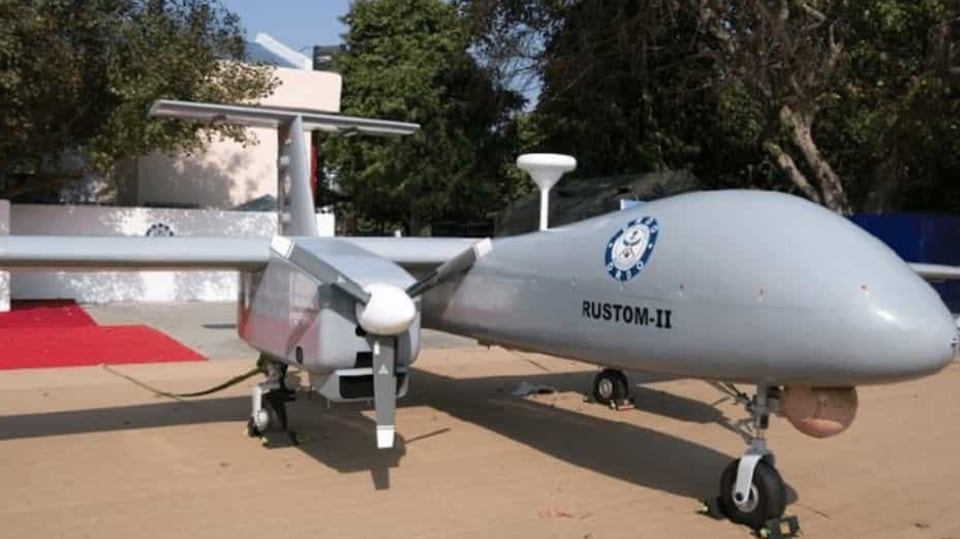
Rustom-2, also known as Tapas-BH (Tactical Airborne Platform for Aerial Surveillance-Beyond Horizon 201), successfully completed the last flight test in October last year when it successfully flew for eight hours at an altitude of 16,000 feet.
“This will be a huge step,” said a senior government official about the indigenously-developed unmanned aerial vehicle (UAV) designed for strategic reconnaissance and surveillance operations. Rustom-1
India’s previous efforts to develop military hardware hadn’t been very successful in the past, forcing the country to import more than 60% of its military requirement. India is the world’s third-biggest military spender in the world after the United States and China.
The drones, officials said, was one of the areas where India lagged behind and ended up relying on pricey imports from countries such as the USA and Israel.
China, which has invested heavily in military equipment over the years, has raced ahead in this sector also. According to the Stockholm International Peace Research Institute (SIPRI), which tracks global arms flows, China has not just built drones for the People’s Liberation Army but also exported 163 large weapons-capable UAVs to 13 countries from 2008 to 2018. It even gave four Wing Loong II armed drones to Pakistan to protect the China-Pakistan Economic Corridor and Gwadar port.
The hard push to Rustom-2 is seen in the context of the continuing efforts to indigenously produce cutting-edge military equipment. Last year, the government unveiled plans to ban the import of 101 types of weapons and ammunition over the next five years ranging from artillery guns to conventional submarines and missiles.
On Sunday, Prime Minister Narendra Modi formally handed over the indigenous battle tank Arjun Mark 1A to the Indian Army as part of this renewed focus on achieving self-reliance in the defence sector. Less than a fortnight earlier, the Cabinet Committee on Security headed by PM Modi decided to award Hindustan Aeronautics Limited (HAL) a ₹48,000-crore contract to supply 83 LCA (light combat aircraft) Mk-1A jets to the Indian Air Force.


