E-Paper



AI to be part of school curriculum from Class 3: Education ministry
Department of school education and literacy held a stakeholder consultation on Wednesday, bringing together expert bodies including CBSE, NCERT, KVS, NVS.

 Prefer HTon Google


New Delhi: The Union education ministry on Thursday announced that Artificial Intelligence (AI) will become part of the school curriculum from Class 3 onwards, starting with the 2026–27 academic session.

The idea behind introducing Artificial Intelligence (AI) at the foundational level — from Class 3 onwards — is primarily to make children aware that “there is something called AI” and how it is already being used in everyday life, a senior official in the Department of School Education and Literacy (DoSEL) of the ministry said.
DoSEL is supporting institutions such as the Central Board of Secondary Education (CBSE), National Council of Educational Research and Training (NCERT), Kendriya Vidyalaya Sangathan (KVS), and Navodaya Vidyalaya Samiti (NVS), along with states and Union Territories (UTs), in designing a meaningful and inclusive curriculum under the broad ambit of the National Curriculum Framework for School Education (NCF-SE) 2023 through a consultative process.
The department held a stakeholder consultation on Wednesday, bringing together expert bodies including CBSE, NCERT, KVS, NVS, and external experts. CBSE has constituted an expert committee chaired by Professor Karthik Raman of the Indian Institute of Technology (IIT) Madras to develop the AI and Computational Thinking (CT) curriculum.
According to the ministry, the development of resource materials, handbooks, and digital resources will be completed by December.
“AI and CT will reinforce the concept of learning, thinking, and teaching, and will gradually expand towards the idea of AI for public good. This initiative marks a nascent yet significant step towards the ethical use of AI to solve complex challenges, as the technology will be organically embedded from the foundational stage, beginning in Grade 3,” the ministry said in a statement.
Also Read: AI in school education: Towards a preparedness framework
“Initially, the focus will be on creating universal awareness about what artificial intelligence is and how it impacts our lives. As students move to higher classes, they will gradually learn related concepts, and by Classes 11 and 12, they will study them as elective subjects,” the DoSEL official said.
The initiative comes amid growing concerns about children’s use of AI chatbots. ChatGPT’s maker, OpenAI, is currently facing a wrongful death lawsuit filed by the parents of a 16-year-old from California who died by suicide in April 2025, alleging that the chatbot “coached” him and failed to protect him. In response, OpenAI in September announced a set of new safety and oversight features targeted especially at teen users and users in distress.
“Technology cannot be stopped. We will design a curriculum incorporating ethical issues on AI,” the official said.
Teachers and experts have welcomed the move but emphasised that there should be teacher training on AI use in classrooms.
Also Reads:India can reinvent education with AI
“Teachers need proper training and clear guidelines on AI before introducing it to students in classrooms. It is crucial they understand not just how to use AI, but how to use it safely,” principal of Delhi’s Mount Abu Public School Jyoti Arora said.
The ministry has said that teacher training, learning-teaching materials, and video-based learning resources will form the backbone of curriculum implementation.
Co-founder of NatureNurture, a curriculum publishing company working with over 300 schools across India, Akshal Agarwal said that the move is a “remarkable step toward preparing students for a tech-driven world.” He added that while the vision is progressive, “the real challenge lies in implementation,” as many schools still lack digital infrastructure. If executed well, he said, the initiative could “build a generation that is not just digitally aware but also responsible and innovative.”
Google Trends
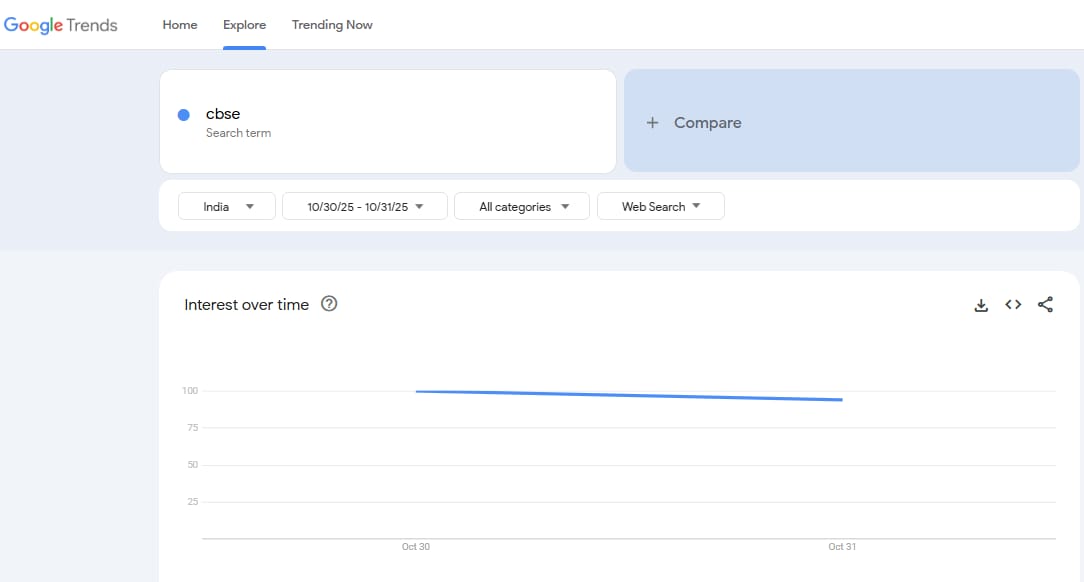
According to Google Trends data, the search term “Rohit Arya CBSE” surged in popularity and peaked on Friday. The highest search interest came from the Andaman and Nicobar Islands, followed by Puducherry, Sikkim, Haryana, and Tripura.
Top related queries included “class,” “CBSE date,” “CBSE 2026,” “class 10 CBSE,” and “CBSE date sheet,” indicating widespread interest in upcoming board-related updates linked to the trending name.