
 E-Paper



What caused Air India crash? Investigators turn to 'tail fire' for clues
Air India's Boeing 787-8 aircraft en route to London crashed into a medical hostel complex soon after take-off from Ahmedabad airport on June 12.

 Prefer HTon Google


Investigators probing the June 12 Air India plane crash in Ahmedabad are closely examining the tail section of the aircraft, which showed signs of a “contained electric fire” but was restricted to only a few components located in the rear, The Indian Express has reported.
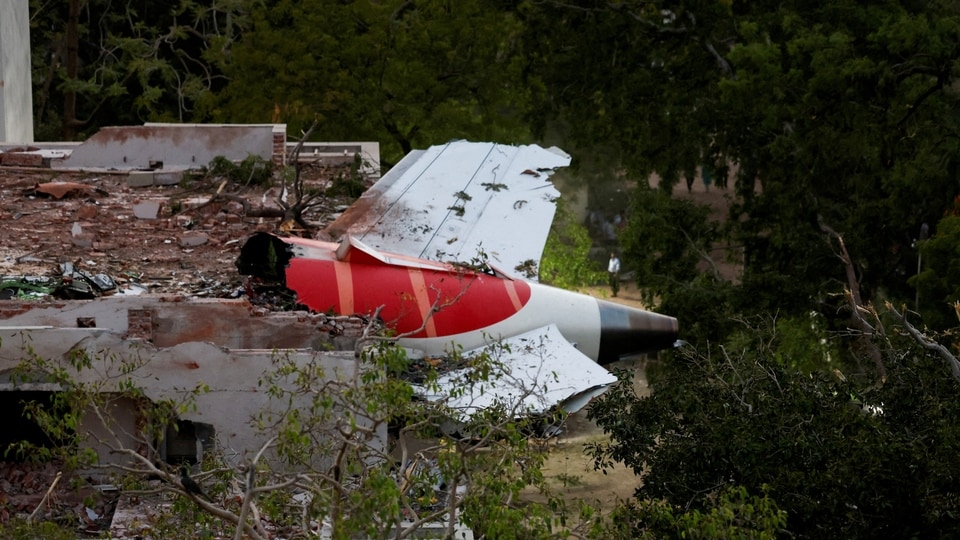
Air India's Boeing 787-8 aircraft en route to London Gatwick crashed into a medical hostel complex soon after take-off from Ahmedabad, killing 241 persons out of the 241 onboard. An additional 19 people lost their lives on the ground in the crash and the post-crash explosion.
The tail section of the aircraft was lodged on the roof of the hostel mess and remained largely unaffected by the post-crash explosion and fuel fire that had charred the rest of the aircraft's body.
Officials cited by The Indian Express said that the aft Enhanced Airborne Flight Recorders (EAFR), or the rear black box, found from the rooftop, had suffered extensive internal thermal damage.
Also Read | 'Speculative': US transport safety body NTSB slams Air India crash media reports blaming pilot
A preliminary report of the investigation into the incident, released by the Aircraft Accident Investigation Bureau after a month, had pointed out that data from the EAFR “could not be downloaded through conventional means” as the “damage was extensive”.
According to the preliminary report, both engines lost power almost simultaneously when the fuel control switches — which regulate the flow of fuel to the engines — shifted from the "run" to "cutoff" position within the space of one second.
Officials, cited by the newspaper, said the aircraft’s tail suffered the expected crash impact when it made contact with the hostel mess building, but added that this was not the rare kind of damage where the aft EAFR (rear black box) should have been damaged beyond salvage. The B787 aircraft model carries two black box sets – one under the cockpit and the other in the tail section -- as standard.
“It needs to be probed if the electric fire in the tail was due to a fault that originated in one of the flight components when it began rolling for take-off, or was it purely a fire following the impact… The fire was contained in the tail section, which, despite being embedded in Building A (hostel mess), did not spread to the structure or its electrical framework,” the official said.
According to The Indian Express, this holds importance as the crew of the previous flight, AI-423 from Delhi to Ahmedabad, had recorded a Pilot Defect Report in the technical log noting the status message “STAB POS XDCR” (Stabilizer Position Transducer – a sensor in the tail). This was troubleshooted by the Aircraft Maintenance Engineer in Ahmedabad before clearing the flight for AI-171 at 12.15 pm on June 12.
“Any malfunction of the electrical system that originated before the flight became airborne could have led to disruption of interconnected flight sensors and, in a cascading effect, triggered incorrect data to the ECU (Engine Control Unit) of the flight to cut off fuel supply… The APU also made an auto logic start after fuel supply transitioned back to ‘Run’ from ‘Cut-off’, which indicates it had been on during the take-off to have more thrust during take-off on a hot day in Ahmedabad…,” the official said.
What the probe report said
The AAIB’s preliminary report has identified fuel being cut off to both engines shortly after takeoff as the cause of the disaster, with fuel control switches found in the “cutoff” position.
The AAIB said that the Air India plane’s engine 1 and engine 2 fuel cutoff switches transitioned from RUN to CUTOFF position one after another with a time gap of 01 sec. “In the cockpit voice recording, one of the pilots is heard asking the other why did he cutoff. The other pilot responded that he did not do so”.
Also Read | Key to fatal Air India crash mystery: 32 seconds in flight deck
The 15-page report was published a month after the disaster. It provided the first official account of India’s worst aviation accident in decades.
The Airline Pilots’ Association of India has pushed back against media reports claiming human action as the cause of the crash. “Pilots are trained professionals who carry the responsibility of hundreds of lives with dedication and dignity.
“The crew of AI 171 made every possible effort -- till their very last breath -- to protect the passengers on board and minimize harm on the ground. They deserve respect, not unfounded character judgments,” ALPA India said in a statement.


