E-Paper



Amid parties’ bid to woo tea-tribes, a legal battle
Tea-tribes, as they are called in Assam are a community of workers or families of former workers in tea-gardens spread across most districts of Upper Assam.

 Prefer HTon Google


On Tuesday, the Gauhati High Court directed the Bharatiya Janata Party-led government in Assam not to take coercive action against tea garden owners over non-compliance of a recent governmentorder regarding increase in daily wages of tea-garden workers in the state.
Acting on a petition by the Indian Tea Association, the biggest organization of tea producers in India, and 17 other petitioners, Justice Michael Zothankhuma ruled that tea garden owners are at liberty to pay workers any interim raise they deem proper till the issue is decided by the court.
The order follows another by the court on March 8 staying a government order issued on February 23 raising daily wages of tea workers by ₹50 from ₹167 to ₹217. The move was clearly aimed at wooing workers in tea gardens. The ITA and other tea planters had approached the court challenging the order.
Click here for the complete coverage on elections
Interestingly, while the state government announced an increase in daily wages to ₹318 per day (including an allowance of ₹101) the Congress promised in its manifesto (CHECK) that it would increase daily wages to ₹365 if it comes to power.
Significantly, the HC fixed the next date of hearing in the case on April 23 by which time polling in Assam will be over. The state goes to polls in three phases on March 27, April 1 and April 6. The results will be announced on May 2.
Tea-tribe and Politics
Tea-tribes, as they are called in Assam are a community of workers or families of former workers in tea-gardens spread across most districts of Upper Assam. The workers were brought by British tea planters from states such as West Bengal, Bihar, Odisha, and Madhya Pradesh in several phases starting the mid-19th century. Over years, the community has grown and currently accounts for 17% of Assam’s total population of 31 million.
Around a million of them are still employed in the 800 big gardens and small tea holdings; many have left work in tea gardens for other professions. Due to their sizeable numbers, the community plays a key role in the outcome of around 35-40 of the total 126 assembly seats in the state. Political parties routinely give tickets to members of the community and over decades several of them have become ministers in both the state and central governments. Prominent among them are Pawan Singh Ghatowar, a five-time MP who was a minister during the Congress regime at the Centre and Rameshwar Teli, a minister in the present Modi government.
But the lot of most members of the community hasn’t improved much; many live in tenements with poor sanitation and have little or no-access to high quality health care or education.
The community was traditionally considered a Congress vote bank. But in the past few years the BJP has been able to make inroads into it. In the first phase of polling, elections will take place in 47 seats in the tea-rich belt. In 2016, when BJP came to power for the first time in the state, it, along with its ally Asom Gana Parishad, won 35 of these seats (the BJP alone won 27). Since coming to power the BJP-led government has launched many schemes targeting the tea-tribe community: cash benefits to pregnant women, reservation of seats in educational institutions, the setting up schools in tea gardens, freebies including mobile phones and bicycles, money for meritorious students and funds to young people to set up small businesses.It has also promised the community, scheduled tribe status
“We have been implementing several schemes for the tea-tribes community over the years. The schemes have earned heavy praise from members of the community,” finance minister Himanta Biswa Sarma told the state assembly last month while presenting a vote on account. He mentioned that the government has opened 730,000 bank accounts for tea workers and transferred ₹8,000to each account in three tranches
Organisations of tea garden workers have been demanding an increase in daily wages to ₹351 . In 2018, the state government in an interim order increased daily wages of tea workers by ₹30 from ₹137 to ₹167. While the earlier order was yet to be notified, another interim order was issued in February this year taking the total increase to ₹80. On top of this, workers receive an allowance of ₹101. The move came few days after Congress promised taking daily wages of tea workers up to ₹365 (including the ₹101 allowance).
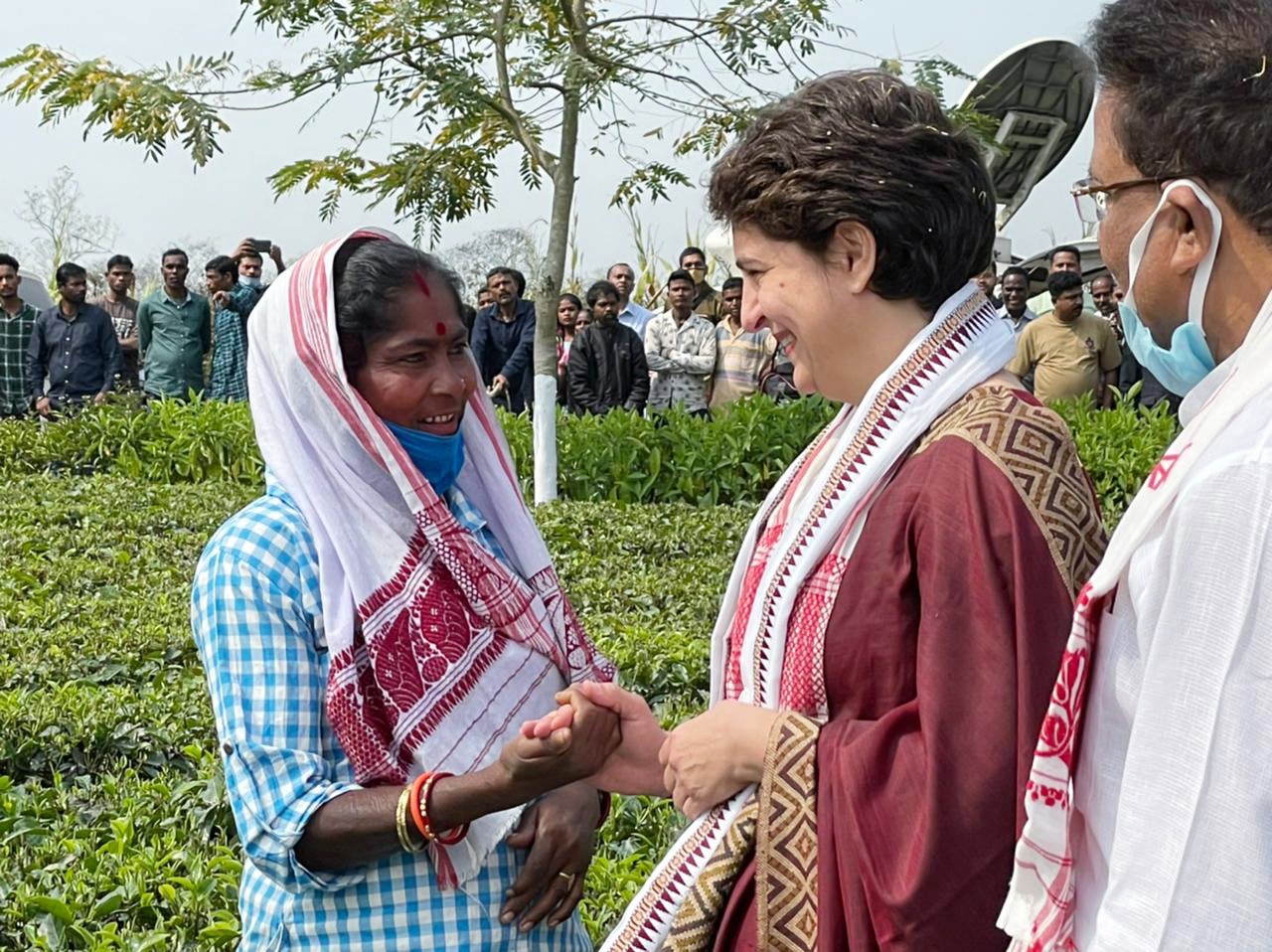
Accusing the ruling BJP-led government in the state of exploiting the tea garden workers and giving benefit to businessmen from Gujarat, Rahul Gandhi promised at a rally in Savasagar on February 14 that if Congress comes to power in the state it will increase daily wage of tea workers from present ₹167 to ₹365. During her visit to Assam few days after her brother, Priyanka Gandhi Vadra also made it a point to visit homes of tea workers, interact with them, even pluck tea leaves along with them.
The tea tribe community has two Lok Sabha MPs and one in Rajya Sabha, all three from the BJP. One of them, Rameshwar Teli is also a minister in the Modi government. In this election, the BJP has given tickets to four members from the community including two sitting MLAs. State minister Sanjay Kishan from Tinsukia is one of them. The Congress has given tickets to six tea-tribe members including three sitting legislators.
Daily Wages and Economics
While political parties try to woo tea workers with promises of increased wages and other schemes, the tea industry, which is trying to recover from the effects of the Covid-19 lockdown and restrictions, says a forced intervention by governments could hurt. Assam produces more than half of India’s total tea output. On average, the 180-year-old industry produces around 650-700 million kg of tea annually. While around half of this comes from the 800 big gardens, small tea growers who number nearly 70,000 account for the rest. As tea production is a labour intensive industry which involves plucking of tea leaves by workers, nearly half of costs of companies goes on wages.
“Nearly 60-70% of our expenses is on salaries of workers. Earlier, decisions on wages were decided between workers and tea garden through discussions. But now political parties have stepped in . There can’t be a sweeping order as all garden have different issues, cost of production and profits. We also know workers need more money, but to pay them that we also need more money. That’s why we went to court against the government’s interim order hiking wages to ₹217,” said Deboshyam Barua, director of Golaghat-based Dalowjan tea estate and an office-bearer of Assam Tea Planters Association.
“The price of tea hasn’t increased significantly in the past two decades. Some argue that tea-gardens in south India pay much higher wages, so why can’t we? But while gardens there produce tea almost throughout the year, we do so for few months. During our meetings with the government, we suggested that the industry would be able to pay around ₹197 daily to workers. We told that if it’s anything higher than that, it would affect the industry adversely. But the government decided to hike it to ₹217 and pushed us to seek relief from court,” he added.
Assam Chah Mazdoor Sanga (ACMS), the most prominent tea workers body (affiliated to Congress) blames the BJP government of playing politics over wages without having any serious intention of implementing its own order.
“The state government itself promised to hike wages to ₹351 daily and even a government committee recommended the same. But the government has been issuing interim orders on wages, the latest one issued days prior to the announcement of polls. Tea gardens found flaw in that on technical grounds and went to court, which in turn stayed the government move,” said Pawan Singh Ghatowar, president of ACMS, which is also a party to the high court petition. One of the most prominent politicians from the tea-tribe community, Ghatowar has been elected an MP from Congress five times and was also a union minister.
“If the tea industry in Kerala can pay ₹380 daily to workers why can’t we do it in Assam? The government should also come to the aid of nearly 500,000 workers in small tea gardens who don’t have any provision of minimum wages or other benefits that workers in big gardens get. A minimum wage for them should also be fixed. If the government can fix wages of those in the unorganized sector why should workers in small tea gardens be left out?” he questioned.
Amidst all this, the Assam Tea Tribes Students Association (ATTSA), a student body of the tea community, has called for a complete shutdown of tea garden across Assam on March 22 in protest against the state government’s alleged negligence of tea garden workers. On Sunday, the association decided to call off the strike as the matter regarding increase in wages is pending in court.