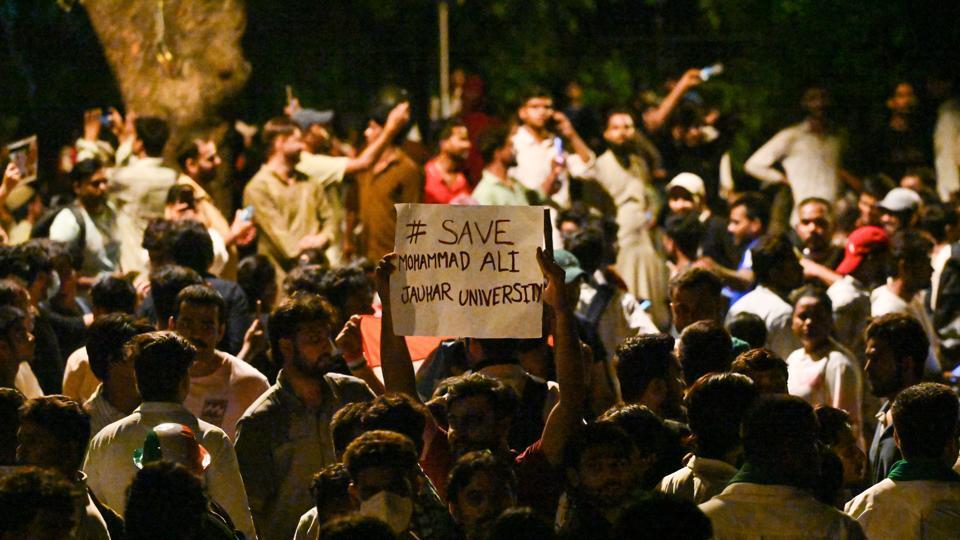
Even as activist Sonam Wangchuk ended his hunger strike and a delegation of the Cockroach Janta Party (CJP) held a second round of talks with the central government on Friday, the mood at Jantar Mantar Road remained defiant. The main protest site was jam-packed, with people by evening waiting between 50 and 100 minutes in a serpentine queue that stretched to the Janpath metro station on Tolstoy Marg.
New Delhi, India - July 24, 2026: CJP supporters gather during protest at Jantar Mantar demanding the resignation of Union Education Minister Dharmendra Pradhan (Hindustan Times/Sanjeev Verma)
Delegations large and small, including lawyers, NGO workers, farmer unions, and groups from neighbouring states, arrived carrying banners and placards to record their presence.
Pankaj Singh, a resident of Rohini, said he had to wait for two hours before he could enter the site. “I felt like I was missing out on something historic, so I had to come. I’ve seen the reels of police violence. They mistreated wrestlers earlier, too. The government handles every issue like this,” he said. All around, the air vibrated with a mix of patriotic songs and aggressive slogans from roaring clusters of young protesters.
From the main stage, CJP leaders congratulated the protesters for their support, and declared that the protest would continue, though Sonam Wangchuk had finally ended his indefinite fast after 26 days.
“By risking his own life, Sonam sir has awakened an entire nation, and we are all grateful for what he has done for the country, but the protest at Jantar Mantar will continue. It is not a protest of one person or CJP alone; it has become a youth movement. We demand resignation of the education minister,” CJP founder Abhijeet Dipke announced
He also mocked the central government over reports that union ministers were told at Friday’s cabinet meeting to increase their presence on social media platforms such as Instagram where this movement had gained large traction.
The sentiment resonated across the crowd. Satish Deshpande, who travelled from Madhya Pradesh, insisted the demonstration must continue. “Once the momentum flags, the government will crush this movement just like it did with others. Now is the time to stand united,” he said.
At the site, the protesters have set up a ‘wall of shame’ showcasing photographs that captured images of police personnel assaulting protesters during the July 20 “Chalo Sansad” march organised by the CJP. It has demanded FIRs against police officers involved in violence or sexual harassment, and asked citizens to upload photos and videos on its website to help identify the security personnel.
While demands for Dharmendra Pradhan’s resignation echoed from the stage, organisers repeatedly appealed to the protesters to keep the movement peaceful and not clash with security personnel so that the negotiations did not get derailed.
At the Sansad Marg barricades outside the NDMC headquarters, a volunteer appealed for calm over loudspeakers: “Sonam Wangchuk has broken his fast, and talks are underway for our remaining demands. Do not do anything that causes these talks to fail.” There had been no major standoff between protesters and police through the evening.
Paras Singh is a New Delhi-based journalist with Hindustan Times, where he serves as Deputy Metro Editor. He reports on urban governance, the Delhi government, the Delhi BJP, water management, the environment, communities and city life. He joined Hindustan Times in 2021 after beginning his journalism career at The Times of India in 2016, where he covered civic bodies, the water and power sectors, and urban infrastructure. Over the last decade, some of his reporting has led to significant public impact, with investigations into environmental violations, corruption and illegal industrial activity contributing to multiple judicial interventions by the National Green Tribunal and the Delhi High Court. A graduate of St. Stephen's College, University of Delhi, Paras studied journalism from the Indian Institute of Mass Communication (IIMC), New Delhi. Having extensively covered the capital's evolving civic and governance landscape, his recent work increasingly explores Delhi's history, built heritage, urban evolution and the relationship between people and place, alongside continuing to report on governance and public policy.Read More
Snehil Sinha is an Assistant Editor with the Delhi Metro bureau of Hindustan Times, where she reports on politics, governance, public policy, urban infrastructure and transport, subjects that shape the everyday lives of millions in the national capital. Over a journalism career spanning 14 years, she has built a reputation for meticulous, data-driven reporting that combines on-ground perspectives with policy analysis.
She began her career with The Indian Express before joining Hindustan Times, where she has reported extensively on civic administration and urban governance in Gurugram, Noida and now Delhi.
Her reporting is distinguished by its clarity, depth and balance. Whether covering large-scale infrastructure projects, environmental challenges, transport reforms or government policy, she tries to translate complex administrative decisions into accessible, engaging stories without losing nuance.
Her work reflects a strong command of public records, official data and field reporting, often connecting policy announcements with their impact on citizens. Her stories go beyond headlines to explain how governance decisions influence the city's growth, mobility and quality of life, making her work an important contribution to informed public discourse.Read More
Get the latest India News, breaking headlines, and real-time updates from across the nation. Stay informed on politics, government policies, crime, weather, and CEC Gyanesh Kumar row Live.
Home/India News/Swelling Crowds, Defiant Mood As Protest Stays Firm At Jantar Mantar

 E-Paper