
 E-Paper



An unprecedented surrender, and the birth of a nation
“Dacca is the free capital of free Bangladesh” – with these historic words, Prime Minister Indira Gandhi announced in the Lok Sabha in December 1971 that the West Pakistani forces in Bangladesh had surrendered unconditionally

 Prefer HTon Google


“Dacca is the free capital of free Bangladesh” – with these historic words, Prime Minister Indira Gandhi announced in the Lok Sabha in December 1971 that the West Pakistani forces in Bangladesh had surrendered unconditionally.
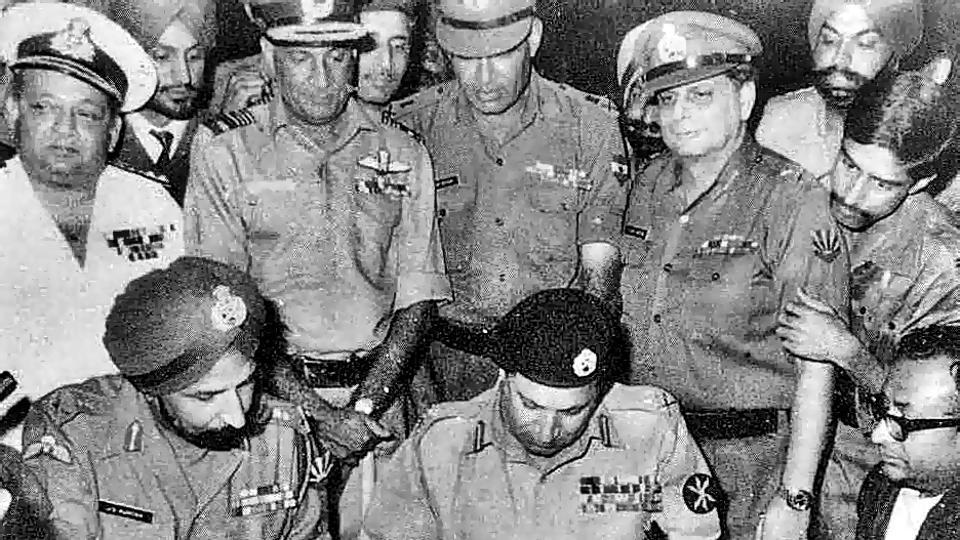
Lieutenant General AAK Niazi, commander of the Pakistan troops, signed the surrender documents at the Race Course Maidan in Dacca at 4.31pm on December 16, and Gandhi’s short statement before a special sitting of the House came at 5.30pm.
While the tragedy of the 75 million people of Bangladesh thus ended at the same place from where Sheikh Mujibur Rehman launched his civil disobedience movement, Gandhi offered a ceasefire on the western front to avoid further bloodshed.
The ceasefire came into effect about a fortnight after Pakistan launched its attack on India.
It was an excited House that assembled for the special sitting; as Gandhi started reading her prepared statement, the House went into rapturous cheering.
As the operations of the Indian defence forces came to a successful conclusion in Bangladesh, Gandhi, in an impassioned letter to the President of the United States, reminded him that Indian jawans had shed their blood to uphold those very values cherished by the people of the US.
The Prime Minister reiterated that India had no territorial ambitions and therefore further bloodshed was not called for. She sent a message to external affairs minister Swaran Singh, informing him of the decision of the government on a ceasefire. Pakistan President Yahya Khan also made a broadcast to his people at the time that Gandhi’s Cabinet was meeting.
In her statement addressed to the UN, Gandhi said: “We have repeatedly declared that India has no territorial ambitions. Now that the Pakistani Armed Forces have surrendered in Bangladesh and Bangladesh is free, it is pointless in our view to continue the present conflict. Therefore, in order to stop further bloodshed and unnecessary loss of lives, I have ordered our armed forces to cease fire everywhere on the western front with effect from 20;00 hours IST on Friday, the 17th December, 1971. It is our earnest hope that there will be a corresponding immediate response from the government of Pakistan.”
The Cabinet reviewed the aftermath of the unconditional surrender of the West Pakistani occupation forces in Bangladesh. The Chiefs of Staff of the Army, Navy and Air Force gave the Cabinet their assessment of the situation.
Thereafter, Gandhi convened a meeting of Opposition leaders in Parliament at which the government’s decision to offer a unilateral ceasefire on the western front was endorsed.
In Dacca, the populace, confined to their homes because of the endless curfew, came out in large numbers to march along with the victorious Indian troops who entered the city without meeting any resistance. Lt General Jagjit Singh Aurora undoubtedly was the hero of the hour. He flew into the city from Agartala along with officers of the IAF, the Navy and the Mukti Bahini to accept the surrender.
Lt Gen Niazi, who had hesitated for long on the surrender, and had walked into the Intercontinental Hotel with a pistol to tell foreign correspondents that he intended to fight to the last man, was in a predicament. At the Race Course Maidan, he found he had no pen to sign the surrender document. Gen Aurora readily lent him his pen. Sowing to the inevitable, Gen Niazi with a swift move stripped off the epaulet of rank from his right shoulder, unloaded his revolver and handed over the bullets to Gen Aurora and finally pressed his forehead to that of India’s Eastern Army Command Chief as an act of humble submission and surrender.


