E-Paper



The flip factor: In Karnataka, Cong did not retain all seats, but wrested several
112 out of the 224 ACs which went to polls have not elected the incumbent party in these elections.

 Prefer HTon Google


The Congress’s seat tally of 136 is the highest in Karnataka since the 1989 elections. It is an increase of 56 from the number of assembly constituencies (ACs) won by the party in 2018. The Bharatiya Janata Party (BJP) and the Janata Dal (Secular) or JD (S) have seen a fall of 40 A and 17 ACs respectively from their 2018 numbers. These headline numbers notwithstanding, how did results in individual ACs change in these elections? This is an important question to judge anti-incumbency both at the state and local level. Here is what an HT analysis shows.
112 out of the 224 ACs which went to polls have not elected the incumbent party in these elections. This number was 130 in 2018. The 2013 elections are not exactly comparable because there was a big split in the BJP. A party-wise break-up of the 112 ACs which did not elect the incumbent party in 2023 shows that 62 of these were held by the BJP, 29 by the JD(S) and 21 by the Congress. In 2018, it was the Congress which was at the receiving end of voters not choosing the incumbent party as 73 ACs held by the Congress in 2013 did not elect a Congress MLA in 2018.
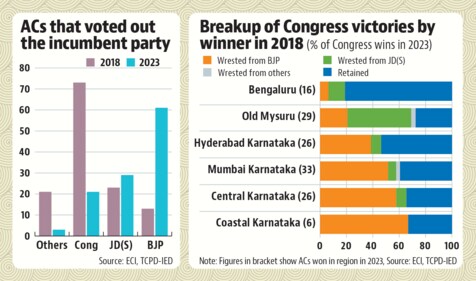
The other interesting question to look at the break-up of the Congress’ tally of 136 ACs? Only 59 of them (43%) are ACs which the Congress won in 2018. 39% of ACs won by the Congress in 2023 were won by the BJP in 2018 and another 16% of them were with the JD(S). To be sure, these trends are not the same in all parts of the state. For example, in Bombay Karnataka, Central Karnataka, and Coastal Karnataka, the BJP’s contribution to the Congress seat tally is higher than the overall figure for the state. On the other hand, in Southern Karnataka, almost half of the Congress victories have been wrested from the JD(S), much higher than the overall figure for the state. This is largely in keeping with the fact that most of JD (S)’s MLAs come from the southern Karnataka region.
A similar breakup of Congress wins by the reservation status of ACs shows that retaining ACs it had won in 2018 is the biggest contributor to its tally in seats reserved for Scheduled Tribes (STs) while defeating the incumbent is the biggest contributor in its tally among seats reserved for Scheduled Castes (SCs).