E-Paper



Delhi records most polluted January day in 2 years as AQI 440 takes over city
Delhi's air quality hit a severe AQI of 440, marking the most polluted January in two years, due to stagnant winds and rising emissions.

 Prefer HTon Google


Delhi’s air quality index (AQI) surged deeper into the most toxic “severe” zone on Sunday, giving the city its most polluted January day in two years and the worst the air has been in the second half of the month since 2019.
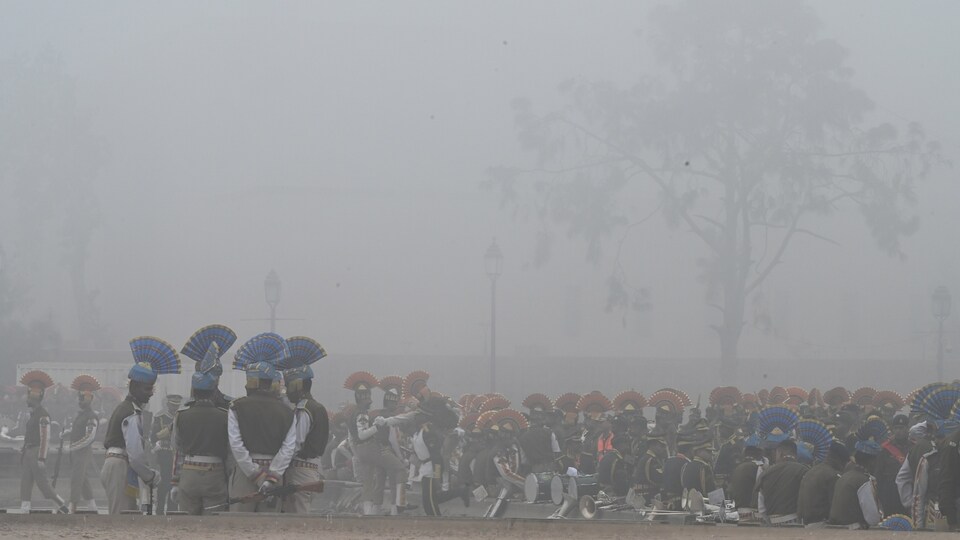
The Capital clocked an AQI of 440 at 4pm on Sunday, according to the Central Pollution Control Board’s (CPCB) daily bulletin, a reading significantly worse than 400 on Saturday and the highest for the month since 447 on January 14, 2024.
Experts stressed that the deterioration is especially unusual in the second half of January, when the air is comparatively less poor than in the first half, which largely marks the zenith of the winter pollution season. Sunday’s AQI was the joint-worst in the second half of the month. It was also 440 on January 17, 2019. That apart, the AQI for the latter half of January peaked at 430 in 2016 (when the city had few pollution monitors), 375 in 2017, 403 in 2018, 370 in 2020, 407 in 2021, 387 in 2022, 407 in 2023, 409 in 2024 and 368 last year.
It is also the first time that the AQI has been 400 or above in this period for two consecutive days, since end-January 2016.
Scientists said the downturn was largely due to slow surface-level winds and a western disturbance that brings in moisture and leads to emissions accumulating. However, the experts also pointed out that the fresh pollution crisis also turned the lens on the ineffectiveness of the Graded Response Action Plan (Grap) and ground-level management, including lifting curbs too early.
“We cannot control climate and meteorological conditions. What can be controlled is the emissions being generated at source. Such alarming levels show that our emissions in the region are only increasing and not decreasing. So even with Grap being implemented, it is doing little to control such drastic spikes when winds become calm,” said Dipankar Saha, former head of CPCB’s air lab.
Forecasts showed that weather conditions may help clean up the air to an extent on Monday, when the AQI may return to the “very poor” zone..
The Commission for Air Quality Management (CAQM) imposed Stage 4 of the Grap curbs on Saturday evening, only as the air inched past the 400 mark for the first time this year.
Also Read: Delhi’s minimum temperature at 4.4°C as AQI remains ‘very poor’
CPCB classifies air quality as “moderate” when the AQI is between 101 and 200, “poor” between 201 and 300, and “very poor” between 301 and 400. Beyond 400, air quality is termed “severe”.
Sunil Dahiya, founder and lead analyst at think tank Envirocatalysts, said little action was being taken against the prevalent sources of pollution.
“It is clear that while Grap is not working, a key reason why it is not working includes our inability to control sources such as industries and thermal power plants in the National Capital Region (NCR),” he said.
“With an easterly wind direction, a large chunk of pollution is coming from Gautam Buddha Nagar and even Bulandshahr, where industries are growing year-on-year. We are also not taking any action against thermal power plants in NCR and these sources only continue to grow, particularly in smaller NCR towners,” he said.
Anand Vihar was Delhi’s most polluted neighbourhood, with an AQI of 497 at 12pm– three points away from the peak of 500.
Other locations that suffered included Mundka and Rohini, with an average AQI of 491 each.
The air quality downturn comes soon after the Supreme Court earlier this month pulled up the CAQM for its inability to clearly identify the causes of air pollution in Delhi-NCR and their relative contribution. Calling this a “complete failure of duty”, the court directed the statutory body to complete a source-identification and apportionment exercise within two weeks and place the findings in the public domain.
Sunday was Delhi’s first official “severe” air day of the year – the AQI on Saturday tipped past 400 only at 5pm, an hour after the day’s official reading is taken – and the first since it was 401 on December 29. It was also the second-worst air day this winter, after 461 on December 14.
December 2025 was the most polluted since 2018 – a stark contrast to November, when the air was marginally better compared to previous years. Again, this was down to favourable meteorological conditions, an early Diwali and reduced stubble burning impact.
Mukesh Khare, part of the 11-member expert panel formed by the Delhi government in December, to tackle air pollution in the region, said such high levels in the latter half of January are an indication of failing governance – at the civic level.
“We see policies being made, but implementation remains an issue. At present, around 30% of the pollution in NCR is coming from diffused sources. This includes road dust, footpaths, medians and even waste burning. These are sources which are easy to control, but our civic bodies across NCR are failing to tackle them. Until we control our sources, such adverse meteorological conditions will keep sending the AQI into the severe zone,” said Khare.
A host of restrictions are already in place in Delhi since Friday, when Grap Stage 3 invoked as pollution levels began to rise. It banned BS-3 petrol and BS-4 four-wheelers in Delhi, Gurugram, Faridabad, Ghaziabad and Gautam Budh Nagar; blanket curbs on private construction and demolition, restrictions on stone crushers and mining operations, and hybrid lessons for schools up to Class 5 in Delhi and neighbouring districts.
Under Stage 4, the entry of BS-IV truck traffic into Delhi is restricted. All construction and demolition work is prohibited, while schools up to Class 10 must shift to hybrid lessons, with only classes 10 and 12 continuing in-person instruction.