
 E-Paper



Article 370 verdict disapproves of back-door amendments
Parliament brought in a new clause under Article 367 to state that the “Constituent Assembly” of J&K would now mean “Legislative Assembly” under Article 370

 Prefer HTon Google


In what may deter governments from introducing a back-door amendment, an important takeaway from the Constitution bench verdict on the abrogation of Article 370 was the Supreme Court’s disapproval of the Centre’s method of amending Article 370 using an interpretation clause in another article of the Constitution.
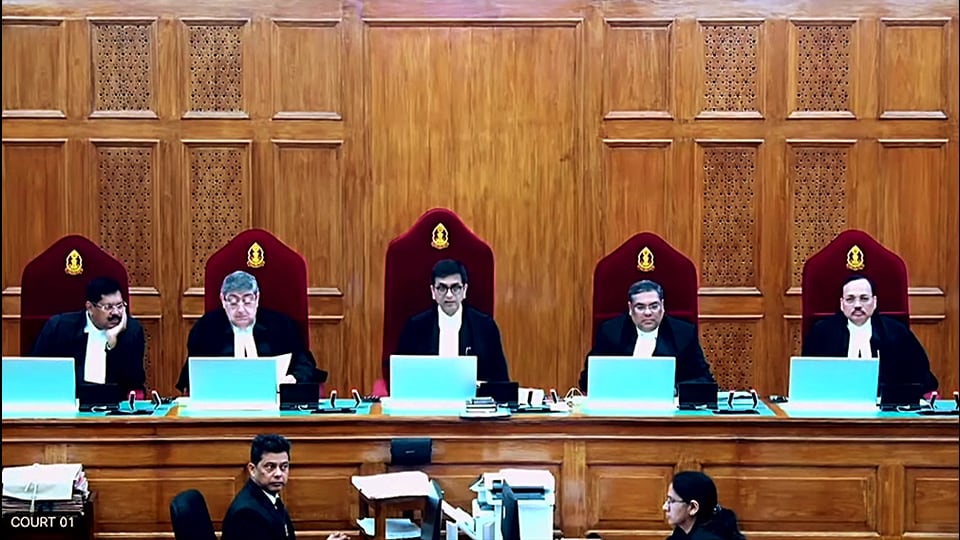
The five-judge bench held by unanimity that the constitutional order by which Article 370 was altered by amending Article 367 was ultra vires to the extent it used an interpretation clause for amending Article 370, bypassing the procedure enunciated for this purpose under the Constitution.
“While the ‘interpretation’ clause can be used to define or give meaning to particular terms, it cannot be deployed to amend a provision by bypassing the specific procedure laid down for its amendment. This would defeat the purpose of having a procedure for making an amendment,” ruled the bench, comprising Chief Justice of India (CJI) Dhananjaya Y Chandrachud and justices Sanjay Kishan Kaul, Sanjiv Khanna, Bhushan R Gavai and Surya Kant.
Parliament brought in a new clause under Article 367 to state that the “Constituent Assembly” of J&K would now mean “Legislative Assembly” of J&K under Article 370. This acted as a precursor to Parliament assuming the powers of J&K legislative assembly in August 2019 and granting its approval for the nullification of Article 370, which otherwise required a recommendation of the constituent assembly of J&K.
The bench agreed with the petitioners that Article 367, which deals with the interpretation of the Constitution, has inherent limitations and cannot be used to issue a presidential order to make substantial amendments, which can be done only through the procedure prescribed under Article 368, or under sub-clauses Article 370 for amending Article 370.
“The consequence of permitting amendments through the circuitous manner would be disastrous. Many provisions of the Constitution would be susceptible to amendments which evade the procedure stipulated by Article 368 or other provisions. Amendments cannot be carried out by bypassing a procedure which has been laid down for that purpose,” stated the judgment authored by the CJI for himself and justices Gavai and Kant.
In the present case, the judgment added, Article 370(1)(c) read with the proviso to Article 370(3) provides a procedure by which Article 370 may be modified upon the issuance of a presidential order. “Articles 370(1)(d) and 367 cannot be used for a collateral purpose in effect to modify or obliterate Article 370...neither the interpretation clause nor the definition clause can be used to substantively alter any of the provisions of the Constitution,” held the CJI’s judgment.
In his concurring opinion, justice Kaul wrote that if the Supreme Court were to allow Article 367(4) to be used to amend other provisions of the Constitution, circumventing the procedure under Article 368 that requires passage of an amendment following an approval of the two Houses, or the procedure contemplated under other provisions, the effect would be disastrous.
“In this case, the modification is an addition that replaces one authority with another, but also changes the very core concept and nature of powers. The Constituent Assembly, is a constituent body and therefore, sovereign. A reference to a sovereign body cannot be construed as reference to Legislative Assembly... Thus, an exception or modification cannot make a radical alteration that effaces the fundamentals of the provision,” justice Kaul held.



