
 E-Paper



Asaram’s son Narayan Sai suffers setback in SC, judges cancel HC order on furlough
The Gujarat Police opposed self-styled preacher Asaram’s son Narayan Sai’s release on furlough on grounds of public peace and tranquillity, and unsatisfactory conduct in jail. The Supreme Court upheld this reasoning and backed the state government.


NEW DELHI: The Supreme Court on Wednesday set aside the Gujarat high court order accepting the appeal for furlough from self-styled preacher Asaram’s son Narayan Sai, ruling in favour of the Gujarat government decision to reject the request on the ground that Sai’s release could lead to disruption of public peace and tranquillity.
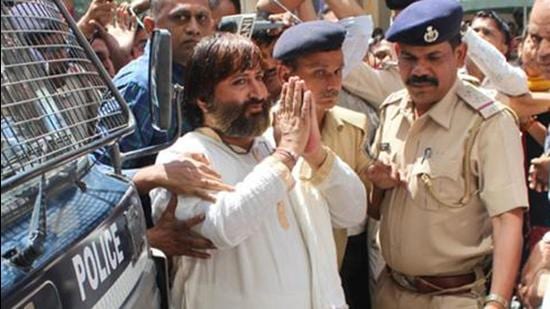
In its ruling, the bench of justices Dhananjaya Y Chandrachud and BV Nagarathna cited Narayan Sai’s track record during and after the trial that led to his conviction. “The conduct after the trial, in jail, has not been shown to be above reproach,” the bench said, concluding that the Gujarat Police was fully justified to decline his furlough request.
Sai was convicted in April 2019 in a rape case on a complaint by two women who alleged to have been raped between 2002 and 2005 at a Surat ashram run by him and his father Asaram. He was convicted for rape, assault, unnatural offences and criminal conspiracy and is serving a life term.
After the Gujarat Police turned down his request for release on furlough on May 8, he approached the high court, which directed the authorities on June 24 to release him on a two-week furlough. The Gujarat government quickly petitioned the Supreme Court against the high court order and was granted a stay.
“The opinion of the Sanctioning Authority under the Bombay Furlough and Parole Rules 1959 does not suffer from perversity nor does it consider material extraneous to the Rules governing the grant of furlough,” the bench said, pointing that the order rejecting furlough “adduced a number of circumstances which cumulatively indicate that the release of the respondent (Sai) on furlough may lead to a violation of public peace.”
Furlough is one of the two types of leave granted to convicts; parole is the other one. A prisoner is entitled to release on furlough on serving time in jail subject to the condition of demonstrated good behaviour before the prison authorities.
The Supreme Court bench referred to the threat that Sai and his followers posed to the complainant in the rape case and other persons who deposed at the trial. “An attempt has been made to threaten and suborn the investigating team and the witnesses. The respondent and his father have a mass following of persons who owe loyalty to them and there is a reasonable apprehension of disruption of public peace and tranquillity,” the court said, noting that Narayan Sai also attempted to bribe public officials during the trial.
Solicitor General Tushar Mehta, who argued the appeal for the state government, had pointed out that Narayan Sai was already granted a two-week furlough under the 1959 Rules in December 2020 since the request was made to attend to his mother’s health who had suffered a cardiac arrest. But since Sai sought furlough again within six months, the Director-General of Police turned down the request on grounds of public peace and tranquillity, and unsatisfactory conduct in jail.
The state government pointed out that even the jail superintendent did not favour his release since Sai kept a mobile phone inside the jail illegally and attempted to make contacts with the outside world. He was also accused of assaulting and murdering witnesses by his followers, besides threatening police officials and inspectors of the Income Tax Department. This, Tushar Mehta said, was ground under the 1959 Rules to deny furlough. Moreover, the police weighed the crime of which he was convicted to be a heinous offence.
Mehta cited the provision in the rule that made it clear that prisoners did not have a legal right to furlough. He also cited a 2006 judgment of the Supreme Court that underlined that furlough is not an absolute right and the idea was to periodically allow the convict to have a family association and avoid the ill-effects of continuous stay in jail.
The bench held, “The grant of furlough must be balanced against the public interest and can be refused to certain categories of prisoners. Although furlough can be claimed without a reason, the prisoner does not have an absolute legal right to claim furlough.” These principles, the Court said, must be applied in the context of each individual case.
Narayan Sai sought to rebut the charges against him, claiming that all allegations against him pertained to the period prior to 2016, after which there were no complaints. He even argued that after being granted parole in December 2020, he did not violate any conditions of furlough and nor was there any disruption of law and order.


