
 E-Paper



Ashoka wins Delhi leg as HT Centennial Debate gets off the blocks
Students faced-off against each other on either side of a topic that is at the core of a fractious global issue at the Hindustan Times Centennial Debate


Sixteen of the Capital’s top institutions battled it out in the inaugural regional round of the Hindustan Times Centennial Debate on Tuesday morning at Bikaner House.
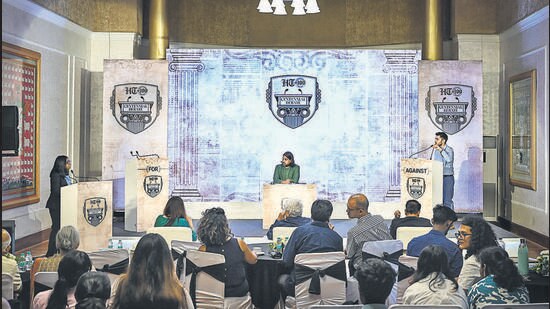
Centred on the motion “This house believes the social media generation is more lost than found”, the three-hour event saw thoughts, ideas and arguments fly thick and fast as speakers attempted to convince the audience and an esteemed jury.
A team of Parth Mahajan and Mehar Chhabra from Ashoka University came up tops as the team winners of the Delhi round. They will proceed to the national finals of the HT centennial debate, along with team runner-up OP Jindal Global University, comprising Nikeeta Singh and Saheyba Kaur Rai.
Mahajan was also adjudicated the best speaker of the day, followed by Tuba Shamsi from Jamia Millia Islamia. The second runner-up position was secured jointly by Diwakar G from Shiv Nadar University and Mouli Chawla from Ramjas College.
The jury – comprising India’s G20 sherpa Amitabh Kant, senior journalist Sonia Singh and businessman Suhel Seth – hailed the centenary of Hindustan Times, and held out advice for the debaters.
Kant, a former CEO of NITI Aayog who played a pivotal role in driving key national initiatives such as Make in India, Startup India, and Incredible India, told the students to focus on content. Singh, editorial director of NDTV dialogues and visiting fellow at Cambridge Judge Business School, underlined the importance of passion in speaking and suggested that young people be as curious about their immediate neighbourhood as they are about global affairs. And Seth, a leading figure in the fields of advertising, branding, and public relations, stressed on how pivotal humour and insight are to the debating process, and cautioned them against reading out speeches.
Students faced-off against each other on either side of a topic that is at the core of a fractious global debate. Speakers in favour of the motion underscored the myriad harms of social media on young people and the perils of misinformation, arguing that social media held imagination captive and caused mental health problems. Those against the motion pointed out that social media had democratised information, helped create a safe space for marginalised communities, and brought attention to ongoing crises such as that in Gaza.
In his speech, Mahajan spoke about how social media had blunted interpersonal relationships and diluted real-life engagement, while encouraging fake news and trend-chasing behaviour. Shamsi argued that social media had forced young people to seek constant validation, noting that an average person is likely to spend more than five years on social media throughout their lifetime.
The debate, which will now be held across India’s biggest cities over the next few months before culminating in a battle of India’s top speakers next year on the national stage, commemorated the journey of Hindustan Times, which turned 100 on Sunday. This journey spans a century and straddles an extraordinary range – from a small band of men and women braving brutal colonial censorship laws to stoke the embers of freedom in the hearts of Indians, to a globally respected voice chronicling the churn in the world’s most populous nation.
At stake were bragging rights and the chance to hold forth on a platform that was inaugurated by Mahatma Gandhi. And there were prizes to add to the shimmer.


