
 E-Paper



Bangladesh army chief’s warning exposes Mohd Yunus as radical Islamists run amok | Point Blank
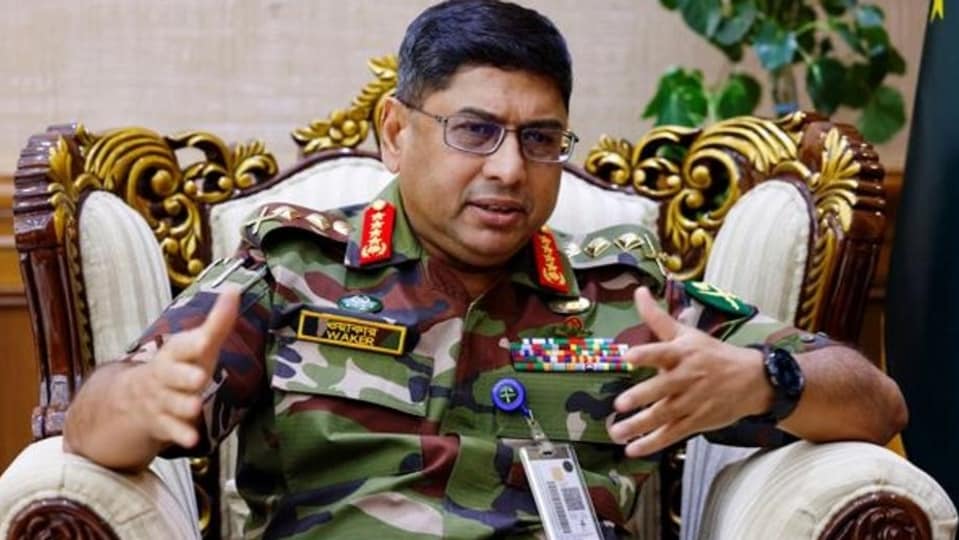
While Gen Waker wants the Army to go back to barracks as he has had enough in the past six to seven months, the country has been put to sword by students.

 Prefer HTon Google


New Delhi: Bangladesh Army chief Gen Waker-uz-Zaman on February 25 revealed the political rot and anarchy within the neighboring country when he warned the fissiparous Islamist forces to stand down or else Republic’s freedom would be put at stake.
Watch full video
Gen Waker’s statement on an Army memorial event in Dhaka was a blunt admission of the state of lawlessness and anarchy in Bangladesh with the nominated Interim government under Mohammed Yunus reduced to a mere bystander in the street fight between radical youth forces of BNP and Jamaat-e-Islami. After the collapse of the Sheikh Hasina government last August 5, Bangladesh is going down the spiral with fighting political forces using political Islam to encourage uncertainty and unrest in the country through their violent actions.
Such is the prevailing situation that the riotous street mobs of political activists mixed with Islamists are attacking not only the Army but have rendered the police largely ineffective in Bangladesh. The law and order situation, according to the Rapid Action Battalion Director, could worsen in the forthcoming Ramzan festival with BNP acting Chairman Tarique Rahman calling for early elections to restore stability in the country.
Also read: View: Is consensus or disruption a path to good governance?
While Gen Waker wants the Army to go back to barracks as he has had enough in the past six to seven months, the country has been put to sword by the radicalized students and youth wings of political parties apart from criminal elements. The attack on Bangladesh Air Force base in Cox’s Bazar by unidentified miscreants shows that the country is on the precipice and unable to control or book those indulging in wanton violence. The state of continued unrest has hit the Bangladesh economy with double digit inflation, weak Taka currency and a hit on the manufacturing and garment sector.
To curb inflation, Bangladesh Bank raised the policy or repo rate to 10 per cent causing bank loan interests to climb up to as high as 15 per cent. Small, medium and large businesses reliant on bank loans have been hit the hardest. Reduced liquidity will push bank rates higher and this would in turn hinder investments and job creation. Industrial production has fallen to 25 from 40 per cent, trade remains stagnant, negative trends are being observed in employment and investment. Manufacturing units all over Bangladesh are facing labor unrest due to political unrest, vandalism and arson with demands for wage increases being the bottom line. Dollar volatility continues to persist with food inflation as high as 14 per cent. This is not all.
Bangladesh Bank Governor has warned that non-performing loans could nearly double within six months. The assessment is that non-performing loans could reach as high as 30 per cent in the coming months from the current rate of 12.5 per cent. The mainstay of Bangladesh, the apparel sector, plagued by labour unrest and high interest rates is showing negative export growth. There is nearly 50 per cent increase in production costs while foreign buyers have reduced the prices for Bangladesh export clothing. Nearly 100 garment factories have been closed in the past six months leaving more than 50,000 workers unemployed with rapidly deteriorating internal security situation further eroding the buyers confidence.
Amid the recent rise in violent incidents across the country, students from various educational institutions staged human chains, protests and road blockades in Dhaka and nationwide. Following the demand by Dhaka University students for the resignation of Home Advisor Lt Gen (Retd) Mohammed Jahangir Alam Chowdhury, the targeted Minister blamed what he called were cohorts of the ousted Awami League for deteriorating law and order situation in the country. The convenor of the Jaitya Nagorik Committee Nasiruddin Patwary has warned the Interim Government that the public would be forced to take law in their hands if the Yunus government delays or remains silent on trial of Awami League.
The vendetta demanded by political parties and Ministers of the Interim government clearly reveals a radical plan to target India as Sheikh Hasina has sought shelter in Delhi and put Awami League party and workers to sword. Since the obvious gainers of this political plan would be BNP, Jamaat-e-Islami, terror groups like HUJI, JUMB, Islamic Chhatra Shibir and forces inimical to India. No marks for guessing the anti-India forces as Pakistan has been thirsting for revenge since the loss of East Pakistan in 1971. The Pakistani deep state is active in the present chaos of Bangladesh with terror groups like Lashkar-e-Tayyeba and Jaish-e-Mohammed breeding in the Rohingya camps on the border with equally unstable Myanmar.
Also read: View: Why the BJP victory in Delhi bodes well for the Capital
Rather than blaming India for harboring Sheikh Hasina or the US for political interference and all the present ills of Bangladesh, it is the weak Yunus government that has still not been able to stem the political rot with even the Army and security forces afraid to enforce the rule of law. If the current situation is not arrested by the Interim government, then it would have serious security ramifications for India and for the world as the spectre of Islamic terrorism looms in the backdrop of this political crisis and power vacuum.
Instead of warning the public about the collapsing state of Bangladesh, Gen Waker would be best serving the country by asking Mohammed Yunus to hold general elections at the earliest so that the public gets to choose its leaders from the mainstream parties like BNP or Awami League. The present flux highlighted by human rights violations of minorities and political opponents at the hands of religiously radicalized youth and their handlers both within and outside the country can only be controlled through free and fair democratic elections.
India on its part has no interest in dabbling with Bangladesh elections apart from its legitimate security concerns over increased activity of Pakistan and all weather friend China in Dhaka. Similarly, the US under the leadership of Donald Trump is a votary of Bangladesh citizens exercising their franchise apart from ensuring that China and its allies do not get traction in the country that is at heart of Indo-Pacific. External Affairs Minister S Jaishankar hit the nail on its head when he said that it was for Bangladesh interim government to decide what kind of relationship it wants with India, rather than blaming New Delhi for all the evils. The ball lies squarely in the court of Yunus and General Zaman as it is their mandate to restore law and order in Bangladesh. The time of make and break of Bangladesh has come.


