
 E-Paper



Joe Biden to visit India for G20 summit, push for MDB reform: Top US official
The bilateral engagement will see both leaders discuss the implementation of the deliverables sealed during Modi’s state visit to the US in June.

 Prefer HTon Google


US President Joe Biden will travel to New Delhi from September 7 to September 10 to attend the G20 summit and participate in bilateral meetings with a range of leaders, American national security advisor Jake Sullivan announced on Tuesday.
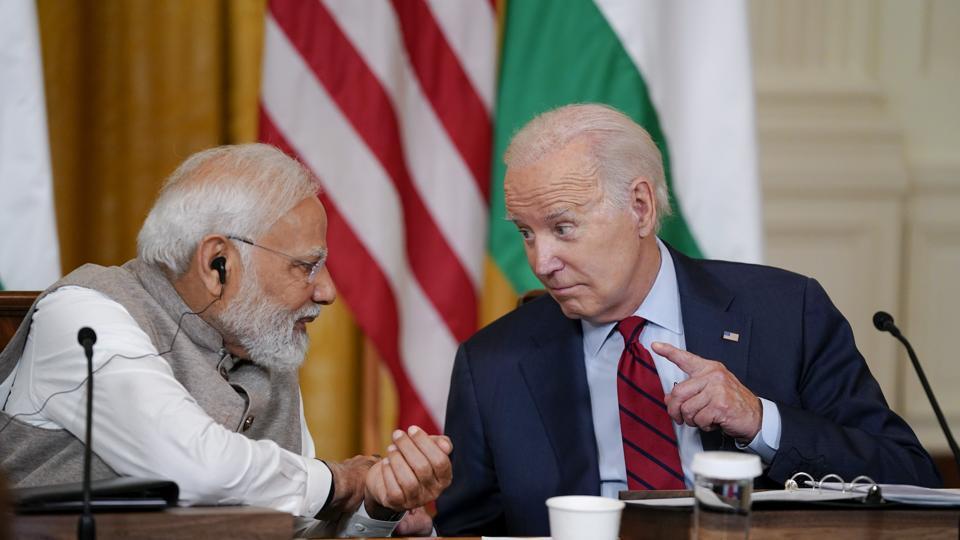
Biden will strongly push for the reform of multilateral development banks (MDBs) with a proposal that enhances the financial capability of these institutions to address challenges of poverty elimination, boosting prosperity and addressing the climate crisis. Sullivan added that Biden will also send a message to the global south that the US stands with them.
Also read: Joe Biden may meet Saudi Arabia's Mohammed bin Salman at G20: Report
In a press briefing on Tuesday morning, Sullivan, in the context of the Brics (Brazil, Russia, India, China, South Africa) summit in South Africa this week, said that the US doesn’t see BRICS as a “geopolitical rival”, claimed that the group has a diverse collection of countries, and Washington has a “positive” relationship with Brazil, India and South Africa even as it “manages” its relationship with China and “pushes back” against Russia.
He said that the grouping had differences amongst themselves on a range of “critical issues”, and the US, with a positive agenda, will continue to work to enhance its value for the global south and invest in issues accordingly.
In a statement announcing the President’s visit, minutes after Sullivan’s briefing, White House press secretary Karine Jean-Pierre said that Biden and G20 partners will “discuss a range of joint efforts to tackle global issues, including on clean energy transition and combating climate change, mitigating the economic and social impacts of (Vladimir) Putin’s war in Ukraine, and increasing the capacity of multilateral development banks, including the World Bank, to better fight poverty, including by addressing global challenges”.
The White House statement added, “While in New Delhi, President Biden will also commend Prime Minister (Narendra) Modi’s leadership of the G20 and reaffirm the US commitment to the G20 as the premier forum of economic cooperation, including by hosting it in 2026.”
Biden and Modi are expected to have bilateral talks but both sides are still working out the details of the bilateral engagement, with Indian ambassador to the US, Taranjit Singh Sandhu, in New Delhi for consultations. The bilateral engagement will see both leaders discuss the implementation of the deliverables sealed during Modi’s state visit to the US in June, but given India’s multiple diplomatic obligations during the summit and the constraints of time, the bilateral engagement is likely to be limited in nature.
Also read: ‘Khalistan supporters’ try to set on fire Indian consulate in San Francisco; US 'strongly condemns’
India is also going to host the next Quad leaders’ summit in 2024, paving the way for a possible second Biden visit to New Delhi early next year with a more substantial bilateral element. If this happens, it will be the first time that an American president will visit India twice in his first term in office.
There has also been speculation about a possible meeting between Biden and China’s president Xi Jinping in New Delhi. Over the past few months, the US has stepped up its engagement with China. Sullivan met senior Chinese foreign policy figure and now foreign minister Wang Yi in Vienna; Secretary of State Antony J Blinken, treasury secretary Janet Yellen, climate envoy John Kerry have already visited Beijing; and commerce secretary Gina Raimondo is headed to Beijing next week. A meeting between Biden and Xi is likely to take place either in Delhi on the sidelines of the G20 summit, or/and during the APEC summit in November in California.
While he did not comment on Biden’s specific bilateral engagements in Delhi, in response to a specific question on the Chinese economy, Sullivan said that the US was not seeking to “slow down or weaken” China’s economy, it only wished to see China play by the rules of the game, and reiterated that engagements were in line with American policy to responsibly manage the competition with China.
At the same time, he pointed to the unprecedented engagement of the Biden administration in the Indo-Pacific. These, Sullivan said, included the President hosting leaders of Japan, South Korea and India for visits to the White House this year; Biden convening a historic trilateral summit with Japan and South Korea at Camp David last week; Biden visiting Tokyo for the G7 and Quad summit; the vice president Kamala Harris paying her third visit to the region to attend the ASEAN summit in Jakarta soon; and Biden’s plan to host leaders of the Pacific Island countries at the White House this year. This was in addition to Biden’s visit to Indonesia as well as him hosting all ASEAN leaders for a summit at the White House last year.


