
 E-Paper



BJP’s UP playbook takes religious tone to counter caste divide
The party has decided that while it will focus on each caste group, it will also ensure that larger “Hindu unity” overrides other caste considerations.

 Prefer HTon Google


As it moves closer to the assembly election, the Bharatiya Janata Party’s pitch to retain power in Uttar Pradesh has acquired a religious undertone to counter caste-based differences that the party fears can adversely impact its political fortunes. Party functionaries aware of developments in the state said even as the BJP is banking on the Modi-Yogi duopoly of a “decisive and honest” governance model; the shift in the campaign is aimed at consolidating a fractured Hindu vote bank.
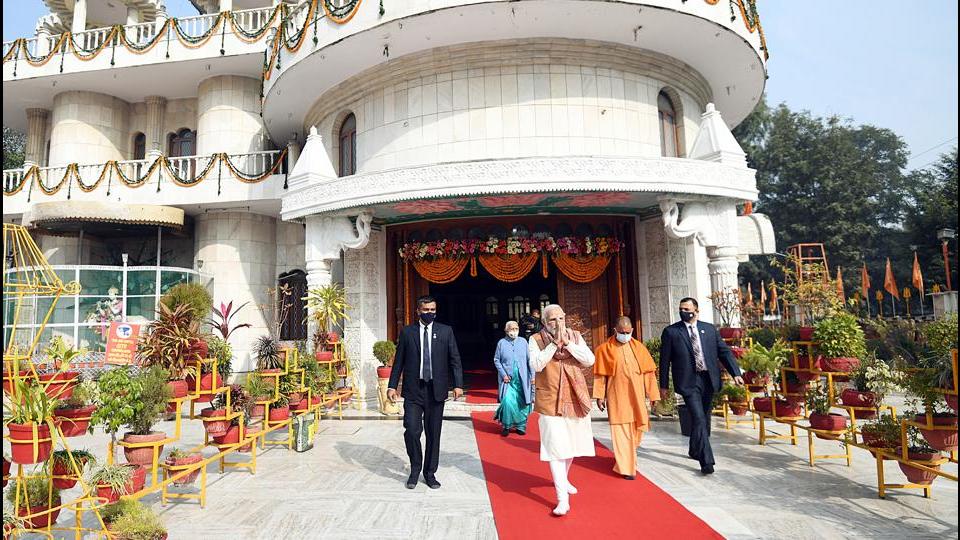
The party has decided that while it will focus on each caste group, it will also ensure that larger “Hindu unity” overrides other caste considerations.
Last month, following inputs from the party’s ideological fount RSS, the BJP announced a four-member committee comprising Rajya Sabha MPs Shiv Pratap Shukla and Ram Bhai Mokariya; former national secretary Abhijat Mishra and Lok Sabha MP Mahesh Sharma to woo the Brahmins. The outreach was preceded by several brain storming sessions chaired by senior RSS leaders Krishna Gopal, Shiv Prakash and Champat Rai.
In the 2017 Assembly elections, BJP bagged 312 seats in the 403-seat Uttar Pradesh assembly, while Samajwadi Party bagged 47 seats, Bahujan Samaj Party won 19 and Congress could manage to win only seven seats.
“Caste balance is tricky in UP; and even though the government has focused on empowerment of all, particularly the weaker and neglected sections, there is some resentment among the Brahmins, who together with the Bhumihars (also upper caste), account for about 14-15% of the electorate,” said a senior party functionary on condition of anonymity.
The functionary added that upper castes can also sway the mood in certain caste groups to some extent. “Unlike the Yadavs who are Samajwadi Party supporters and Jatavs who swear allegiance to the Bahujan Samaj Party (BSP), there are many castes that tend to follow the lead of the upper castes, so the party has decided to address whatever concerns they have to ensure there is no negative fallout,” the functionary explained.
The party is however, cautious given that post-2014, it has made a conscious effort to shed its image of a “Brahmin-Baniya (upper caste) party” and boasts of support from a larger multi-caste coalition that constitutes the Hindu vote bank.
“The support that the party got in 2017 (state polls) and in 2019 (general elections) from the OBCs, SCs and STs was instrumental in the BJP’s victory. These caste groups benefitted from social schemes, but they still harbour grievances as far as political empowerment is concerned, even though the BJP has tried to ensure their presence in positions of power. There is a clamour for going beyond the symbolic appointments and larger presence (of these castes) in institutions, judiciary and administration,” said a Delhi-based functionary.
The second functionary pointed out that “Hindu consolidation” is a viable option to counter the Muslim-Yadav combination that weighs in for the SP and from preventing the other OBCs from moving away.
“There are about 42-45% OBC voters in UP of which 9% are Yadavs. SP banks on this 9% Yadav vote plus the 19% Muslim vote. The BJP has to fight to get the lion’s share of the remaining 32-35% of the non-Yadav OBC votes, which includes Kurmi (5%), Lodh (4%), Nishad (4%) among others. To bring these castes together is not easy, though PM Modi’s popularity is a binding force,” the second functionary said.
To address such caste fractures the party has made religion the pivot along with development. Speeches of Prime Minister Narendra Modi and the UP chief Minister, Yogi Adityanath have been populated with references to religion; other senior leaders including Union home minister Amit Shah have also made pointed references to issues of religious consequence.
Take for instance, the PM’s speech at the inauguration of the Rs. 339-crore Kashi Vishwanath Corridor, which began with the salutation of Har Har Mahadev. The unmistakable Hindu rituals at the inauguration were followed by his speech where he said a new chapter is being written in the history of Kashi Vishwanath.
“Vishwanath Dham premises is not just a grand ‘bhavan’ but a symbol of India’s ‘Sanatan’ culture and traditions. Here, you will see how inspirations of the ancient are giving direction to the future,” he said.
To be sure, this is not the first time such a reference has been made by the PM. In 2017 while addressing a rally in Fatehpur, he took a dig at the SP for differentiating on the grounds of religion and said, “…If land is given for cemetery in a village, it should be given for cremation ground also. If electricity is supplied during Ramazan, it should be supplied during Diwali also. There should not be discrimination.”
During a speech in Lucknow in December, Shah referred to Modi as the “only leader with the idea of strengthening Hindu religion in the country”. He referred to the Ram Temple in Ayodhya and the Kashi Vishwanath temple as examples of the PM fulfilling the dreams of Hindus.
While the BJP says these religious references are respect for tradition, culture and social sentiments, the opposition spies a design in the religious overture.
“We are not chunavi Hindus (Hindu during elections). We have always respected faith and have been committed to development of religious places. It is the Congress and the Samajwadi Party that brought Hindutva and Jinnah to the election table,” said BJP spokesperson Manish Shukla.
Shukla also added that temple development helps boost economy and employment and has not been limited to the Hindu faith alone. “Work on the Buddhist corridor was started by the BJP government as well. Development of religious sites in turn leads to expansion of tourism and job opportunities is not limited to a particular religion,” he said.
Former SP MLA Javed Ali Khan countered Shukla saying the campaign pivoted on religion has been the BJP’s calling card. “For long they have used communal polarisation as a weapon. Now that they have failed to provide jobs, security and improve farm incomes, they are resorting to Mandir-Masjid,” he said.
The BSP too feels that the diversion toward religious issue is to sidestep the questions about jobs and economy. “Religion and nationalism will not wash out issues such as rural distress and job losses. Outreach based on religion is also an indicator of them not having been able to secure the support of the OBCs that they were banking on. The reason for that is there is a lack of jobs, avenues for higher education, funds for the welfare of the OBC, SC, ST communities have not been released; no jobs have been created and they are talking of privatisation of the discoms and automation,” said Ritesh Pandey, BSP’s Lok Sabha MP.
The Yogi Adityanath government’s claims of having improved health infrastructure were questioned when deficiencies showed up during the second wave of the pandemic which left over 18,000 dead as per Union government data. The government’s claims of providing free ration have also been linked to the polls. Will the turn towards religion help overcome the governance deficit?
Professor at Jawaharlal Nehru University, Ajay Gudavarthy said the BJP began in 2014 with a pitch for development and Hindutva, but its agenda for growth and development has remained a “nonstarter”.
“What the BJP is attempting today is Hindutva without the hope of good governance and high growth. We will have to wait and watch if the electorate will accept Hindutva without the promise of aspirational mobility.”


