Prime Minister Narendra Modi on Wednesday highlighted the provisions and intention of the Union Budget presented by finance minister Nirmala Sitharaman on February 1, calling it one that would “take the country on the path towards modernisation”.
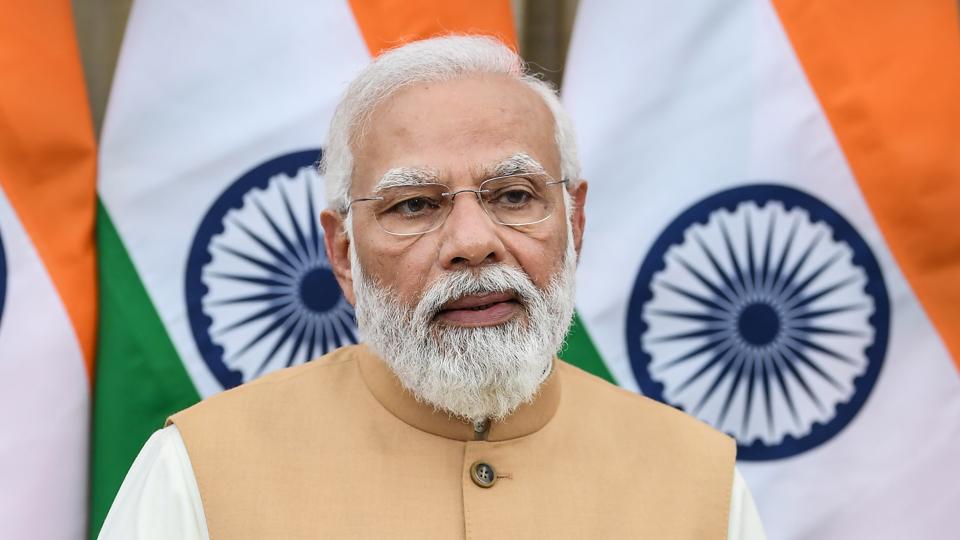
“This Budget focuses on the poor, middle class and youth and aims to provide them basic necessities. Our government is working on the provision of basic facilities,” the Prime Minister said, addressing Bharatiya Janata Party (BJP) workers virtually in a speech titled “Atmanirbhar Arthvyawastha” (self-reliant economy).
“It is very difficult to explain the whole Budget in one speech... The party has invited me to speak about the government’s vision with the Budget. I will try to explain the basic intent of the Budget,” he started, before listing some of its key provisions and the larger thinking behind them.
“This Budget has several steps to take India on the road towards modernisation. In the last seven years, decisions taken are continuously enlarging the Indian economy. About 7-8 years ago, India’s GDP was ₹1.10 lakh crore. Today, our GDP is nearly ₹2.3 lakh crore,” Modi said.
He added that time has come for fulfilment of new resolutions. “It is very important that India should become self-reliant and a modern India should be built on the foundation of self-reliant India.”
{{/usCountry}}He added that time has come for fulfilment of new resolutions. “It is very important that India should become self-reliant and a modern India should be built on the foundation of self-reliant India.”
{{/usCountry}}The central government launched the Atmanirbhar Bharat campaign as part of the first ₹20,000-crore stimulus necessitated by the Covid-19 pandemic in 2020 to boost domestic manufacturing capabilities in key sectors such as defence, electronics, telecom and pharmaceuticals.
Union Budget 2022-23 pumped up capital expenditure massively to spur growth, raising its outlay by a record 35.4% to ₹7.5 lakh crore. It has taken a classic economic mantra, according to which investments begets growth.
“We’ve taken steps to make a natural farming corridor which will be 2,500km long and nearly 10km wide. In the first phase, it will be implemented in Uttarakhand, UP, Bihar, Jharkhand and West Bengal around river Ganga. It will be a complete ecosystem,” Modi said, referring to the Budget’s provisions on agriculture.
“The Budget also focused on modernising Indian agriculture with a focus on organic farming. This will make farming more lucrative. Kisan drones and other machinery will be made available to the farmers at reasonable prices,” Modi said.
In December 2021, the government cancelled three farm laws in a rare climbdown, forced by widespread protests by tens of thousands of farmers across states such as Punjab, Haryana, Rajasthan and Uttar Pradesh. The Budget 2022-23 unveiled by the finance minister eschewed any reforms in the farm sector but promised a policy boost to digital technologies involving drones and startups for efficient farming.
The Prime Minister also highlighted the Budget’s digital push after finance minister Nirmala Sitharaman announced that the launch of a central bank digital currency in her speech on Tuesday.
“There is also a lot of discussion about central bank digital currency in today’s newspapers. This will give a big boost to the digital economy. This digital rupee, which is our physical currency now, will have a digital form and it will be controlled by RBI. It can be exchanged with physical currency,” the PM said.
Modi lauded the decision in the Budget to announce a central bank digital currency, saying it would boost the digital economy.
The roll-out of 5G services (also announced by Sitharaman as slated for FY23) is going to give a “different dimension to ease of living and ease of doing business in India”, Modi said.
The budget speech highlighted that the PM GatiShakti infrastructure mission was “transformative approach for economic growth and sustainable development”, driven by seven growth engines: roads, railways, airports, ports, mass transport, waterways and logistics infrastructure.
PM Modi said the government’s GatiShakti mission would bring great speed to infrastructure expansion for jobs to youth.
“In 2014, the nation had 90,000 kms of National Highways. These were built in the last 70 years. In the last 7 years, we’ve created 50,000 km of national highways. Under PM Gati Shakti, thousands of km of new national highways will be created,” Modi said.
The GatiShakti Master Plan, which is a cornerstone of the Union Budget’s capex push, is an integrated platform of 16 ministries to speed up multimodal connectivity infrastructure, from ports to cargo terminals.
Modi said that, leaving aside the “political angle”, people from all walks of lives and businesses have all welcomed the budget.
The Union Budget has been seen as a growth booster, with a 35% uptick in investment spending on capital infrastructure, while avoiding populist sops for the middle class or the poor.
Congress leader P Chidambaram has criticised the Union Budget, saying there was “not a word” about giving relief to the tax-paying middle class or cash assistance to the very poor, and the Budget speech “was the most capitalist speech” ever read by a finance minister.