
 E-Paper



Cabinet clears ₹13,966 Cr plans for digital agri push, climate resilience
The government plans to create an end-user mobile-based transactions and information platform for farmers, similar to UPI


The Union Cabinet chaired by Prime Minister Narendra Modi on Monday approved seven agricultural plans, with an outlay of ₹13,966 crore, geared towards climate resilience and sustainable farming, from harnessing public-funded digital infrastructure to research focussed on emerging challenges in the farm sector.
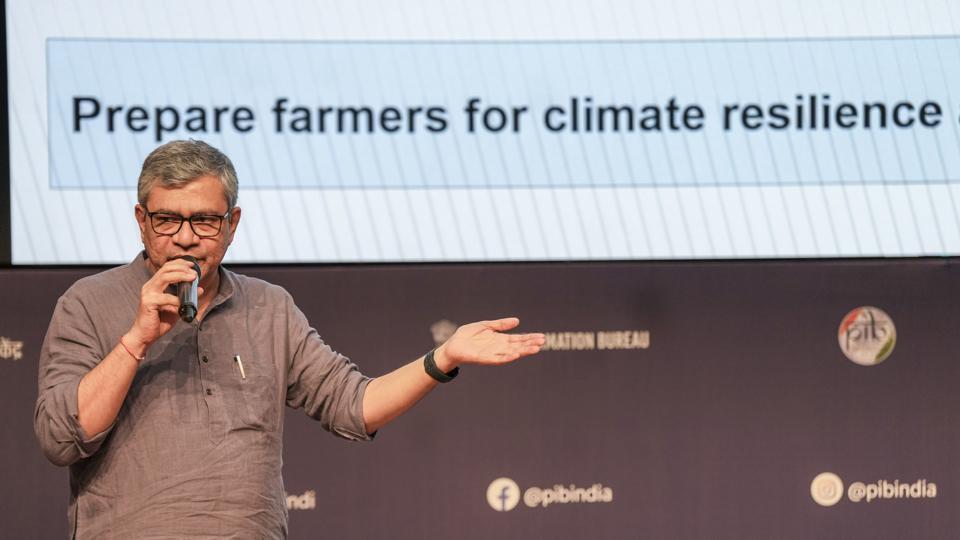
Under the Digital Agriculture Mission, for which ₹2,187 crore will be allocated, the government plans to create an end-user mobile-based transactions and information platform for farmers, similar to the Unified Payments Interface (UPI), Union minister of information and broadcasting Ashwini Vaishnaw said, briefing reporters.
The digital platform will be built by leveraging the agri stack, a farmers’ database developed by collating statistics generated through the PM-KISAN cash-transfer programme, which has bank-authenticated, land holdings-based records of nearly 100 million cultivators. Under the programme, every landholding farm household is given cash handouts worth ₹6,000 a year, paid in three equal instalments of ₹2,000, one every four months.
The agri stack was built during the previous tenure of the Modi government and is continuously updated, primarily to help build a digital superstructure for efficient services. The unified farmer service platform approved by the Cabinet is aimed at “digitising agricultural services delivery by the public and private sectors”, an official said.
The platform will have records, such as farmers’ registry, land maps, weather updates and crop yields for farm insurance, among other information, which will help agricultural firms and creditors to offer quicker services, Vaishnaw said.
“For example, in our pilots where this has been implemented, it was found that the whole process of applying for loans to disbursal took about 40 minutes,” the minister said. Since digital land records and Aadhaar-based identification are readily available in the agri stack, processing farm credit becomes faster, just as digital consumer loans.
On the platform, farmers will be able to access buyers for their produce and sellers of inputs, borrow from scheduled banks, access their soil profile as well as estimation of yields for greater efficiency and utility, a Cabinet statement said. HT had reported on the agri stack’s development on March 9, 2021, when it was being run on an experimental mode.
As part of its sustainable agriculture goal, the Cabinet also approved a programme to prepare farmers and rural stakeholders on climate change worth ₹3,979 crore. A part of the fund will be utilised for improving productivity of pulses and oilseeds, apart from plant-genetics management. India seeks to end its dependence on costly imports to meet local pulses demand by 2027, a key agriculture-sector priority.
In the financial year ended March, imports went up 84% year-on-year to 4.65 million tonne, the most in six years. In value terms, the country’s spending on imports rose 93% to $3.75 billion. India largely imports from Canada, Australia, Myanmar, Mozambique, Tanzania, Sudan and Malawi.
Extreme weather linked to the climate crisis has dented farm output in Asia’s third largest economy, hurting crops such as wheat and stocking prices. According to an RBI analysis last month, a series of “climate-related extreme weather” and supply shocks have made high food inflation “endemic” since the second half of 2019.
The government seeks to strengthen agricultural research and education to tackle the impacts of climate change, another programme for which the Cabinet gave its approval. The project, worth ₹2,291 crore, will be initiated by the State-run Indian Council of Agricultural Research (ICAR). It will upgrade the country’s curriculum in agricultural universities to prepare agricultural students and researchers towards challenges such as climate shocks in line with the National Education Policy 2020, the statement said.
The Cabinet also cleared a programme to boost the genetic potential of livestock, with an outlay of ₹1,702 crore. The livestock economy accounts for 30% of the agricultural sector’s gross value added or GVA, a measure of growth that strips out net taxes. On an average, farmers earn far more returns from livestock than from crops alone, official data show.
The livestock programme will focus on managing animal diseases, which affect their productivity, as well as livestock nutrition and enhancing the quality of veterinary education.
The Cabinet also made an outlay of ₹800 crore for a sustainable horticulture scheme to improve productivity of a range of fruits and vegetables, mushroom crops and spices, an export commodity. Additional funding of ₹1202 crore and ₹115 crore was cleared for modernising Krishi Vigyan Kendra, which are farm resource centres, and for efficient utilisation of natural resources.
“Climate adaptation has emerged as one of the biggest challenges for Indian agriculture. Adaptation technologies have to be developed quickly. It cannot take years. Any effort (towards mitigation) should look at collaboration with global agencies to hasten the process,” said TK Mani, a former faculty at the Tamil Nadu Agricultural University.


