E-Paper



CDS Chauhan says covergence between China, Pakistan and Bangladesh has implications for regional stability
CDS Chauhan said over the past five years, Pakistan had acquired “almost 70% to 80% of its weapons and equipment from China”

 Prefer HTon Google


A convergence of interests between China, Pakistan and Bangladesh may have implications for regional stability and security at a time when India faces several challenges in its neighbourhood, Chief of Defence Staff Gen Anil Chauhan said on Tuesday.
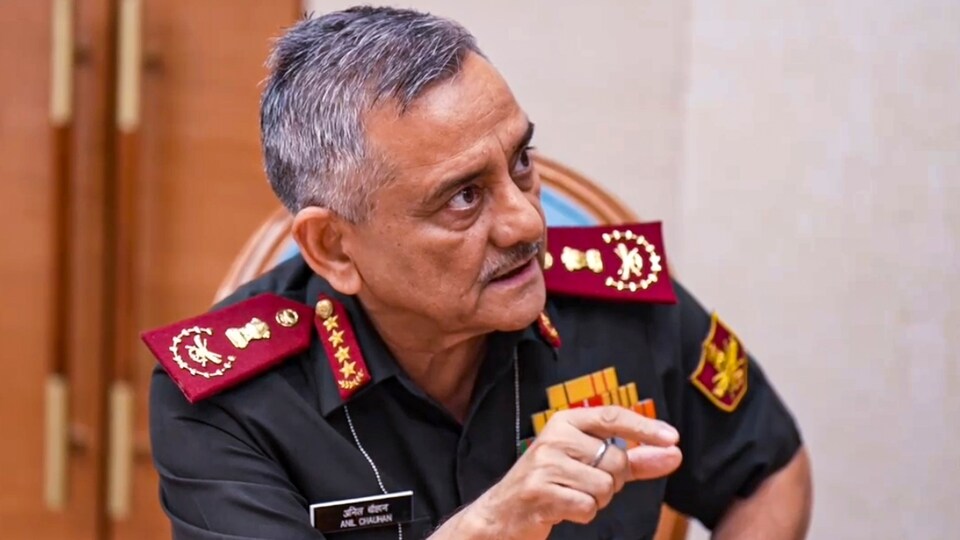
Unlike past conflicts between India and Pakistan, there was no activity along India’s borders with China during the four days of hostilities in May after the launch of Operation Sindoor, Chauhan said while delivering an address on the theme of “India’s evolving national security landscape” an at event organised by the Observer Research Foundation.
However, Chauhan listed other indications of the close military and security links between China and Pakistan, such as Islamabad acquiring almost 80% of its weaponry from Beijing in the past five years and the presence of representatives of Chinese original equipment manufacturers (OEMs) in Pakistan.
Referring to challenges faced by India within the neighbourhood, Chauhan pointed to economic instability in countries such as Myanmar, economic distress in nations in the Indian Ocean region that has allowed “outside powers to leverage their influence”, and frequent shifts in government in South Asia.
In this context, he said: “There’s a possible convergence of interest…between China, Pakistan and Bangladesh which may have security implications for regional stability and security dynamics.”
Referring to Operation Sindoor, which was launched by India on May 7 to target terrorist infrastructure in Pakistan in retaliation for the Pahalgam terror attack in April, Chauhan said that “there was no unusual activity on the northern borders during the duration of this conflict”.
He added, “In past conflicts, there had been trouble on the [northern] borders…But that’s a fact that there was no activity on the northern borders.”
Over the past five years, he said, Pakistan had acquired “almost 70% to 80% of its weapons and equipment from China”. He added, “A reasonable assumption would be that Chinese OEMs will have commercial liabilities which they have to fulfill and will have people in Pakistan…That equipment has to be serviced, it has to function.”
Chauhan also alluded to sharing of information between China and Pakistan, such as commercially available satellite imagery from Chinese companies. “So that’s possible. How much state support will be there, it’s very difficult to define. When this information turns into intelligence, it’s also very difficult to define,” he said.
He further said that Operation Sindoor had shown that there is scope for “further expansion of space in conventional operations”. He noted that Operation Sindoor was unique as the “only example of a conflict between two nuclear weapon states”.
“I think that in this particular conflict, we thought that there was a lot of space for conventional operations,” Chauhan said, listing three reasons for his argument.
“First is India’s nuclear doctrine, that is no first use. I think that gives us strength and that contributes to creating this particular space between us and Pakistan.
Second is the way we responded actually…we destroyed terrorist camps in response to terror attacks as part of a prevention strategy,” he added.
While Pakistan escalated the conflict into a “fully conventional domain”, it reduced its option to “raise the threshold [to a] nuclear conflict”, Chauhan contended. “Thirdly, I think there is space because there was no capture of territory involved…I think that further expansion of space in conventional operations is possible in each ladder of that escalation, by taking it to newer domains of warfare like cyber, electromagnetic spectrum…So we can still expand space for conventional operations,” he said.
Chauhan, however, pointed to an evolving military challenge in the shape of vulnerability to long-range weapons and long-range precision strikes. “There is currently no full-proof defence mechanism against ballistic missiles, hypersonics, cruise missiles and large-scale attacks by drones or loiter ammunition, especially when they were all used in conjunction with one another,” he said.