The Centre has issued detailed guidelines to states and union territories for raising, equipping, operationalising and training within the next five years, state disaster response forces (SDRFs), with preference to be given to Agniveers and NCC certificate holders for direct recruitment and 15% of the openings reserved for women.
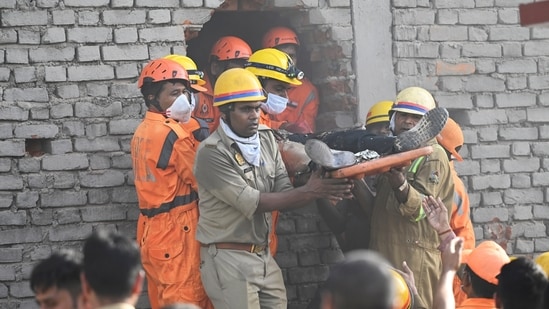
The units will be modelled on the National Disaster Response Force (NDRF) to deal with the natural and man-made disasters.
The amended disaster management act, 2025, cleared by the Parliament last year, mandates every state and UT to have a specialised SDRF to deal with the disasters.
The latest guidelines, issued by the National Disaster Management Authority (NDMA) in June this year, but made public earlier this week, provide a comprehensive uniform framework aimed at creating decentralised disaster response capacity.
Also Read | Yogi govt sends teams to rescue UP residents stranded in Nepal
The units will work seamlessly with the NDRF and SDRFs of neighbouring states when the scale of the event demands this, officials familiar with the matter said.
{{/usCountry}}The units will work seamlessly with the NDRF and SDRFs of neighbouring states when the scale of the event demands this, officials familiar with the matter said.
{{/usCountry}}While many states have established SDRFs in some form, their capacities and training standards vary.
In some states, they exist largely on paper and disaster response functions fall on NDRF. Asserting that a capable SDRF provides immediate, local specialized response, ensuring timely life-saving operations while NDRF can focus on L-3 events (catastrophic, large scale) and advanced capabilities, training and mentoring, the guidelines state that “over-reliance on NDRF even for minor hazards weakens national specialised capacity and can delay state-level response due to connectivity and competing demands during widespread events”.
On the structure and strength of SDRFs, the guidelines say that “they shall be organised on the battalion model -- 600 to 1200 personnel in each battalion, broadly aligned with NDRF”, and headed by a director general of police (DGP) rank officer.
Also Read | Delhi’s own SDRF to have 4 battalions, as per disaster management plan
Each battalion can be divided into 9 to 10 multi-disciplinary, self-sufficient teams and each team will have “45-50 responders with all integral rescue, medical, communications and logistics elements”.
Asserting that SDRFs should recruit “young”, “fit” personnel not above the age of 50 as responders, the NDMA guidelines say that for direct recruitment, “Agniveers and NCC certificate holders would be given preference”. The primary source of hiring responders would be state armed police, state police, central armed police forces (CAPFs), armed forces, ex-servicemen (especially engineers) and ex NDRF personnel.
Each SDRF, the guidelines add, “should include engineers, technicians, medical staff, communications experts, dog handlers, divers and CBRN (chemical, biological, radiological and nuclear) specialists”.
The deployment of SDRFs, according to the guidelines, should be based on “predominant terrain and hazard characteristics”.
Also Read | India watches Nepal flood crisis, puts NDRF on high alert in UP, Bihar
For instance, “teams may be sub-divided to cover multiple valleys, pilgrimage corridors or landslide-prone sectors,” the guidelines said, adding that emphasis should be on seasonal and anticipatory positioning during monsoon, winter and peak pilgrimage periods.
The guidelines also provide a provision for SDRFs to conduct safety preventive audits as part of their non-disaster mandate.
In this, they will conduct safety audits and validation mock exercises at high-footfall recreational, tourist and religious congregation sites, “with particular emphasis on locations associated with water-based recreation (rivers, reservoirs, waterfalls, ghats, beaches, dams and water parks) and mass religious gatherings (melas, yatras, pilgrimage circuits, festival venues)”.
At no point, NDMA has said, should SDRFs be deployed “in situations requiring the use of armed force or enforcement of law and order”.