
 E-Paper



Chennai’s air quality worsens to ‘very poor’ after Diwali night
There has been an increase in PM10 & PM2.5 parameters which is above the National Ambient Air standards, the board said in a statement


The air quality of Chennai fell to “very poor” category on Thursday, the Tamil Nadu pollution control board said on Friday. The Air Quality Index (AQI) in the state capital ranged between 342 to 385 on Thursday evening and Friday morning.
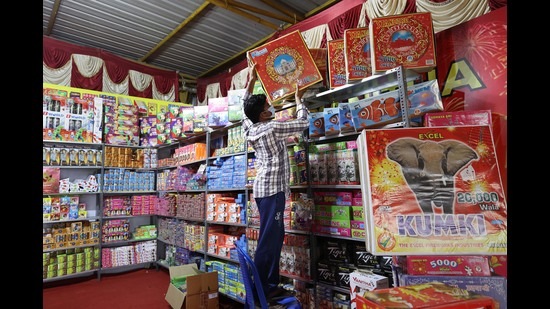
Based on the directions of the Supreme Court to carry out short-term monitoring for 14 days (commencing from 7 days prior to Diwali and ending 7 days after) for the parameters namely aluminium, barium and others, the board has conducted manual monitoring in five different locations in Chennai that is in Besant Nagar, T Nagar, Nungambakkam, Triplicane and Sowcarpet to monitor the impact of Diwali celebrations by bursting of firecrackers for the Ambient Air Quality and also Noise pollution levels.
There has been an increase in PM10 & PM2.5 parameters which is above the National Ambient Air standards, the board said in a statement. Similarly, they found that the noise pollution had also increased compared to 2020 on Diwali day. The PM10 values ranged from 187 to 283 ug/m3 on Diwali day against the standard of 100 ug/m. PM 2.5 results ranged from 175 to 257 microgram/m3 against the prescribed 60 ug/m3. “The PM10 and PM2.5 values are above National Ambient Air standards prescribed in all the stations during Deepavali day,” the statement said.
The ambient noise level ranged from 55 to 66 dB (A) on a non-festive day which increased to 69 to 79 dB (A) on Diwali day. These values were also found to be higher this year compared to Diwali in 2020.
The considerable increase in Air pollution level and AQI values are mainly due to high relative humidity (above 90%) and low wind speed and heavy bursting of crackers during the permitted timing, the department said.
Gaseous pollutants were found to be well within prescribed limits.
Meanwhile, the Greater Chennai Corporation collected 138.2 metric tonnes of waste that came out of burning firecrackers. In previous years, the civic body had collected 85 tonnes of cracker waste in 2017 and 95 tonnes in 2018. In 2019, 103 tonnes of cracker waste was collected. In 2020, around 98 tonnes were collected.


