E-Paper



'Fair, lawful, reasonable': SC lays down procedural safeguard in citizenship cases
“Citizenship and foreigner status occupy a field of high constitutional and legal significance,” the court observed.

 Prefer HTon Google


The Supreme Court on Monday laid down an important safeguard governing citizenship determination, holding that a person cannot be declared a foreigner through a mechanical or one-sided process and that the constitutional guarantee of fairness applies even where the individual ultimately fails to establish Indian citizenship.
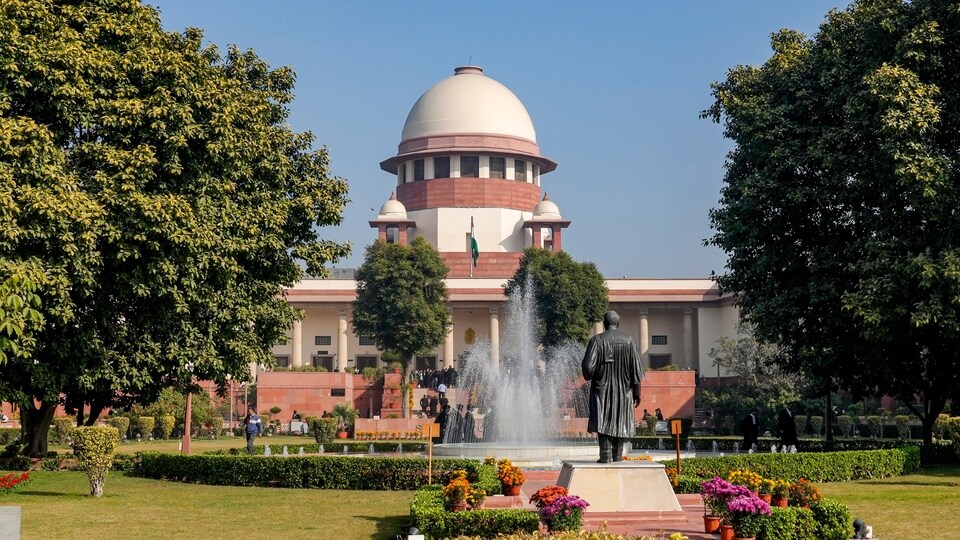
A bench of justices Vikram Nath and Sandeep Mehta underlined that citizenship and foreigner status must be determined through a “fair, lawful and reasoned” process, emphasising that the grave consequences of declaring a person a foreigner require strict adherence to constitutional and statutory safeguards.
The ruling assumes significance at a time when the special intensive revision (SIR) of electoral rolls has generated concerns over citizenship claims in several parts of the country, with questions over documentary proof and citizenship status once again coming to the fore.
Also Read: Amid row over MEA passport statement, what constitutes proof of citizenship in India?
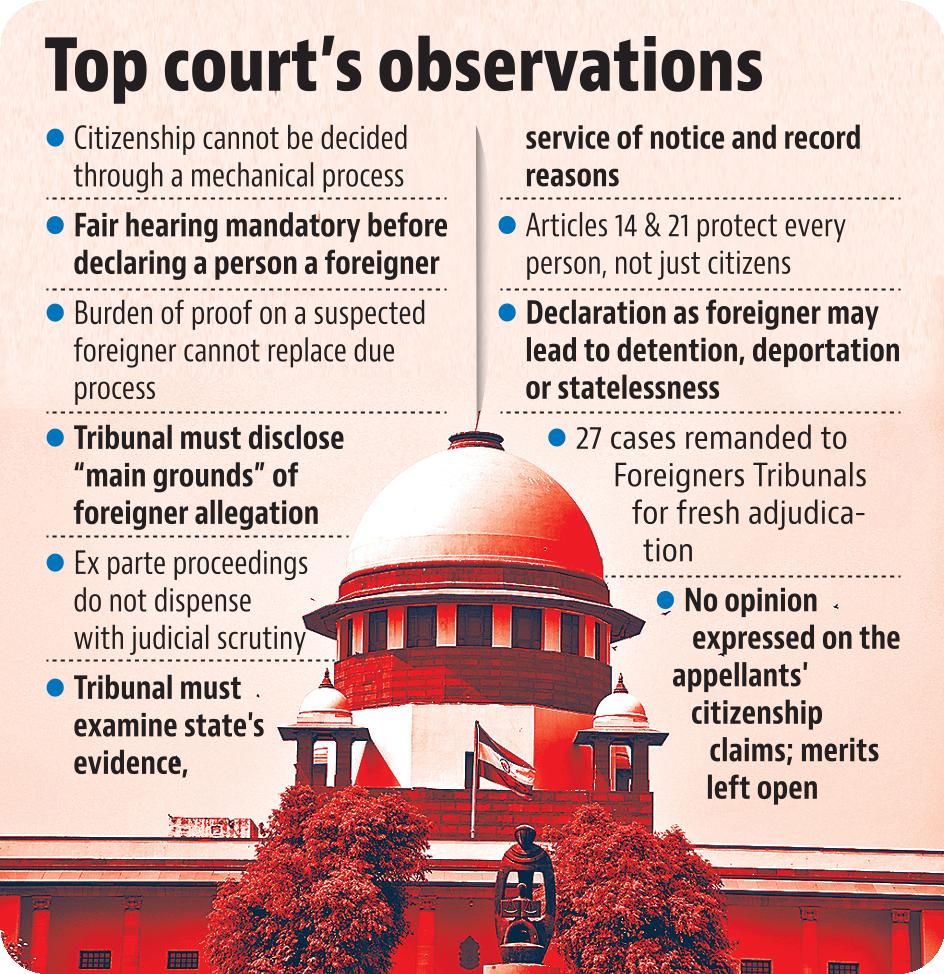
The court allowed 27 appeals, set aside Gauhati High Court judgments affirming the appellants’ declarations as foreigners, and remanded the matters to the concerned Foreigners Tribunals for fresh adjudication.
The bench clarified that it was not deciding whether the appellants were Indian citizens. Instead, it held that the process leading to such a determination must satisfy the requirement of fairness under the Constitution, the Foreigners Act, 1946 and the Foreigners (Tribunals) Order, 1964.
“Citizenship and foreigner status occupy a field of high constitutional and legal significance,” the bench said, repeatedly emphasising that although Section 9 of the Foreigners Act places the burden on the person to establish that he or she is not a foreigner, that burden does not dispense with the tribunal’s obligation to conduct a lawful adjudication.
“The burden on the proceedee operates within a legal process. It does not replace the legal process itself,” the court said, emphasising that Section 9 does not authorise a “mechanical declaration” of foreigner status or permit a reference to be accepted merely because it has been made.
Explaining the statutory scheme, the bench held that the expression “main grounds” under the 1964 Order cannot be reduced to a bare allegation that a person is suspected to be a foreigner. The individual must be informed of the essential basis of the allegation so as to meaningfully answer the reference and discharge the statutory burden.
The court said that even where a person fails to appear before the tribunal despite being served notice, the tribunal continues to function as a quasi-judicial body and cannot mechanically declare the individual a foreigner.
“It must satisfy itself that notice was duly served in accordance with law. It must examine whether the main grounds were made available to the proceedee. It must consider the evidence produced by the State...and record reasons, even if briefly,” the judgment said, adding that an ex parte proceeding dispenses only with the participation of the absent party, “but it does not dispense with objective consideration and meaningful adjudication by the Tribunal.”
The bench anchored these procedural safeguards in Articles 14 (equal protection of law) and 21 (liberty) of the Constitution, noting that both provisions protect “any person” and are not confined to Indian citizens.
“A person proceeded against before a Foreigners Tribunal may ultimately fail to establish Indian citizenship, but the process by which such determination is made must still satisfy the constitutional requirement of fairness, reasonableness and non-arbitrariness,” it held.
Relying on a body of judicial precedents, the court said the principles of natural justice remain applicable to proceedings before Foreigners Tribunals because their opinions carry grave civil consequences. Those consequences, the judgment noted, extend beyond an ordinary civil dispute and may include detention, deportation, separation from family and community, and even the possibility of statelessness.
For that reason, the court stressed that a notice must not merely be formally issued but must precisely apprise the person of the case he or she has to meet. The opportunity contemplated under the 1964 Order, it added, must be “an effective opportunity, and not a merely formal one.”
The court also held that high courts should ordinarily not become the first forum to appreciate evidence where the tribunal proceedings had remained ex parte, observing that factual examination of ancestry, family linkage, electoral records and other citizenship documents must primarily be undertaken by the statutory tribunal.
At the same time, the bench made it clear its decision should not be construed as rewarding the appellants for defaulting in the earlier proceedings. The remand, it said, was being granted only once and subject to strict conditions. The appellants have been directed to appear before the tribunals within four weeks, cooperate with the proceedings and avoid unnecessary adjournments, failing which the tribunals would be free to proceed in accordance with law.
Clarifying the limited scope of its order, the court said it had expressed no opinion on the genuineness or sufficiency of the documents relied upon by the appellants.