
 E-Paper



‘CJI is not superior to 33 other judges in SC’
CJI Bhushan R Gavai emphasized that he is "first among equals," asserting no superior power over other Supreme Court judges amid a plea on bail rulings.


Chief Justice of India (CJI) Bhushan R Gavai on Tuesday underscored that the country’s top judge is not vested with powers superior to the other 33 judges of the Supreme Court, adding that the judges leading the first court of the country are bound by the principles of judicial propriety and discipline.
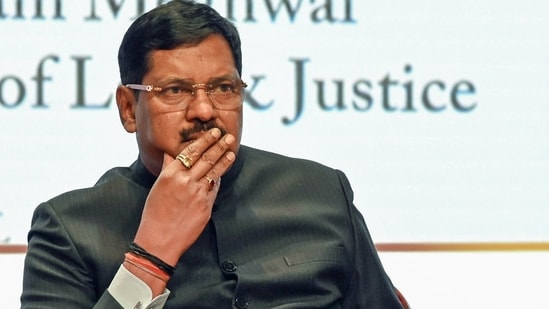
“The CJI is not superior to other judges. He exercises the same judicial power like the other 33 judges of this court. The CJI is just the first among equals,” Justice Gavai said while heading a three-judge bench that also included justices K Vinod Chandran and NV Anjaria.
The bench was hearing the Union government’s plea to recall an April 26, 2023 judgment in Ritu Chhabaria Vs Union of India, which held that an accused is entitled to default bail if the investigating agency files an incomplete charge sheet. The ruling, delivered by a bench of justices Krishna Murari and CT Ravikumar, triggered a spate of bail applications across the country in high-profile cases.
The Centre’s recall plea pointed to a May 1, 2023 order of a two-judge bench led by then CJI Dhananjaya Y Chandrachud, which effectively put the April 26 ruling on hold after Solicitor General Tushar Mehta warned of “large-scale ramifications”. On Tuesday, Justice Gavai’s bench questioned whether a bench, “just because it sits in the first court”, could alter an order passed by another bench of equal strength.
“We believe in adherence to judicial propriety and discipline. If we permit this, one bench can go on interfering with orders of another bench just because the former does not like it,” Justice Gavai remarked.
Mehta, on his part, urged the bench to consider the “all India ramifications” of the Ritu Chhabaria ruling, citing around 50 pending applications where accused have claimed that mentioning Section 173(8) of the Criminal Procedure Code (CrPC) in a charge sheet implies that further investigation is pending and, therefore, the chargesheet is incomplete, entitling them to default bail.
“It can create chaos,” submitted Mehta, adding that the special leave petition (SLP) in the matter should be heard to settle the law.
The bench, however, pressed Mehta on procedural propriety: “Where is the question of recalling an order in an independent case? What happened to your review plea in the Ritu Chhabaria case?” Mehta replied that the review had been dismissed on July 31 this year.
Justice Gavai then indicated that a three-judge bench would be constituted to hear the matter in detail.
The April 26, 2023 ruling in Ritu Chhabaria held that filing a charge sheet without completing the investigation or filing supplementary charge sheets merely to defeat the accused’s statutory right cannot deprive an arrested person of default bail under Section 167(2) CrPC. This provision mandates release on bail if the investigation is not completed within 60 days (or 90 days for serious offences).
The verdict arose from a petition filed by Ritu Chhabaria, whose husband was booked under the Prevention of Corruption Act. The Central Bureau of Investigation (CBI) had named him only in supplementary charge sheets while the final report remained incomplete.
In contrast, Mehta and the Enforcement Directorate (ED) have argued that the ruling contradicts earlier three-judge bench decisions, including Vipul Agarwal Vs State of Gujarat (2013), and undermines provisions such as Explanation (ii) to Section 44 of the Prevention of Money Laundering Act (PMLA), which allows further investigation even after a complaint is filed.
The government has further argued that this ruling should be considered per incuriam, or made in ignorance of the law because it ignored a binding precedent from a co-equal bench in the Dinesh Dalmia case in 2017. For the past 16 years, the recall plea stated, the Dinesh Dalmia judgment had established a different legal principle. In that case, the Supreme Court held that the court that originally took cognisance of an offense could grant police custody during a further investigation. This was permitted as long as it followed the rules and limitations outlined in Section 167(2) of CrPC.
On May 1, 2023, the then CJI-led bench agreed to examine the April 26 verdict’s validity, directing that bail applications relying on it be deferred. ED separately challenged orders granting bail based on Ritu Chhabaria, including to accused in high-value money laundering cases.
The Tuesday hearing has now added a layer of institutional significance as well, with the apex court openly deliberating on whether its benches of equal strength can virtually sit in appeal over one another’s orders, and the CJI reaffirming his role as “first among equals” in the judicial hierarchy.


