
 E-Paper



Climate crisis fund, petrol tax cut part of TN budget
After releasing a White Paper on Monday to show the dire straits of the state’s finances, Tamil Nadu finance minister Palanivel Thiaga Rajan presented a revenue-deficit budget without announcing any major reforms


Chennai: The Dravida Munnetra Kazhagam (DMK)-led Tamil Nadu government on Friday presented its maiden state budget, announcing a reduction of ₹3 per litre in petrol prices and focusing on school education and climate change, even as the principal opposition All India Anna Dravida Munnetra Kazhagam (AIADMK) staged a walkout from the legislative assembly.
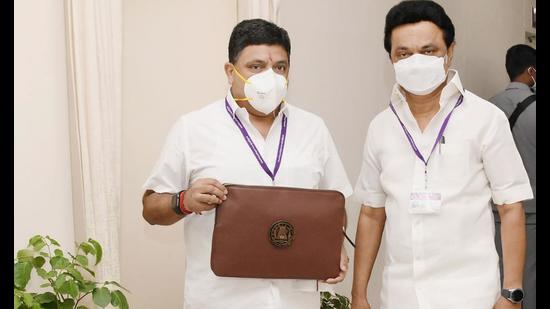
After releasing a White Paper on Monday to show the dire straits of the state’s finances, Tamil Nadu finance minister Palanivel Thiaga Rajan presented a revenue-deficit budget without announcing any major reforms. Rajan said given the impact of Covid-19 pandemic on the economic situation, it was not the ideal time for fiscal consolidation while adding that the primary aim of the revised estimates, which covers only the next six months, was to lay a foundation for the 2022-23 full budget.
An interim budget was presented by the previous AIADMK government in February before the state went for assembly elections on April 6.
Rajan presented a three-hour-long budget, which is Tamil Nadu assembly’s first paperless budget, amid walkout from the AIADMK. Legislators sat through the session reading from the computer monitors that were set up for them more than a week ago.
The revenue deficit for this year is expected to go up to ₹58,692.6 crore from ₹41,417.3 crore, which Rajan said, was estimated unrealistically in the interim budget. “This increase in revenue deficit is on account of the exceptional times that we find ourselves in and does not detract in the least from this government’s commitment to fiscal rectitude and consolidation in the coming years, as emphatically indicated in the White Paper,” Rajan said.
“As soon as the impact of the Covid-19 pandemic is overcome, deeper reforms will be undertaken to ensure that Tamil Nadu’s debt overhang is corrected without any delay.”
According to the White Paper, the projected outstanding debt of the state is likely to be ₹5.7 lakh crore as of March 31, 2022, which effectively means the burden on every resident in the state is around ₹70,000. The fiscal deficit is also estimated to go up to Rs.92,529.4 crore by the end of the current fiscal.
One of the highlights of the budget was the announcement of cut in petrol prices by ₹3 a litre, which aims to benefit the working class in the state. Around 26.3 million people in Tamil Nadu use two-wheelers. The price cut will come into effect on August 14, said finance secretary S Krishnan in a post-budget press conference. The price cut will, however, result in a loss of Rs1,160 crore a year in revenue for the state government, the minister said in his budget speech.
In its election manifesto, the DMK had promised to cut the state tax on petrol by ₹5 per litre. However, it reiterated in the budget that the onus of providing relief to consumers also lies with the Union government.
The DMK government in its budget also announced establishing an expert advisory council to develop a ‘Federal Fiscal Model’ on legislation involving revenue and taxation (including GST). “Nowhere is this dilution of the spirit of federalism more apparent than in the taxation of petrol and diesel at the pump. The overall Union levies on petrol were increased from Rs.10.39 per litre in May 2014 to Rs.32.90 per litre today,” Rajan said.
The government also announced setting up a high-level committee of educationists and experts to formulate a State Education Policy for Tamil Nadu. The DMK has been critical of the Centre’s new National Education Policy. The highest allocation of ₹32,599.5 crore in this budget went to the department of school education with an aim to bring Tamil Nadu among the top three states in terms of learning outcomes in the country. The school education department had seen the highest allocation of ₹34,181 in the 2020-2021 budget as well.
In the budget speech, Rajan also announced that Tamil Nadu Climate Change Mission will be launched to focus on climate change adaptation and mitigation activities with a total outlay of Rs.500 crore. This year, a bank-linked fund flow of ₹20,000 crore, including a special pandemic loan assistance, will be provided to various Self Help Groups and the third highest allocation of ₹18,9333 crore has been earmarked for the health department. Several disabled-friendly infrastructure projects were also announced in the budget. Subsidies for transgender were also in focus.
The White Paper had called for the re-orientation of subsidies, which had alarmingly increased in the state in terms of food, power and transport. Rajan had previously said that even people who are well off were receiving the state’s cash doles and other benefits intended for the poor. While earlier the government did not have data on taxpayers and ration-linked economic status, in this budget, it has indicated moving towards targeted subsidies by announcing that it will link all available government data sources to understand the true economic status of all citizens and households.
Rajan said the government was in the process of identifying households eligible for receiving benefits of ₹1,000 to women heads, another poll promise of the DMK. A major initiative for smart metering for all public utilities will be launched to ensure that people pay based on consumption, the minister announced.
Meanwhile, experts have welcomed the announcement to meet the drinking water objectives by implementing Jal Jeevan Missions at ₹2,000 crore, creating industrial parks in tier-2 cities and districts and four Tidel (IT) parks in Villupuram, Vellore, Thoothukudi, and Tiruppur districts. They, however, added that the roadmap for how revenue would be improved was missing in the minister’s budget speech.
“The budget has set an ambitious target of lowering the revenue deficit to ₹58,692 crore, which is lower than the figure in 2019-20 and less than 60% of the revised revenue deficit estimate for 2020-21. It is unclear for now, without knowing the details on the revenue side how this would be achieved,” said Vidya Mahambare, professor of economics, Great Lakes Institute of Management, Chennai.


