
 E-Paper



CMs, CJs to adhere to timelines on judicial appointments, says CJI Ramana
The chief justices from high courts also raised issues of low connectivity in hilly areas and north eastern states which was resolved by asking the Centre to provide adequate financial support and upgrading of information technology infrastructure.


New Delhi: Constitutional authorities at state and central levels should adhere to the timelines fixed for making judicial appointments, said Chief Justice of India (CJI) NV Ramana on Saturday as this turned out to be one of the big resolutions agreed between state chief ministers, lieutenant governors and administrators of union territories and chief justices of the high courts, at a joint meeting held in the Capital after a gap of six years.
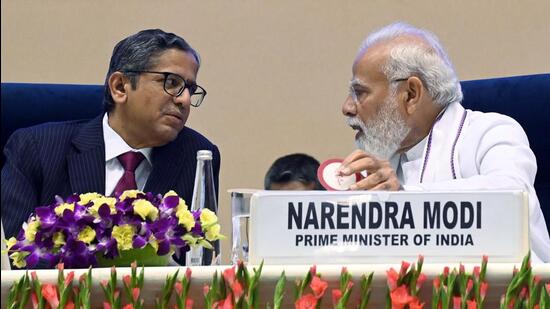
The CJI said, “On the appointment of judges, all expressed concern about the delay in filling vacancies in the high courts and district courts. In one of the resolutions passed today it has been agreed that all constitutional authorities and judicial authorities will adhere to the timelines fixed in the previous judgments of the Court.” He was speaking to journalists at a press conference held jointly with Union law minister Kiren Rijiju after the conclusion of the meeting.
The CJI was referring to the decision passed by the Supreme Court in April 2021 in M/s PLR Projects v Mahanadi Coalfields, where a three-judge bench headed by then CJI SA Bobde had laid down elaborate timelines for clearing proposals for appointment of high court judges, right from the stage of initiation of proposal to its final clearance.
On a question whether the meeting took up the pending issue of finalizing memorandum of procedure (MoP) for appointment of judges, CJI said, “The issue of MoP is not to be discussed with the chief ministers. The time schedule for appointment has been fixed by us in the PLR judgment. We have reiterated that from the initiation of the proposal to the prime minister’s office level, they have to follow the timelines.”
The PLR judgment had fixed 4 to 6 weeks for the intelligence bureau to submit report/inputs to the Centre on the recommendation made by the high court collegium. If the appointment was accepted, the Government was directed to carry it out immediately but in case of any reservation, the same was to be forwarded to the Supreme Court within 8 to 12 weeks. If the Supreme Court collegium, upon reconsideration, unanimously reiterated the recommendation, such appointment was to be carried out by the Centre within 3 to 4 weeks.
Another highlight of the meeting was the issue of judicial infrastructure and strengthening security of serving judicial officers at the level of subordinate courts. On infrastructure, the meeting took up a resolution passed by CJI and chief justices of high courts on Friday where it was resolved to have a national judicial infrastructure authority along with state bodies to act as special purpose vehicles to accelerate creation of judicial infrastructure.
However, the state chief ministers felt that instead of having a national authority, the set-up at the state level would be meaningful and the same should have representation of the Chief Minister or his/her nominee, besides other stakeholders in the judiciary and executive. CJI said, “There was near unanimity on such bodies to be established at state level by including chief minister or their nominee.”
Union law minister pointed out, “We are ready to associate with state governments for setting up infrastructure of district courts. Some chief ministers could not agree on having the present set-up at national level because implementation and execution lies at the state level. So the body will be constituted at the state level with involvement of chief ministers and chief justices.”
The CJI further informed that the state judicial infrastructure authority on infrastructure will not involve the Supreme Court while the Centre will be involved with the funding of projects through its centrally sponsored scheme. The state authorities will monitor the ongoing projects and ensure speedy construction, justice Ramana said.
Earlier in the day, during his speech, CJI said, “When we last met in 2016, the sanctioned strength of judicial officers in the country was 20,811. Now, it is 24,112, which is an increase of 16% in 6 years. On the other hand, in the corresponding period, pendency in district courts has gone up from 2 crore 65 lakh to 4 crore 11 lakh, which is an increase of 54.64%. This data shows how inadequate the increase in the sanctioned strength is.”
CJI said, “For the district courts, effective steps will be taken to clear pending proposals for filling posts in subordinate judiciary that have gathered over last five years. In this regard, there is already a matter pending in the Supreme Court for monitoring the required strength of judicial officers and making timely appointments. In addition, CJI said, “The resolution has been adopted to provide adequate security to serving judicial officers.” This follows the death of a Dhanbad district judge who was killed in a road accident in July last year followed by incidents of low intensity blasts inside district courts of Delhi and Punjab.
The chief justices from high courts also raised issues of low connectivity in hilly areas and north eastern states which was resolved by asking the Centre to provide adequate financial support and upgrading of information technology infrastructure.
Union Law Minister welcomed the resolutions taken at the joint meeting of states and chief justices and said, “All decisions will be given full shape by us.” To a question, Rijiju said that the government was committed to promote use of local languages in judiciary and legal education. “This is a process which needs wider consultation. We require approval of CJI to have orders and judgments in local languages.”
CJI Ramana clarified, “This is a serious issue. The demand for introducing regional language at the level of high court has been from Tamil Nadu. They are asking the same right as is being given for the use of Hindi in four high courts in the north. I believe with technology and artificial intelligence this can be worked out.”


