E-Paper



Conditions seem favourable for onset of monsoon: IMD
India's Meteorological Department said conditions are gradually becoming favourable for the onset of the delayed monsoon over Kerala, but did not announce a tentative date. A low-pressure area is likely to form over the southeast Arabian Sea within the next 48 hours, which could create favourable conditions for the onset phase of the monsoon during the next three to four days. However, the low-pressure area may intensify and move away from the Indian coast, hampering the normal progress of the monsoon.

 Prefer HTon Google


Conditions are gradually becoming favourable for onset of monsoon over Kerala, which is already delayed from its usual arrival on June 1, India Meteorological Department (IMD) said on Sunday. The weather forecaster, however, did not announce a tentative date for the southwest monsoon arrival.
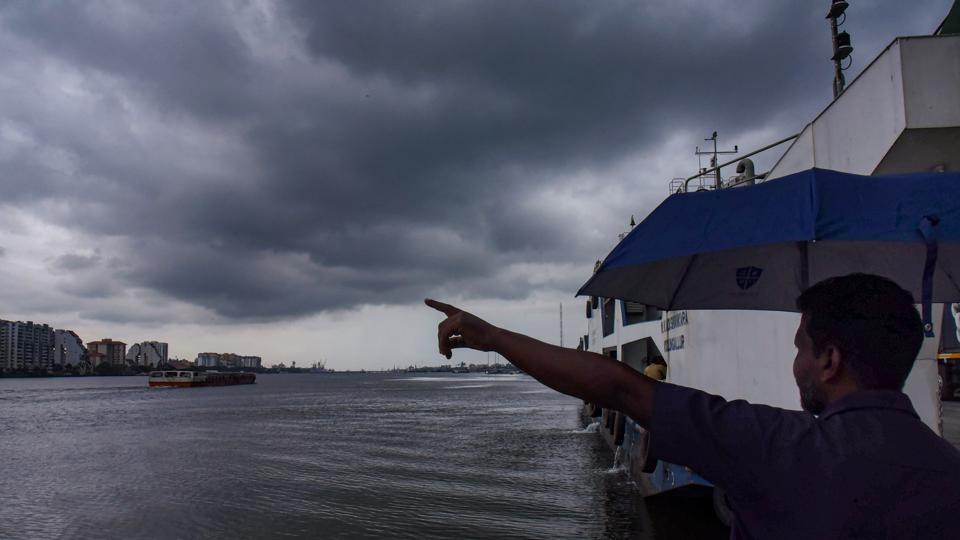
A cyclonic circulation is likely to develop over southeast Arabian Sea on Monday. Under its influence, a low-pressure area is likely to form over the same region during subsequent 48 hours, IMD said in its bulletin on Sunday.
“Conditions are becoming favourable with increase in westerly winds over south Arabian Sea. Also, the depth of westerly winds is gradually increasing and today, June 4, the depth of westerlies has reached up to 2.1 km above mean sea level. The cloud mass over southeast Arabian Sea is also increasing,” IMD said in a statement. “We expect that these favourable conditions for monsoon onset over Kerala will further improve during next 3-4 days. It is being monitored continuously and further update will be provided tomorrow, June 5.”
IMD officials said the low-pressure area which is expected to form near the Indian coast will help create favourable conditions during the onset phase of monsoon during next three-four days. But thereafter, the officials added, it may intensify further and move away from the Indian coast which will hamper the normal progress of monsoon.
“We are not specifying any date now. It will be declared as soon as the onset criteria is met,” M Mohapatra, director general, IMD, said. “Once the low-pressure area forms over Arabian Sea, its impact on monsoon progress will depend on the intensity and movement.”
Models are showing divergent results on the intensity and likely track of the low-pressure system over Arabian Sea, officials said.
“We expect the low-pressure area to help with monsoon onset as it is forming near the coast. Thereafter, it may intensify to a depression and cyclone and move away from the Indian coast,” a senior IMD official said. “In that case, monsoon progress is likely to be hampered as all the moisture will be pulled away by the system. At the moment we cannot depend on the model results because they are highly divergent.”
IMD declares monsoon onset over Kerala based on three features: 1. If after May 10, 60% of the 14 stations — situated at Minicoy, Amini, Thiruvananthapuram, Punalur, Kollam, Allapuzha, Kottayam, Kochi, Thrissur, Kozhikode, Thalassery, Kannur, and Kudulu in Kerala, and Mangaluru in Karnataka — report rainfall of 2.5 mm or more for two consecutive days (in such case the onset will be declared on the second day); 2. Depth of westerlies should be maintained at a specified level; and 3. Satellite derived Outgoing Longwave Radiation (OLR) is low.
OLR represents the total radiation going to space emitted by the atmosphere or extent of cloudiness.
Monsoon normally sets in over Kerala around June 1. It advances northwards, usually in surges, and covers the entire country around July 15.
On May 16, IMD predicted that the monsoon was likely to make onset over Kerala on June 4 with model error of +/-4 days. IMD forecast a “normal” monsoon at 96% (with an error margin of +/-5%) of the long-period average. The LPA for monsoon season between June to September is 87 cm, which is calculated for the period of 1971 to 2020. Private met forecaster, Skymet Weather, predicted “below normal” rainfall during the monsoon season to the tune of 94% (with an error margin of +/-5%).
IMD follows a well laid out process of identifying onset parameters before announcing monsoon arrival.
“The first thing that is considered is rainfall. Out of 14 representative weather stations in Kerala, at least 60% of stations should report more than 2.5 mm rainfall for two consecutive days. Before monsoon sets in, thunderstorms normally start. When at least 60% of these stations record rainfall, it means there is largescale rainfall activity in Kerala and surrounding regions,” M Rajeevan, former secretary, ministry of earth sciences, had said on May 24. “But if we have only rainfall as a criterion then there is a high chance of bogus monsoon onset. The happened in 1995 and again, in 2015. So, two other criteria are also critical. These are: a cross-equatorial flow of winds or a westerly flow at both lower and higher levels and whether there is adequate clouding over the region which is also a sign of rainfall approaching.”
There is a nearly 100% probability of El Nino conditions during monsoon months, and it is expected to continue till next year, IMD said last month. El Nino is characterised by an unusual warming of waters in the eastern equatorial Pacific Ocean, which has a high correlation with warmer summers, drought, and weaker monsoon rains in India.
The 2023 El Nino is expected to develop following a triple dip La Nina event (2020-22). La Nina is the opposite of El Nino, and is characterised by cooler currents in the equatorial eastern Pacific.
According to the Union agriculture ministry, 51% of India’s farmed area that accounts for 40% of production is rain-fed, making the monsoon critical. With 47% of the country’s population dependent on agriculture for their livelihood (according to this year’s Economic Survey), a bountiful monsoon has a direct correlation with a healthy rural economy.