
 E-Paper



Couple of years away from superintelligence: Altman
OpenAI's CEO Sam Altman predicts early superintelligence could emerge in a few years, urging global governance similar to the IAEA for AI management.

 Prefer HTon Google


Early versions of true superintelligence could arrive within “a couple of years,” OpenAI chief executive Sam Altman said on Thursday at the India AI Impact Summit, offering the most aggressive timeline of any speaker at the three-day event — and warning that the world may need “something like the IAEA” to govern what follows.
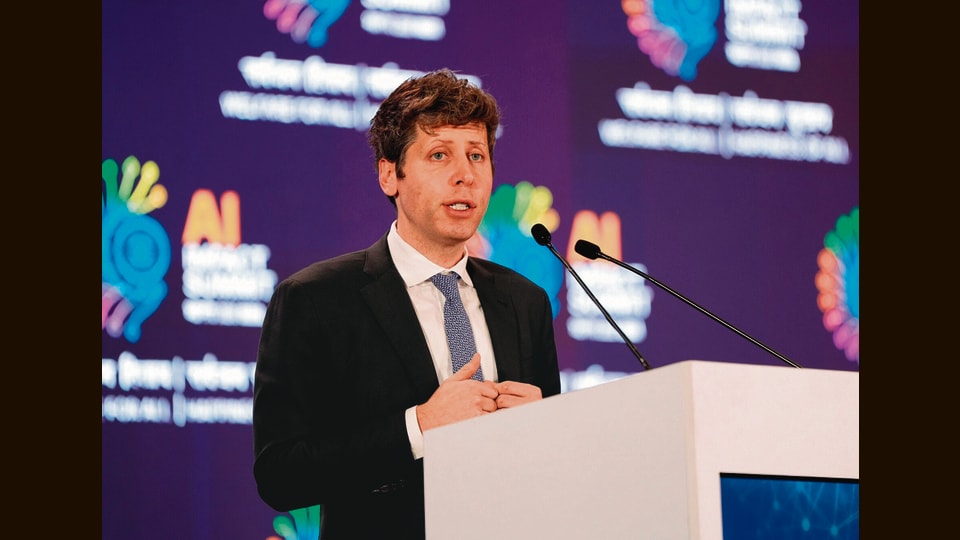
“On our current trajectory, we believe we may be only a couple of years away from early versions of true superintelligence,” Altman said in his keynote address at the summit. “By the end of 2028, more of the world’s intellectual capacity could reside inside of data centres than outside.”
Altman said the pace of progress demands a new kind of international institution. “We expect the world may need something like the IAEA for international coordination of AI, and especially for it to have the ability to rapidly respond to changing circumstances,” he said in his keynote speech earlier.
Speaking to HT in a closed-door interaction with select journalists shortly after his speech, Altman cited recent evidence to support the superintelligence claim, saying an OpenAI model had solved the majority of research-level mathematics problems with no prior published proof. “We did this event called First Proof, and the model got seven out of 10,” he said.
Some AI models, he contended, had independently produced new results in theoretical physics — evidence, he argued, that AI systems were beginning to generate original knowledge, not just retrieve it.
“We are converting even some of the biggest sceptics,” Altman said, adding, “maybe not some of the ones from today.” The remark came after Altman was asked about comments by other AI industry leaders the day before. Google DeepMind CEO Demis Hassabis and Meta’s Yann LeCun, speaking at the same summit, had questioned whether current architectures can reach AGI at all.
Asked about the risk of cognitive offloading — the tendency for users to outsource thinking to AI tools — Altman acknowledged the concern, a notable concession from the CEO of a company whose chatbot has 100 million weekly users in India alone, roughly a third of them students. “If we don’t make any changes to the way we teach and evaluate students, maybe they will do too much cognitive offloading to ChatGPT,” he said, comparing the concern to early fears about Google in classrooms but arguing that expectations must rise alongside the tools.
In his keynote, he spoke of what he saw as economic contexts of labour and AI. “It’ll be very hard to outwork a GPU in many ways,” he said, though he predicted humans will lean into interpersonal roles. “We really seem hard-wired to care about other people much more than we care about machines.”
He also described AI tools as part of a “collective external lattice” built around human cognition that would fundamentally change what we do day-to-day.
A key focus of Altman’s at the summit was a broader argument against concentrating the technology in any single entity. “Centralisation of this technology in one company or country could lead to ruin,” he said, positioning OpenAI’s expansion in India as part of a deliberate push to distribute AI’s benefits. To illustrate the high stakes, he presented a dilemma during his keynote: “Some people want effective totalitarianism in exchange for a cure for cancer. I don’t think we should accept that trade-off, nor do I think we need to.”
The company on Wednesday announced “OpenAI for India,” a partnership with Tata Group to build sovereign AI infrastructure through TCS HyperVault data centres, beginning at 100 megawatts and scaling to one gigawatt. OpenAI also rolled out more than 100,000 ChatGPT Edu licences to institutions including IIM Ahmedabad and AIIMS Delhi, and said it would open offices in Mumbai and Bengaluru alongside its existing Delhi presence.


