
 E-Paper



Court sentences 38 to death for 2008 Gujarat bombings
Life term for 11 others with links to SIMI, Indian Mujahideen over coordinated blasts that killed 56 people, injured 200.

 Prefer HTon Google


A special court in Gujarat on Friday sentenced 38 people to death and 11 others to life imprisonment for serial bomb blasts that killed 56 people and injured 200 more in Ahmedabad 14 years ago. This is the first time that an Indian court has handed out capital punishment to so many convicts in one go, said legal experts.
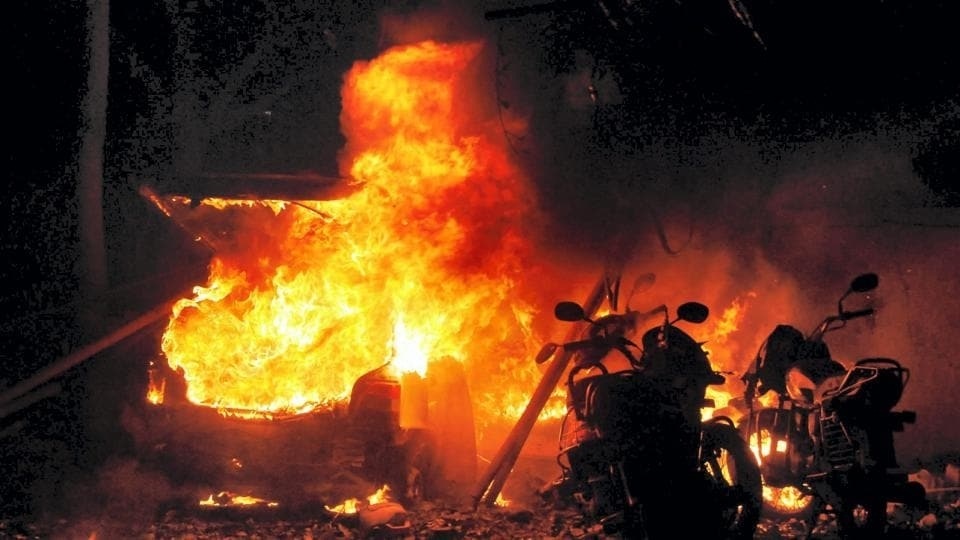
The 49 convicts, which included former Students Islamic Movement of India (SIMI) chief Safdar Nagori, were punished for carrying out 21 blasts that ripped through the city during the busy evening hours of July 26, 2008 within a span of 70 minutes.

In the 7,000-page judgment, judge AR Patel said it was a rarest of rare case, according to public prosecutor Amit Patel.
As per Section 368 of the Code of Criminal Procedure, the entire record of the proceedings will be now sent to the Gujarat high court for confirmation of the death sentences, the court said in its 59-page order on Friday. Till the high court decides on the case, all the accused will remain in jail, the order said.
On February 8, the court convicted 49 of the 77 accused, acquitting 28 people.
The public prosecutor said 38 people were convicted under the Indian Penal Code (IPC) sections 302 (murder) and 120B (criminal conspiracy) and provisions of the Unlawful Activities (Prevention) Act (UAPA). Eleven others were held guilty for criminal conspiracy and under various sections of the UAPA, he said. The court imposed a fine of ₹2.85 lakh on 48 convicts and of ₹2.88 lakh on another one.
The court also awarded compensation of ₹1 lakh to the families of those who died in the blasts, ₹50,000 to those who were seriously injured and ₹25,000 to those who received minor injuries.
The families of the victims said justice was finally done. “I lost my son in the terror attack. There are many like me who have lost their dear and near ones on this fateful day. We have gone through a lot in these 14 years. Today, I can sleep in peace,” said Daxaben Modi, the 64-year-old mother of 18-year-old Ankit Modi, who died in the blasts in the old city area of Ahmedabad.
According to a government lawyer, it was the first time in the history of independent India that so many convicts were awarded the death sentence. In 1998, a Tamil Nadu Terrorist and Disruptive Activities (Prevention) Act court awarded the death penalty to 26 people accused of assassinating Rajiv Gandhi in 1991. “In one case (Rajiv Gandhi assassination), 26 people were given death sentence. But in this case, the number is 38,” said the public prosecutor Amit Patel.
Those awarded the death sentence include key conspirators -- Madhya Pradesh resident and then SIMI chief Safdar Nagori and Qumaruddin Nagori, who provided training to about 50 young men for the blasts in a forest in Kerala, Gujarat residents Qayumuddin Kapadiya, Zahid Shaikh and Shamsuddin Sheikh, who collected funds for buying explosives and carrying out the blasts – according to the police charge sheet filed in November 2008.
All the convicts were present for the hearing via video-conference from different jails in Ahmedabad, Delhi, Bhopal, Gaya, Bengaluru, Kerala and Mumbai.
According to Section 368 of the CrPC, the entire record of the proceedings will be now sent to the Gujarat high court for confirmation of the death sentences. Till the high court decides on the case, all the accused will remain in jail.
On the evening of July 26, 2008, bombs exploded at various spots in Ahmedabad, including the state government-run civil hospital, Ahmedabad Municipal Corporation-run LG Hospital, on buses, parked bicycles, in cars and other places, killing 56 people.
Another 29 live bombs were found in Surat in the next couple of days, though none of them exploded.
The attacks occurred in two waves with explosive devices hidden in lunch boxes and bicycles. The first blast took place near busy shopping centres in Ahmedabad and the second in and around hospitals where the casualties were being taken.
Then Gujarat chief minister Narendra Modi announced compensation of ₹5 lakh for the families of the victims and then prime minister Manmohan Singh ₹1 lakh.
In its investigation, Gujarat Police unearthed a nationwide network of radical elements involved in the blasts. The police said that people associated with Indian Mujahideen, a faction of the banned SIMI, planned the attack as revenge for the 2002 communal violence in Gujarat that killed 1,000 people, many of them Muslims.
The state government transferred the investigation to the Ahmedabad crime branch, under the supervision of the then joint commissioner of police Ashish Bhatia, who is now serving as the Gujarat director general of police.
Bhatia called it a landmark judgment. “The court has set a strict precedent with this judgment,” said CR Paatil, Gujarat BJP chief.
The trial began in December 2009 and concluded in September last year. The court merged 20 First Information Reports ( FIR) in Ahmedabad and 15 in Surat. The prosecution examined at least 1,100 witnesses and marked 26 as star witnesses, whose identities were concealed for their safety.
A total of nine different judges presided over the case. AR Patel, who pronounced the judgment, started hearing the case on June 14, 2017.


