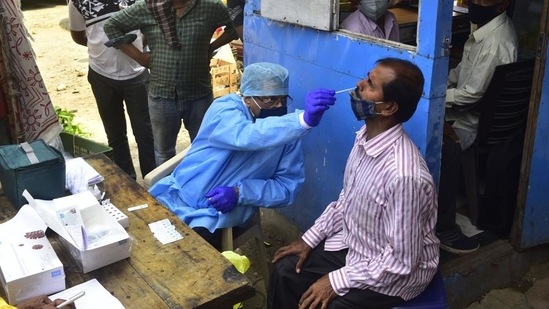
Covid-19 cases case among Odisha tribal group rises, 35 infected
According to the officials, 12 members of the Bonda tribe, known for its secluded lifestyle, have tested positive for Covid-19 since the first case was reported on April 26.
With the second wave of Covid-19 sweeping across rural areas of Odisha, infections among the Particularly Vulnerable Tribal Groups (PVTGs), including the Bonda and Dongaria Kondh tribes, have increased to 35 within a fortnight, officials familiar with the development said on Sunday.

According to the officials, 12 members of the Bonda tribe, known for its secluded lifestyle, have tested positive for Covid-19 since the first case was reported on April 26.
Bondas live in highlands, 3,500-feet above sea level, in Malkangiri, the southernmost district of Odisha. There are about 6,000 Bondas in Odisha.
“So far we have tested 61 Bonda tribals and found 12 positive. Four persons have recovered and the remaining 8 are in home isolation. Health conditions of the affected persons are being closely monitored by our rapid response team (RRT) and required medicines are being given. We are taking all precautionary measures to ensure that the virus does not spread any further,” said Prafulla Nanda, the chief district medical officer in Malkangiri.
Similarly, 23 members of the Dongria Kondh tribe, another PVTG group, have tested positive for the viral disease in Parasali panchayat of Kalyansinghpur block in Rayagada. Kalyansinghpur block development officer, Kalucharan Nayak, said at least four people have recovered from the disease so far, while the remaining are in home isolation. The 10,000-odd Dongaria Kondhs live in 112 villages on the Niyamgiri mountain plateau on Rayagada-Kalahandi border.

ABOUT THE AUTHORDebabrata MohantyDebabrata Mohanty is a senior assistant editor of Hindustan Times who works as state correspondent from Odisha covering the state's politics, governance, public policy, natural disasters, environment and its society for close to three decades. With his long years of reporting from the state capital of Bhubaneswar, Mohanty has been known as one of the most experienced and credible journalists covering Odisha for the national English dailies. His reporting combines on-ground detail with deep institutional knowledge detailing the state's changing politics, governance issues, administrative reforms and the functioning of its public institutions. He has regularly reported on issues ranging from legislative developments and public policy implementation. Politics is his core areas of expertise as he closely tracks Odisha's political landscape, including the rise and transformation of the Bharatiya Janata Party (BJP), the Biju Janata Dal (BJD), the two principal political parties in Odisha. His long association with the state's political establishment enables him to write on contemporary developments in a larger political context. Mohanty takes a deep interest in writing human interest stories, environmental issues and documenting the impact of cyclones, floods, heatwaves, and other climate-related events in one of the most disaster-prone states. His coverage extends to public health, governance reforms and stories on accountability of government institutions. Before joining Hindustan Times, Mohanty worked with The Indian Express, Mail Today, and The Telegraph, where he covered at least six general elections and as many assembly elections. In 2007, he was selected for the prestigious Chevening Young Indian Print Journalist Programme at the University of Lincoln, United Kingdom, where he received advanced training in print journalism. In 2009 he won the Press Institute of India-International Committee of Red Cross award on conflict reporting for his on-ground reportage of 2008 Kandhamal riots.Read More

E-Paper