E-Paper



Create Global Traditional Knowledge Repository under G20 framework: PM Modi
The creation of the ‘Global Traditional Knowledge Repository’ under the G20 framework to preserve and share humanity’s collective wisdom to future generations was one of the key proposals highlighted by Prime Minister Narendra Modi at the 20th G20 Summit at Johannesburg in South Africa on Saturday.

 Prefer HTon Google


The creation of the ‘Global Traditional Knowledge Repository’ under the G20 framework to preserve and share humanity’s collective wisdom to future generations was one of the key proposals highlighted by Prime Minister Narendra Modi at the 20th G20 Summit at Johannesburg in South Africa on Saturday.
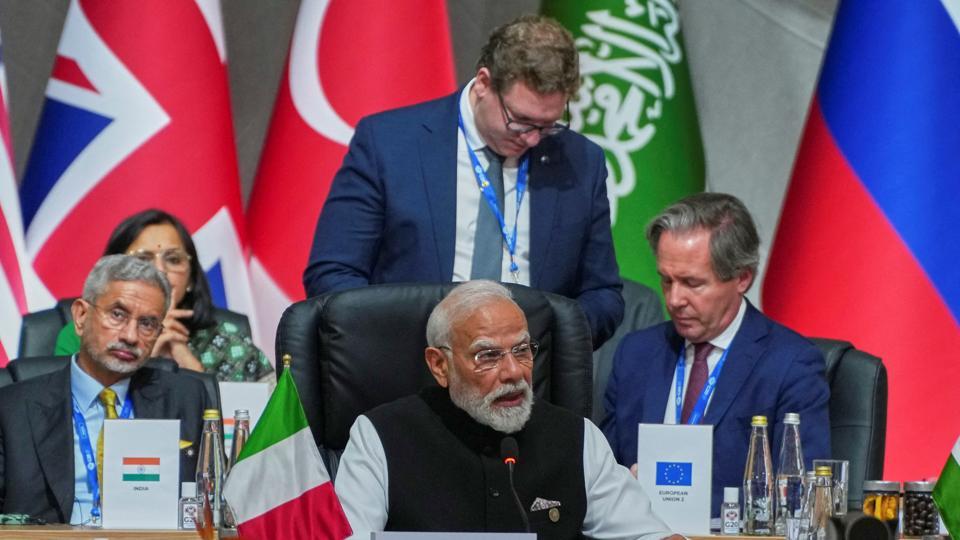
India’s Indian Knowledge Systems (IKS) initiative could form the foundation for the proposed platform, he said.
“There are many communities in the world that have preserved their traditional and eco-balanced lifestyles. These traditions not only reflect sustainability, but also embody cultural knowledge, social cohesion, and a deep respect for nature. India has proposed that a Global Traditional Knowledge Repository be created under the G20 framework. India’s own Indian Knowledge Systems initiative can serve as its foundation. This global platform will help pass the collective wisdom of humanity on to future generations,” Modi said at the first session of the Summit.
In line with National Education Policy 2020, which calls for integrating India’s traditional knowledge into mainstream education, the Union ministry of education established IKS division in October 2020. IKS focuses on incorporating subjects like Vedic mathematics, Ayurveda, yoga, and ancient Indian sciences into school and university curricula while promoting India’s indigenous knowledge traditions and their contemporary relevance.
The G20 Leaders’ Declaration adopted in South Africa has also placed education and knowledge systems at the heart of its cooperation goals, saying leaders remain committed to ensuring that “no one is left behind” through solidarity and multilateral action. Leaders note they “share a vision to harness science, technology, entrepreneurship, and Indigenous and local knowledge… to unlock new pathways to prosperity, leaving no one behind”
The declaration states that reducing inequalities in producing and accessing knowledge is a key priority. The declaration “reiterates that research and innovation should… promote the participation of women and girls in Science Technology Engineering and Mathematics (STEM), and reduce global inequalities and asymmetries in the access to and production of knowledge.”
On foundational learning, G20 leaders agree that they “will advance a comprehensive approach to Early Childhood Care and Education (ECCE)” and address shortages “especially in early and basic education,” while improving digital access and infrastructure. Leaders also reaffirmed plans to “bridge digital divides, including halving the gender digital divide by 2030” and recognising the “transformative potential of digital public infrastructure” for equitable access.