E-Paper



Culture of freebies for votes dangerous: PM Modi in UP's Jalaun
The Prime Minister used the term ‘revadi’, a popular north Indian sweet often distributed during festivals, as a metaphor for freebies being promised by various political parties to grab power.

 Prefer HTon Google


Prime Minister Narendra Modi on Saturday cautioned people against those who try to attract votes by distributing ‘free revadis’ (freebies) and said the practice was harmful for the country and has to be wiped out from politics.
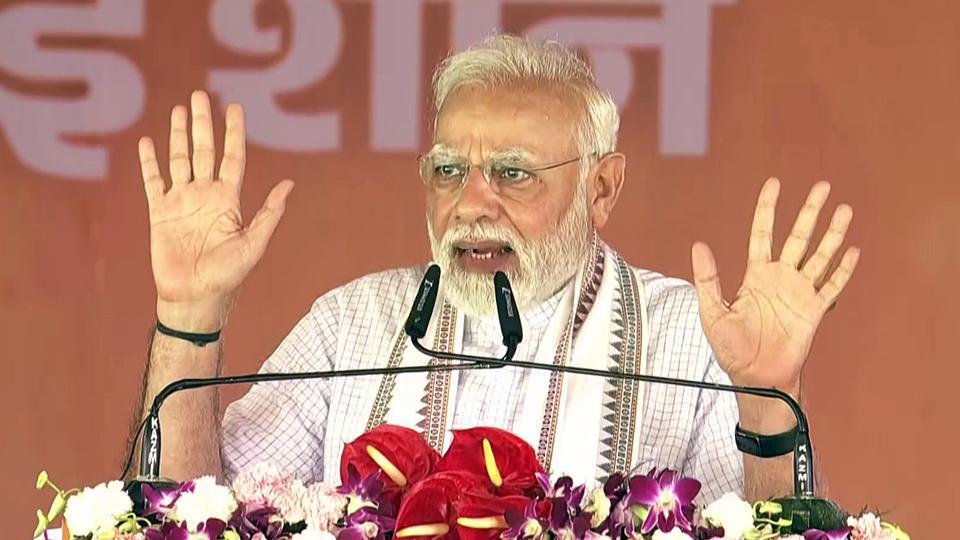
The Prime Minister was addressing a public gathering near Uttar Pradesh’s Katheri village after inaugurating the 296-km four-lane Bundelkhand expressway.
“The ‘revadi culture’ is very dangerous for the development of the country,” Modi said, calling upon youngsters to not fall for this culture.
The Prime Minister used the term ‘revadi’, a popular north Indian sweet often distributed during festivals, as a metaphor for freebies being promised by various parties to grab power.
“Those behind this ‘revadi culture’ do not believe in building expressways, airports and defence corridors. Together we have to defeat this thinking and remove this culture from politics,” he said.
He added that the double engine governments, wherever they are, believe in taking a longer route and working hard for the people.
He lauded the Yogi Adityanath government and said under his leadership, the state was undergoing a major transformation in law and order, and connectivity was fast improving.
Modi, who hit out at the previous governments for not working for Uttar Pradesh, said during the past eight years, he had realised that if two issues, law and order and connectivity, were sound the state can face challenges and fight off all odds.
“The way the Yogi government has changed the picture of the state is remarkable. Law and order and connectivity have vastly improved,” he said.
The Bundelkhand expressway which has been built at a cost of ₹14,850 crore, will connect Chitrakoot with Lucknow-Agra expressway near Etawah. “This expressway will not only give speed to vehicles but also accelerate the industrial progress of the entire Bundelkhand,” the PM said, adding it was the gateway to many opportunities.
He said earlier, the big cities had the right to modern ways of transport. The scenario has changed as the Modi-Yogi governments take development not merely to cities but also to villages.
In the past eight years, his government had not focused on big cities but had been connecting the smaller towns and cities. The development model pursued was inclusive, he said.
The Prime Minister said the Bharatiya Janata Party (BJP) governments followed the deadlines and completed the projects well before time. “The Kashi Vishwanath beautification was started by our government and completed by us. Meerut expressway’s foundation stone was laid by us and inaugurated by us. Bundelkhand expressway was completed in eight months before the deadline that was February next year,” he said.
The double-engine government had put the state in the race towards growth and prosperity for all citizens. Not only surface connectivity but air links will also be available in many smaller cities soon, he said.
He asked chief minister Yogi Adityanath to build a tourism circuit in Bundelkhand which was dotted with forts on both sides of the expressway and was a repository of culture and heritage. “People in Europe visit forts in large numbers. The same can be replicated in Bundelkhand and the tourism will add to growth,” he said.
Fulfilling the dreams of India’s youngsters was the goal and resolve of his government, he said, adding the houses, toilets and modern facilities that the poor people were getting was a kind of social justice. He said Bundelkhand, which the previous governments considered backward and gave up for seven decades, has been linked with fast paced development, making social justice stronger and benefiting the people.
He also called upon the people to chalk out a plan for a month-long celebration of ‘Azadi Ka Amrit Mahotsava’ in every village.