The ban on construction work and offline classes in Delhi was extended to all cities falling in the National Capital Region (NCR) and trucks carrying non-essential supplies will not be allowed to enter the national capital, the Commission on Air Quality Management announced late on Tuesday, after officials scrambled for ways to battle the air pollution crisis nearly two weeks after hazardous conditions first set in over the region.
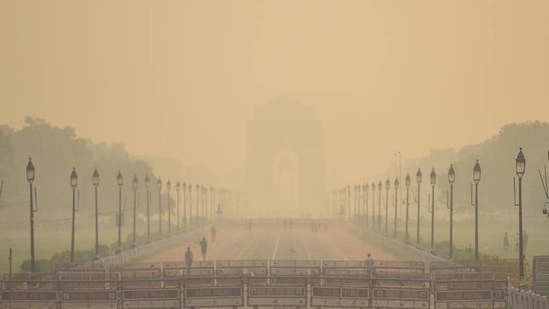
The CAQM, states government officials and agencies held a meeting earlier in response to a 24-hour deadline set by the Supreme Court on Monday to meet and prepare a list of urgent action that can be taken, and came as weather forecasters predicted meteorological parameters to remain such that pollution may not naturally be blown away for at least 10 more days.
Also read | Delhi asks Centre to clarify data in SC affidavit on stubble fires
In an order issued late in the night, CAQM cited predictions by the India Meteorological Department that show the air quality was likely to remain in very poor category till at least November 21 to issue a slew of new directions.
The orders, in addition to the ones above, mention a strict enforcement of the ban on diesel-generator sets and the closing of schools and colleges for in-person classes indefinitely. Industries using fuel are only allowed to run if they use gas, or will need to close, and six of 11 thermal plants in 300km of radius of Delhi will have to stop functioning till November 30.
{{/usCountry}}The orders, in addition to the ones above, mention a strict enforcement of the ban on diesel-generator sets and the closing of schools and colleges for in-person classes indefinitely. Industries using fuel are only allowed to run if they use gas, or will need to close, and six of 11 thermal plants in 300km of radius of Delhi will have to stop functioning till November 30.
{{/usCountry}}Authorities in NCR “shall ensure that no vehicle of more than 10 years (diesel) and 15 years (petrol) are found plying on the road”, it added.
Also read | ‘Pollution-related’: Pvt hospital in Delhi’s diagnosis for respiratory problems
Chief secretaries of each NCR state have been asked to submit a compliance report of all these activities on November 22, the order reads.
Air pollution in Delhi, meanwhile, rose back into the severe category with the AQI reaching 403 at 4pm on Tuesday. Since November 5, the day after Diwali, the air quality in the capital has been in the severe category for seven days, and very poor for the remaining four. This period has seen hospitals record a spurt in people coming in with respiratory diseases, with some now officially diagnosing it as pollution-related ailments in order to draw attention.
The central ministry and the states of Delhi, Punjab, Haryana and Uttar Pradesh as well as their pollution control boards, attended the meeting.
Delhi environment minister Gopal Rai later said that the state government suggested the curbs implemented in Delhi be extended to other NCR states.
“In the meeting, on behalf of the people of Delhi, we proposed that work-from-home be implemented, all construction work and industries in the Delhi-NCR region be shut for the meantime. The other states presented their proposals too and the final decision and minutes of the meeting are still awaited,” said Rai.
According to a person who asked not be named, the Delhi government also suggested a temporary ban on heavy vehicles not carrying essential supplies.
A senior Haryana Pollution Control Board official that they have volunteered to temporarily shut down all industries that are not operating on Piped Natural Gas (PNG) and also suggested that in order to bring down pollution levels, two of the biggest thermal power plants of the state, located in Panipat, can also be temporarily shut down.
“In the coming days we will also start a major crackdown against all aged diesel (over 10 years) and petrol (over 15 years) vehicles. We are also requesting corporate houses to encourage work from home, so that vehicular emissions can be controlled,” the Haryana official said, asking not to be named.
According to the first official, the CAQM was also briefed by the India Meteorological Department, which said weather conditions are likely to remain unfavourable at least for the next 10 days, which meant stringent pollution control measures will have to be taken by all NCR states.
The Supreme Court on Monday pulled up the Union and several state governments – Delhi, Punjab, Haryana and Uttar Pradesh included – for the continuing crisis in NCR. The judges gave 24 hours for them to hold an emergency meeting and prepare a list of urgent steps that can be put in place immediately to bring down the levels of pollution in the “forseeable future”.
But multiple experts believe steps such as lockdowns and post-facto measures in response to the crisis, will achieve little, causing major economic disruption, and triggering an emissions rebound once they are rolled back.
“First and foremost there is no difference in air pollution levels even after the air quality commission is established. With so much fanfare, the Centre established an air quality commission (CAQM) but we don’t know what directions they have issued. They are not under the air or water act but the Commission is a law passed by parliament which has independent power to issue directions and take action against air pollution,” said Ritwick Dutta, environmental lawyer.
“The commission has said no construction but we don’t know if even a single action has been taken. There is no will to police. They are not like the Pay Commission. They are a statutory body with power to police. The Grap (graded response action plan) is very clear on what interventions should be made when air pollution has crossed a particular threshold but now they are not even debating the odd-even scheme. Same drama continues every year,” Dutta added.
On Monday, experts warned against steps like lockdowns, one of the steps suggested by the court. “It will set a terrible precedent, and show that we are not able to handle the spikes in pollution at this time of the year. We also cannot judge the meteorological factors that will be at play, even if a lockdown is imposed,” said Santosh Harish, fellow at the Centre for Policy Research (CPR), told HT on Monday.
The Supreme Court is scheduled to hear the matter on Wednesday.