E-Paper



Number theory: How have El Nino and delayed onset affected monsoon in the past
An analysis of the 19 El Niño years shows that there was a deficit in monsoon compared to the 1961-2010 Long Period Average in 15 of them.
Updated on: Jun 9, 2023, 18:13:06 IST

 Prefer HTon Google
Share via


Copy link

The India Meteorological Department (IMD) considers June 1 as the normal date of the onset of monsoon in India. This is the date on which monsoon rains have arrived on the Indian mainland (on the coast of Kerala) on average in the past. This year, monsoon rains have not started on the Kerala coast even on June 6. Can a delayed onset create a deficit in monsoon? This question is especially important this year because forecasts expect monsoon months to be affected by El Niño, a warming of the tropical Pacific Ocean that decreases monsoon rains. It could, though a HT analysis suggests that the relation between monsoon onset, El Niño, and monsoon performance, is not straightforward. Here are three charts that explain this.
The charts thaṭ matter
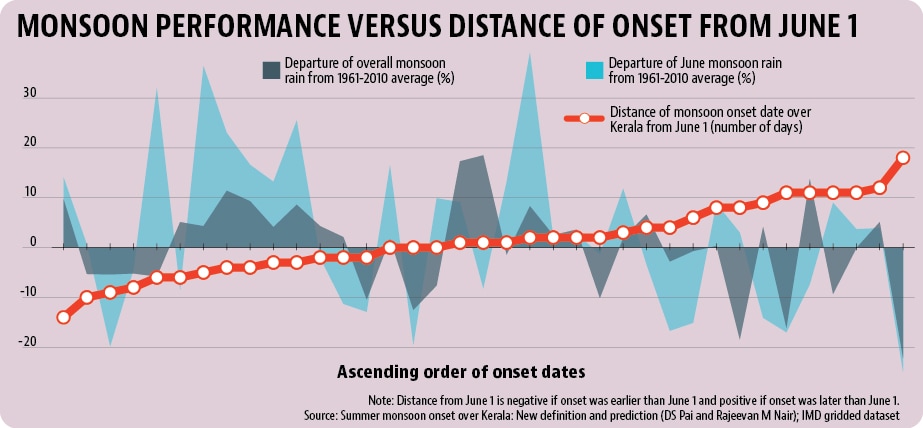
 A delay in onset is not a cause for worry in itselfThere is reason to suspect a relation between the monsoon onset date and its performance . A depression in the Southeast Arabian Sea, which has delayed the onset of monsoon, can affect rains this month depending on how the depression develops into a cyclonic storm. IMD has forecast that June rain overall for the country and overall monsoon rain from June to September for northwest India will be less than 92% of the 1971-2020 average or the Long Period Average (LPA) . This is considered “below normal” rainfall under the current IMD classification. This forecast when read with the delay in onset over Kerala might suggest a relation between the two. However, a HT analysis suggests that this has not been the case in the past. An analysis of monsoon rains from 1971 to 2007 shows that the distance of the onset date from June 1 has no correlation with either the overall monsoon performance or with its June performance. For example, monsoon rain was more than the LPA in 58.8% of the years when monsoon arrived over Kerala before June 1 and in 55% of the years when it arrived after June 1. This suggests that a surplus or deficit in monsoon is almost equally likely if onset over Kerala is delayed. HT analysed the 1971 to 2007 period because this is the period for which the onset date (by the objective criteria in use since 2006) is available from “Summer monsoon onset over Kerala: New definition and prediction,” a research paper by climate scientists DS Pai and Rajeevan M Nair.
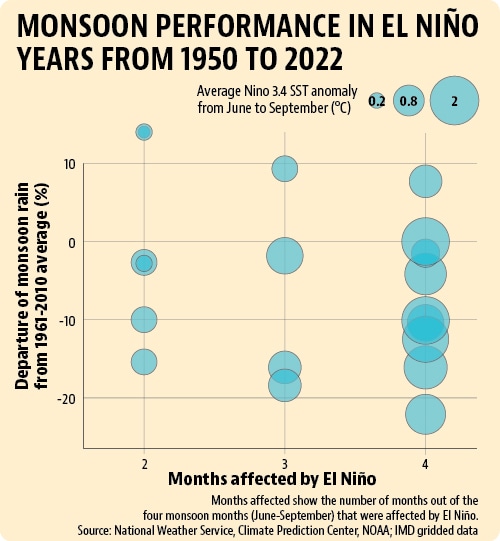
- El Nino has a bigger chance of disrupting monsoonWhile onset dates have not been related with monsoon performance in the past, the temperature in the equatorial Pacific has some correlation. The metric that shows this correlation is the sea surface temperature (SST) deviation in the Niño 3.4 region (5oN-5oS, 120o-170oW). When the three-month rolling average of this temperature deviation is a warming of 0.5 degrees Celsius (°C)for at least five consecutive months, that entire period is termed El Nino. When that average is a cooling of 0.5°C for at least five consecutive months, that entire period is termed La Nina. To be sure, this means both of them can affect different parts of the June-September monsoon. However, since 1950 (the earliest year for this data was readily available from NOAA), that has happened only in 1998, when June was affected by El Nino and August and September were affected by La Nina. HT has considered 1998 a La Nina monsoon. An analysis of the 19 El Nino years shows that there was a deficit in monsoon compared to the 1961-2010 LPA in 15 of them. To be sure, monsoon would be considered “deficient” only if there was a deficit of at least 10%. That was the case in only nine of 19 El Nino years. On the other hand, two of the four surplus years had a surplus of more than 10%, a criteria that would put the year’s monsoon in the “excess” category. This suggests that while a deficit is usually likely during El Nino, it is equally possible for the deficit to remain within the bounds of a “normal” monsoon as IMD has forecast for monsoon 2023. Still, with almost 80% of El Nino years resulting in a deficit and almost 50% seeing “deficient” rainfall, the correlation between El Nino and the monsoon is pretty strong.
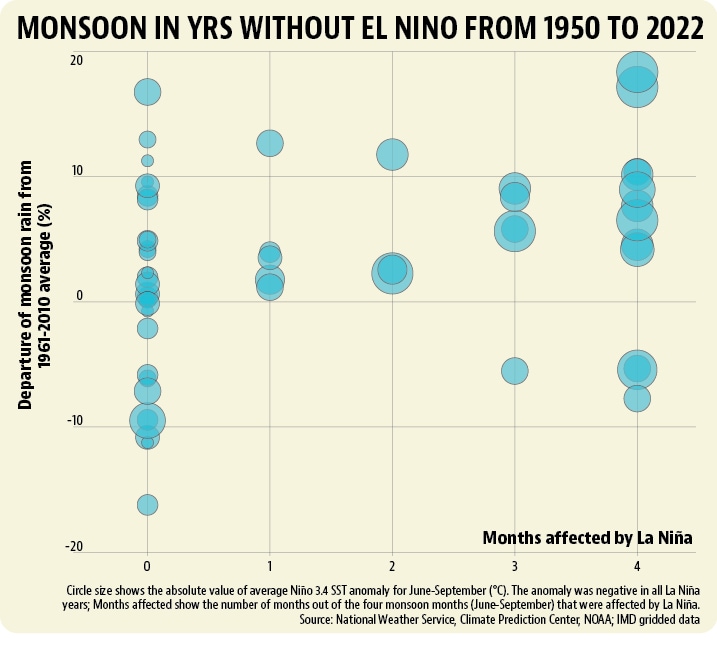
- A monsoon deficit is less likely in a non El Nino yearThe strength of this correlation is evident in the fact that only four of 25 years of La Nina (16%) and only 11 of the remaining 25 years since 1950 seen deficient rainfall. There has been no La Nina year since 1950 when the deficit was more than 10% and there are only three years when there has been no El Nino or La Nina that the monsoon rains have seen a deficit. Clearly, temperature deviations in the equatorial Pacific are a powerful driver of monsoon performance. However, as the previous sections shows their influence is not always powerful over everything else -- which means there is an equal chance of Monsoon 2023 being normal.