
 E-Paper



‘Delhi AQI crossed 3,000’: AAP's Saurabh Bharadwaj alleges ‘AQI data fraud’ by government
His allegations follow reports that many monitoring stations stopped reporting on Diwali night, while functioning stations recorded severe air quality.

 Prefer HTon Google


As Delhi continued to choke a day after Diwali, Aam Aadmi Party (AAP) leader Saurabh Bharadwaj accused the government of “AQI data fraud”, alleging that pollution readings were being manipulated to bring down the city's overall air quality index (AQI).
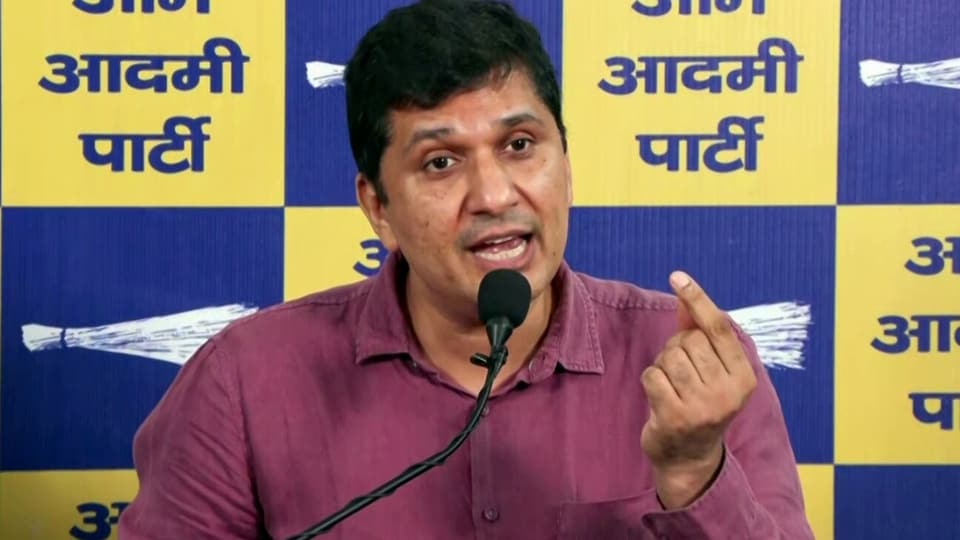
In a video shared on X, Bharadwaj claimed that the government had installed 20 new monitoring stations in open areas surrounded by greenery and was sprinkling water around stations in heavily polluted localities to lower their readings.
'Everyone is involved in this fraud': Bharadwaj
Bharadwaj alleged that the measures were aimed at lowering Delhi's average AQI. He claimed that water was being continuously sprinkled around the Jahangirpuri monitoring station to bring down its readings.
Deep Dive

Questioning the credibility of the government's pollution data, he asked how citizens could trust a government that allegedly manipulated AQI figures and shut down monitoring stations on Diwali night. He also accused the government of “vote chori”, “Ram Mandir chori”, “GDP data chori” and, now, “AQI data fraud”.
ALSO READ | New stations on periphery may be clouding AQI data in Delhi, HT analysis shows
Bharadwaj said he had repeatedly raised the issue with the Commission for Air Quality Management (CAQM) and the Central Pollution Control Board (CPCB) through letters, but alleged that the manipulation continued.
“Everyone is involved in this fraud,” he said.
Speaking to ANI, Bharadwaj questioned the authenticity of official pollution readings.

“People do not trust the Govt AQI; I, for one, do not trust it... Last night, several areas in Delhi had an AQI of more than 3000,” he said.
He urged authorities to take responsibility and disclose accurate pollution levels, warning that misleading data could put vulnerable sections of the population at risk.
“Take responsibility and present the true AQI to the public, or else vulnerable citizens—the sick, the elderly, and children—could lose their lives,” he added.
More than half the stations went dark on Diwali night
More than half of Delhi's air quality monitoring stations stopped reporting data around midnight on Diwali night, HT reported. The stations that continued operating recorded AQI levels above 400, indicating ‘severe’ air quality.
Nearly 80% of the functioning stations reported ‘severe’ air quality between 10 pm on Diwali and 6 am the following morning.
ALSO READ | On Diwali night, Delhi's PM2.5 readings climbed towards 1,000, then went blank
At 9 pm on Diwali night, the last available reading before the number of reporting stations dropped sharply, 61% of the 57 stations reporting data had recorded an AQI of 400 or above.
New stations may be altering Delhi AQI data: HT analysis
An HT analysis of CPCB data found that 13 newly installed AQI monitoring stations on the city's periphery may be affecting Delhi's overall pollution readings.
On November 6, Delhi's recorded AQI stood at 382. However, without the readings from these newly installed stations, the AQI would have been 393, or 11 points higher.
Delhi's AQI remains ‘very poor’ after Diwali
Delhi's average AQI stood at 366 at 6:15 am on Monday, in the ‘very poor’ category, according to the CPCB's Sameer app and HT Pollution Dashboard. The city's average AQI was 376 on Diwali, compared with 369 a day earlier.
According to the HT Pollution Dashboard, Sonia Vihar recorded the highest AQI at 463, followed by Burari Crossing at 452, Jahangirpuri and Vivek Vihar at 447 each, Rohini at 442 and Delhi University's North Campus at 440.
Several other locations also recorded AQI levels in the ‘severe’ category. These included DTU (436), Bawana (431), Chandni Chowk (423), Patparganj (419) and NIH Narela (410).


