E-Paper



Delhi's water crisis enters third day, work at key canal stopped
Delhi Jal Board (DJB) officials said the crisis prompted an urgent decision to suspend maintenance and revert water flow to what is the regular channel.


New Delhi: Authorities called off maintenance work on a key supply canal on Friday to restore normal water flow routes, officials said, after a spike in river pollution forced treatment plant shutdowns that have left large parts of the city without water for three consecutive days.
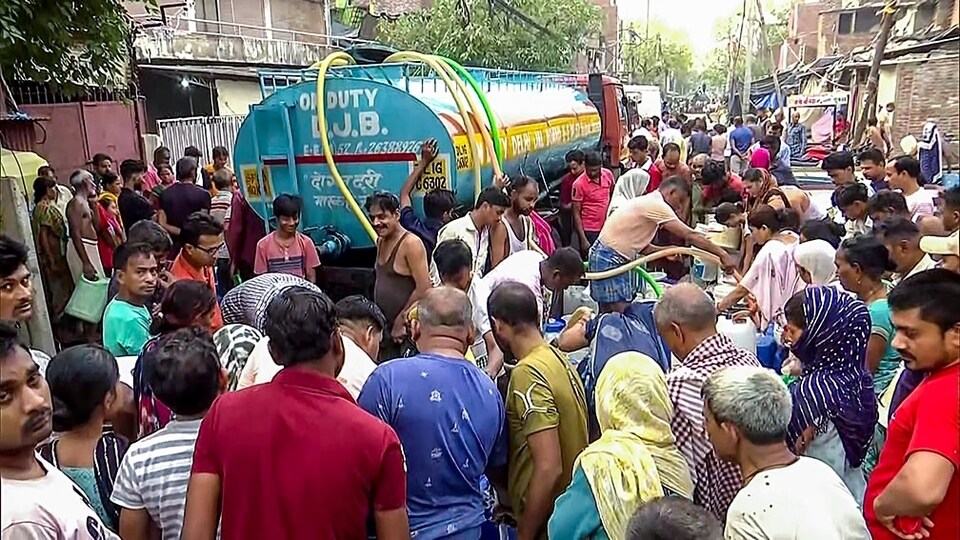
The supply disruption, which has hit neighbourhoods in north, west and northwest Delhi, was triggered by high ammonia levels in the Yamuna river, which resulted from planned repair work on the Munak canal.

Delhi Jal Board (DJB) officials said the crisis prompted an urgent decision to suspend maintenance and revert water flow to what is the regular channel.
“A temporary maintenance-related diversion was undertaken on a section of the canal network, for which Delhi was requested to receive its water share through alternate channels. During this diversion, water flow from Khubru towards the Yamuna increased, leading to a sudden spike in ammonia levels, which affected raw water availability for treatment in Delhi and resulted in temporary water scarcity,” said a DJB official said, asking not to be named.
High ammonia loads prevent treatment plants from functioning effectively, forcing the temporary closure of the Wazirabad and Chandrawal facilities, which together supply around 200 million gallons per day (MGD).
The shortage has forced residents to rely on alternative sources.
“We did get some water supply, but not as much as we usually do,” said Ashok Bhasin, president of a federation of North Delhi Residents’ Welfare Associations. “Later we got to know from DJB people that they have diverted the supply from somewhere else... this is only a temporary solution.”
In Burari, residents reported receiving no supply for a third day.
“While most of the residents here have hand pumps outside their houses, the groundwater is very dirty,” said Narayan Dutt Sanwal, president of a Burari resident welfare association. “For drinking water, they have to keep buying bottles, which is expensive.”
Similar shortages hit Adarsh Nagar and Indira Vikas Colony. Monika Singh, a resident of the latter, said her locality had gone 24 hours without water. “If this is the situation in the country’s capital during winters, what will happen in the summers, when more water cuts happen?” she asked.
Officials said the situation is expected to stabilise by Saturday morning as ammonia levels recede and the Wazirabad plant resumes operations. However, the board also issued an advisory for separate water cuts on January 24, 27 and 28 due to an annual flushing programme for underground reservoirs.
The crisis has ignited a political row. The Aam Aadmi Party (AAP) accused the administration of mismanagement, with AAP Delhi president Saurabh Bharadwaj stating that shutting the Munak canal during a period of rising ammonia was a “major mistake”.
“Industrial pollution from Haryana had led to the ammonia spike and the government failed to plan maintenance schedules around predictable seasonal water vulnerabilities,” Bharadwaj said.
Virendra Sachdeva, the Delhi president of the Bharatiya Janata Party (BJP), dismissed the allegations, defending the administration’s response.
“Two days ago, as soon as the ammonia level in the Yamuna increased, Delhi’s water minister Parvesh Verma instructed officials of the DJB to speak with Haryana officials,” Sachdeva said, adding that Verma had ordered the halt to repair work.
Delhi’s nine water treatment plants treat 865MGD altogether.
Gurugram supply affected too
Meanwhile, supply was also affected on Friday in neighbouring Gurugram along Southern Peripheral Road (SPR) after a 1,600 mm master water pipeline got damaged and started leaking water on one of the service lane of Sohna road near Subash Chowk on Thursday.
To repair the pipeline, the Gurugram Metropolitan Development Authority (GMDA) started digging the service lane on Thursday evening following which traffic slowed down on Sohna road and heavy congestion was caused near Subash Chowk till Friday afternoon.
“The repair work took time and it was delayed further due to rain early on Friday morning. The pipeline was repaired by 9.30 am and water supply was resumed,” said a senior GMDA official.
Rakesh Bhardwaj, an official of Oriental Engineering, which maintains the Sohna highway said GMDA had dug up the road to repair the pipeline and traffic was restored on the service road in the afternoon.