
 E-Paper



Delhi’s air quality index in severe category on Wednesday morning, curbs continue
As per IMD, the city woke up to shallow fog in the morning and the sky will partially clear towards towards afternoon and evening

 Prefer HTon Google


New Delhi:
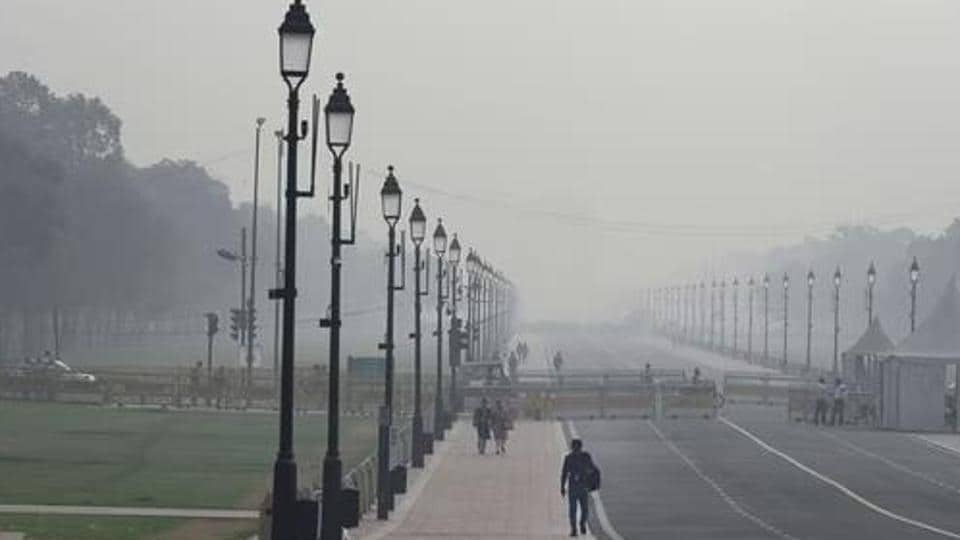
Delhi’s pollution level was in the severe category on Wednesday morning with the air quality index (AQI) of 420 recorded at 8am by the Central Pollution Control Board (CPCB). At 11am, the city recorded an AQI of 424, and the air quality continues to remain in the Severe category.
The city woke up to shallow fog with mist in the morning and the general visibility was at 800 metres at 8am, according to the India Meteorological Department (IMD). Delhi’s 24-hour average AQI was recorded at 395 (very poor) at 4pm on Tuesday and a downward trend was observed overnight.
As per the IMD report, the city woke up to shallow fog in the morning and the sky will partially clear towards afternoon and evening. The maximum and minimum temperatures would be around 31 and 16 degrees Celsius, respectively, the IMD said.
The prominent pollutants in the capital’s air are PM2.5 and PM10. Punjabi Bagh area in West Delhi is currently the most polluted region with an AQI of 466. The most polluted areas in Delhi at 11am were Punjabi Bagh (466), Bawana (465), Jahangirpuri (461), Narela (458), Rohini (458) and Anand Vihar (454).
Out of the 35 air quality monitoring stations spread across the city, only six stations are in very poor range (AQI 301 and 400). The lowest levels of AQI are being recorded in East Delhi’s Dilshad Garden with AQI 316 followed by Alipur at 354 and Lodhi road with an index of 374.
Delhi’s air quality was back in the ‘very poor’ category for a few hours on Tuesday, before turning back to the ‘severe’ category after the wind direction shifted to northwesterly in the last 24 hours, bringing stubble intrusion towards the Capital. Delhi’s 24-hour average AQI was down to 392 (very poor) at 2pm, before deteriorating to 395 (very poor) at 4pm and further deteriorating to 402 (severe) at 7pm.
Data from the Decision Support System (DSS) showed an estimated contribution of stubble burning to Delhi’s air pollution to be around 33.07% on Wednesday down from 37.8% on Tuesday. Delhi’s transport sector was the next biggest contributor, with an estimated share of 12.64% in Delhi’s PM 2.5 concentration. The biggest pollutants in Delhi’s air continue to be PM2.5 and PM10.
Also Read: Odd-even mere optics, says SC; Delhi govt waits for order to spell scheme rules
Forecasts by the Early Warning System (EWS) for Delhi show AQI is likely to improve back to ‘very poor’ on Thursday, due to the impact of much stronger winds, all the way until Saturday. The IMD has said there is a possibility of a drizzle in Delhi on November 10.
Kuldeep Srivastava, scientist at IMD, said Delhi recorded wind speeds between six to eight km per hour between 10am and 6pm on Tuesday. “We can then expect a gradual increase in wind speed from Thursday as the western disturbance comes closer and there are chances of isolated drizzle on Friday. By Saturday, wind speed can touch 15 km/hr,” he said.
Delhi recorded a maximum temperature of 31.7 degrees Celsius – two degrees above normal. The minimum 14.9 degrees, a degree above normal. The approaching western disturbance is expected to raise minimum temperature further – to around 17 degrees Celsius by Friday. The maximum, however, will continue to remain around 30-31 degrees Celsius, the IMD said.
Measures under stage 4 of the Graded Response Action Plan (GRAP) continue to remain in place on Wednesday. Curbs under stage 4 were introduced by the (CAQM) on Commission for Air Quality Management Sunday evening. The measures under it include a ban on diesel light commercial vehicles that are registered outside Delhi and are non BS VI, from entering the capital. Similarly, there is a ban on entry of trucks into Delhi, alongside a ban on plying of all diesel-Medium Goods Vehicles (MGV) and Heavy Goods Vehicles (HGV) in the capital. Under this category, all linear construction projects such as highways, roads and flyovers have also been stopped.
On Tuesday, the Supreme Court questioned the Aam Aadmi Party government’s odd-even car rationing scheme’s effectiveness in Delhi and termed it “all optics”.
The top court, which was hearing a matter relating to debilitating air pollution in the Delhi-National Capital Region (NCR), asked the Delhi government’s counsel whether the odd-even scheme had succeeded when it was implemented earlier.
The court also directed Punjab, Haryana, Uttar Pradesh and Rajasthan to ensure crop residue burning was stopped “forthwith”, saying it cannot let “people die” due to pollution.
On Wednesday morning, officials and technicians were seen working at the non-operational smog tower located near Connaught Place. The minister said the central govt has imposed a new law on Delhi to snatch the rights of elected government and the situation is now different. “Earlier too we had written to CM (chief minister) and LG (lieutenant governor) regarding smog tower and real time source apportionment study. Disciplinary action must be taken in this case. The smog tower was set up as per the Supreme Court order but neither the court nor the cabinet was informed before closing it,” he added.
Meanwhile, environment minster Gopal Rai has called a joint meeting of the minister and senior officials at the Delhi secretariat on Wednesday for the implementation of the order issued by the Supreme Court on Tuesday. Rai said that during the meeting, the implementation of steps and observations of the court that need to be taken by Delhi will be taken up. “The Supreme Court has asked all states to stop stubble burning and hold high level meeting. Whether Punjab or Haryana, everyone should act to reduce stubble burning,” he added.
Rai said that all states will have to cooperate. “All governments will have to cooperate to reduce air pollution. If crackers are not burst in Delhi and they continue in the neighbouring states, the smoke will reach here. The pollution contribution of the other states is double our internal sources,” he claimed.


