
 E-Paper



'Demolitions can’t be retaliatory action': SC tells UP govt to act with sensitivity
The bench, which was hearing two applications filed by Muslim body Jamiat Ulama-i-Hind asking that the Uttar Pradesh government be restrained from any further demolition of properties of people allegedly involved in any protest or riots.


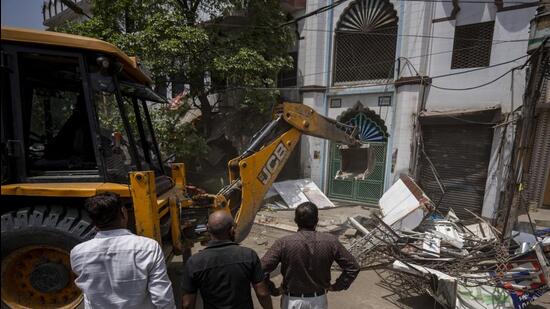
Demolition of properties must take place in accordance with the law and not as a retaliatory measure, the Supreme Court said on Thursday while seeking replies from the state of Uttar Pradesh and municipal authorities of two of its cities where bulldozers razed properties of people accused of allegedly participating in violent protests against remarks by two Bharatiya Janata Party (BJP) leaders on Prophet Mohammed.
“We are conscious that no demolition can take place without notice and following due process... everything should look fair. People must have confidence when the matter is before the highest court of the land... It should not be done without following the due process. Our concern is that the rule of law must be followed in every case,” remarked a bench of justices AS Bopanna and Vikram Nath, fixing Tuesday as the next date of hearing.
The bench, which was hearing two applications filed by Muslim body Jamiat Ulama-i-Hind asking that the Uttar Pradesh government be restrained from any further demolition of properties of people allegedly involved in any protest or riots in the aftermath of certain contentious statements made by BJP leaders, urged the state government and its authorities to “act with sensitivity”.
The court’s observations are significant: over the past few years, the governments of several states have bought into the trend of demolishing properties of those believed to be involved in riots, violent protests, or unlawful activities. In some cases, the demolitions have been carried out even before proof of guilt has been established, but experts point to a larger concern — even the properties of those proven guilty can be demolished only if they have flouted building or property laws, and then too, after due process is followed and adequate notice has been given.
In this case, at least four properties were demolished by authorities in Kanpur, Prayagraj and Saharanpur after violent protests, against now suspended BJP spokesperson Nupur Sharma and expelled BJP leader Naveen Jindal for their remarks on Prophet Mohammed, rocked these cities on June 3 and June 10. Forty-nine people, including 20 police personnel, were injured in the violence; over 350 people have been arrested so far.
“Demolitions can only happen in accordance with the provisions of the Act and not as a measure of retaliation... We are sensitive to this issue and we are saying they (authorities) should also be sensitive to this. We are also citizens of this country,” the bench told solicitor general Tushar Mehta and Harish Salve, who represented the state government and the municipal bodies of Prayagraj and Kanpur respectively.
On their part, Mehta and Salve maintained that no particular community was targeted in the demolition, and that prior notices were issued in each case. According to them, due process was followed when actions were taken against one property in Prayagraj and two in Kanpur, which formed the basis of the complaint by Jamiat before the top court.
The lawyers further urged the court not to pass any generic order against demolitions, especially when the pleas before the Supreme Court were not filed by the individuals affected by the action but by an “omnibus organisation” that does not have any personal knowledge of show-cause notices or the procedure followed in each case.
The bench, however, retorted that it may not be possible for all individuals to approach the apex court, and that it would not let the technicalities stand in the way of the issues concerning the due process.
“We also keep seeing...we are also parts of society. We also see what’s happening. Sometimes, we have also formed some impressions. In someone’s case of grievance, if this court doesn’t come to rescue, that wouldn’t be proper. Everything should look fair...Ultimately, when someone has a grievance, he has a right to have it addressed,” it added.
Senior advocates CU Singh and Nitya Ramakrishnan, appearing for Jamiat, requested the bench to issue some interim orders to ensure authorities refrain from employing bulldozers as a part of criminal action against those involved in protests or named in the cases of violent protests. The two lawyers called it a “curious coincidence” that demolitions were carried out against those who were named in the cases related to the recent protests over BJP leaders’ comments. Singh claimed there were statements made by high constitutional functionaries, including UP chief minister Yogi Adityanath, that bulldozers will be used to teach lessons to such protesters.
Salve, at this point, assured the court that the judges’ concerns over demolition action before the next date of hearing have been duly noted and that the authorities concerned shall be apprised of it.
“Allow us to bring everything on record through an affidavit within three days. There are three instances they (Jamiat) have cited in their applications. In the first case relating to Prayagraj, the show-cause notice was issued on May 10, fixing a personal hearing on May 22 which is much before the riot. The demolition order was passed on May 25 and the property was fairly valuable. So, this cannot be a case where the individual concerned was not able to approach the court himself or herself,” he said.
Defending the demolitions in Kanpur as well, Salve contended that a show-cause notice was issued to one of the property owners in August 2020 while a boundary wall was partly brought down in the second case after serving notice. “Media picks this up and connects it to something else and hype is created. But we will place everything on an affidavit. Why should a generic order be passed?” the senior lawyer argued.
Mehta added that someone who has contravened laws in raising structures should not get refuge under any order of the court and that the procedure was followed in every case of demolition in UP. The SG too resisted issuance of any generic order at this stage.
Even as the bench observed that it would want to ensure safety in the meantime, it said it cannot pass an order staying demolitions across the country. “At the same time, when the issue is before this court, there should be some respect shown by the authorities. Things cannot be done by saying some omnibus organisation has come to the court or that there is no specific order in a particular case,” it added.
The court then asked the state government and the municipal authorities to submit their written replies to Jamiat’s applications and fixed the matter for hearing next on Tuesday.
In its pleas to the top court, Jamiat has sought immediate direction to the state government to stall the ongoing demolitions in several districts, and action against officials behind demolition of properties. The applications also said that soon after the violence, UP chief minister Adityanath told reporters that houses of accused persons would be razed using bulldozers. The statement was reiterated by additional director general (law and order) Prashant Kumar and Kanpur commissioner of police Vijay Singh Meena, it said.
“Adoption of such extra-legal measures is clearly in violation of the principles of natural justice, especially when this Court is hearing the present matter (relating to demolitions in New Delhi’s Jahangirpuri).”
Jamiat earlier filed a plea on the issue of demolition of properties of alleged Muslim accused in violence-hit Jahangirpuri area. Communal clashes rocked the area on Hanuman Jayanti in April. The top court has directed status quo on the demolitions carried out by North Delhi Municipal Corporation.


