
 E-Paper



DGCA deploys officials in IndiGo office, airports
India's DGCA intervenes at IndiGo amid flight cancellations affecting millions; external experts will assess the crisis impacting third-quarter revenue.

 Prefer HTon Google


India’s civil aviation regulator on Wednesday installed officers at IndiGo’s corporate office and airports to oversee and report on the airline’s flailing operations even as the company’s board said external technical experts will be brought in to determine what caused the scheduling meltdown that affected millions of flyers.
The airline warned of the crisis impacting its third quarter revenue, as officials aware of the matter said the carrier could face hefty fines in the coming days.
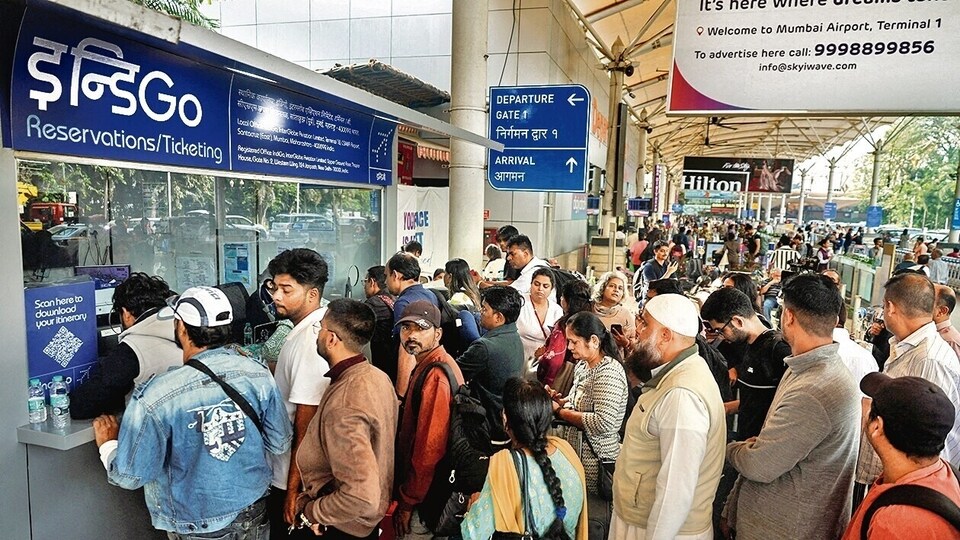
After nine days of scrapped flights, stranded passengers and airports overflowing with misdirected pieces of baggage, cancellations continued on Wednesday, though on a lower scale, despite assurances to the contrary by the carrier as well as the government.
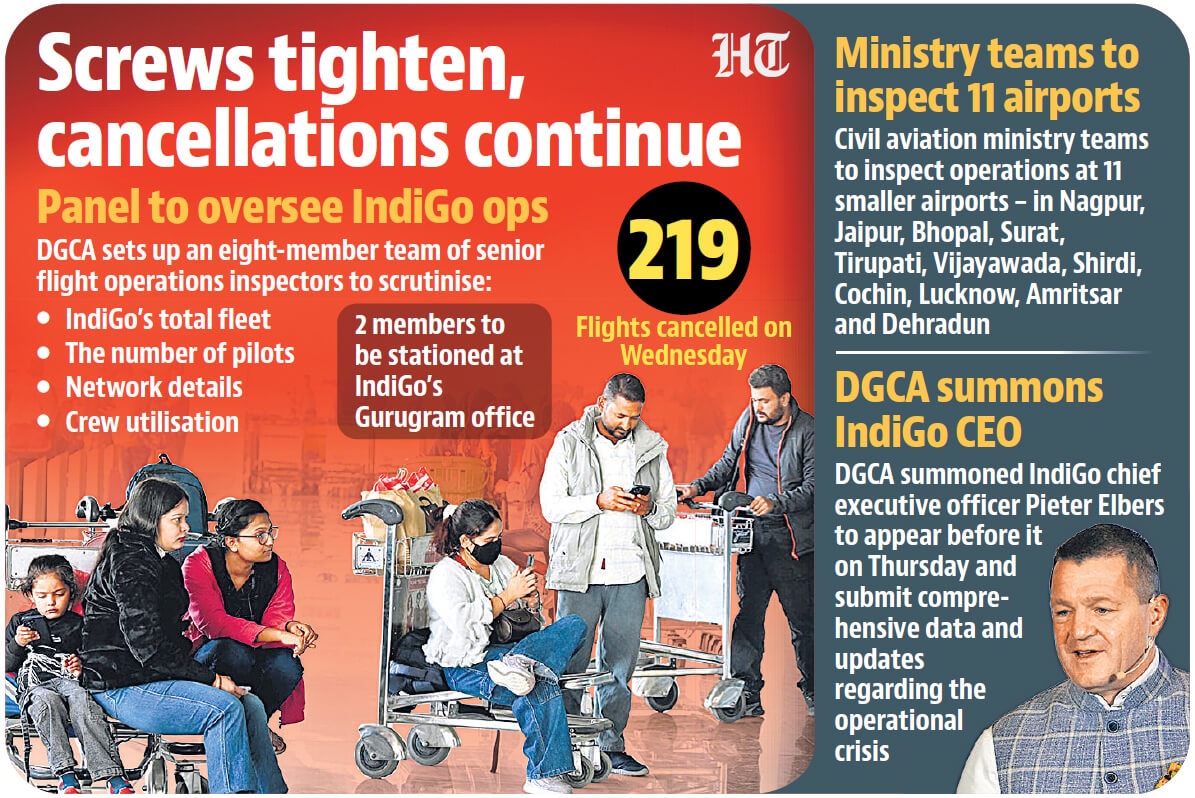
The Directorate General of Civil Aviation (DGCA) set up an eight-member team of senior flight operations inspectors and said they will scrutinise IndiGo total fleet, the number of pilots, network details and crew utilisation, amid a crisis that has led to the airline, India’s largest, cancelling thousands of flights and leaving millions in lurch since December 2. A two-member team, also deployed at IndiGo’s corporate office, will monitor the status of cancellations, on-time performance, refunds and baggage returns to fliers.
“Both these teams will submit a daily report,” DGCA said in the two-page order.
The move to tighten the oversight screws on IndiGo came on a day the airline cancelled 220 flights and delayed hundreds more, despite the airline’s chief executive officer Pieter Elbers claiming the previous day that it had got its operations back on track after eight days of mayhem. DGCA summoned Elbers to appear before it on Thursday afternoon and submit comprehensive data and updates regarding the operational disruptions.
Also under fire for its role during the aviation meltdown, the civil aviation ministry said its teams will fan out to inspect the airline’s operations at 11 smaller airports – in Nagpur, Jaipur, Bhopal, Surat, Tirupati, Vijayawada, Shirdi, Cochin, Lucknow, Amritsar and Dehradun. Officers will visit the airports and focus on IndiGo’s operational and safety protocol, as well as the status of flight delays and cancellations, congestion at terminal areas, queue management at check-in, security and boarding gates, and adequacy of airline and airport operational manpower.
The low-cost carrier – which controls more than 65% of India’s domestic aviation market – is the dominant service provider at these airports, where tens of thousands of people were left without any options over the previous week.
The developments came a day after the government trimmed the airline’s winter schedule by 10% and Elbers and other IndiGo officials met civil aviation minister K Ram Mohan Naidu.
DGCA has also sought updates on flight restoration, including the status of restoring flight services across the network, progress in re-accommodating affected passengers, priority handling for vulnerable travellers such as the elderly, medical passengers, and unaccompanied minors, and the monitoring mechanism to ensure timely completion of the restoration.
In a video message, Vikram Singh Mehta, the chairman of the IndiGo board, pushed back against allegations that the company orchestrated the chaos but acknowledged that the firm erred. “The IndiGo board has decided to involve external technical experts to work with the management, help determine root cause,” he said in his first message since the crisis began.
For decades, IndiGo relied on aggressive scheduling and maximum night-flight utilisation -- a business model that collapsed when new safety regulations increased the mandatory weekly rest period for pilots. The crisis began on December 2, when IndiGo, which prides itself on its heady on-time performance numbers, cancelled over 100 of its 2,300-odd flights. Between then and December 9, the airline cancelled an estimated 5,500 flights and delayed much of the rest. These were largely domestic flights as the airline redeployed its staffing to prioritise international operations.
People scrambled to reschedule their flights, struggled to get refunds and find their luggage as the airline stonewalled passengers and offered little transparency. As the turbulence deepened, the ministry and regulator also came under fire for not doing enough to mitigate the crisis.
On December 5, DGCA exempted Indigo’s Airbus A320 fleet from certain rules on pilot duty hours at night and allowed IndiGo to call back pilots deputed elsewhere for flying duties. Separately, it withdrew a rule that prevented airlines from counting pilot leave as weekly rest to meet flying duty norms. Still, the disruptions continued unabated. The move was criticised by pilots and experts who said that this would compromise safety, which was the primary motivation for such rules. The regulator insisted the exemption was granted “solely to facilitate operational stabilisation and in no way amounts to dilution of safety requirements”.
On Wednesday morning, as India’s skies continued to swirl from the chaos of IndiGo’s mismanagement and shoddy planning, the Delhi high court also pulled up the central government for allowing the situation to precipitate, not taking action on time and for not adequately putting a lid on airfares, that surged multifold as passengers struggled for alternatives. “The question is why, at all, this crisis arose and what have you been doing?” asked a bench of chief justice Devendra Kumar Upadhyaya and justice Tushar Rao Gedela, directing the Centre and airline to take steps to adequately compensate the affected persons.
The bench also asked how other airlines were allowed to “take advantage” of the chaos.
“The ticket which was available for ₹5,000, the prices went up to ₹30,000 to ₹35,000. If there was a crisis, how could other airlines be permitted to take advantage? How can it (ticket price) go up to ₹35,000 and ₹39,000? How could other airlines start charging? It’s like a pound of flesh, how could this happen,” asked the bench.
The ministry on December 6capped airfares at ₹7,500 for routes up to 500km, ₹12,000 for 500-1,000km, ₹15,000 for 1,000-1,500km, and ₹18,000 for routes above 1,500km, excluding airport fees and taxes. But many flyers complained that airlines flouted the cap with abandon.
Officials aware of the matter on Wednesday said the cap was “temporary.” “Once the IndiGo crisis settles down, the cap will be removed, possibly within a week,” said a ministry official. The airline also submitted its trimmed flight schedule to DGCA, said people aware of the matter, though the details of these revisions were not immediately clear. A 10% deduction in its winter flight operations would amount to a reduction of some 220 flights per day.


