
 E-Paper



Are embassies 'foreign soil'? Explained as Afghanistan's no-women presser stirs row
Women journalists claimed they were denied entry at presser held recently at the Afghanistan embassy in Delhi during the visit by country's foreign minister.

 Prefer HTon Google


The controversy over the no-women-allowed press conference at the Afghanistan embassy in New Delhi on Friday is still hitting headlines with the Opposition continuing its attack on the Bharatiya Janata Party (BJP)-led central government for the “shocking” move to agree to the ban on female journalists at the presser.
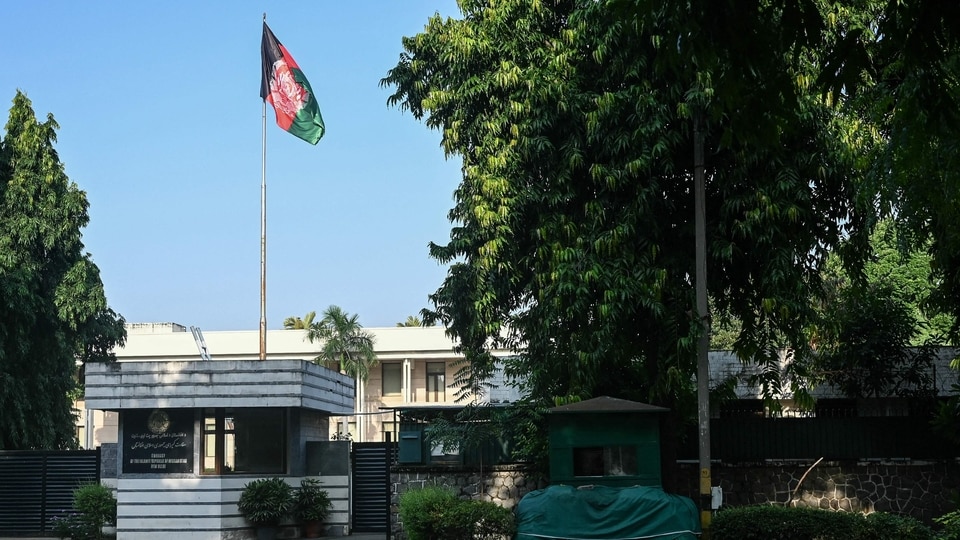
The press conference was organised at the Afghanistan embassy in Delhi following bilateral talks between external affairs minister S Jaishankar and Afghanistan's foreign minister Amir Khan Muttaqi.
Women journalists claimed they were denied entry at the above-mentioned press conference.
Did India 'allow' the ban on women journalists?
Amid the backlash, the ministry of external affairs said on Saturday that it had no involvement" in the press interaction held on Friday by the Afghan FM in Delhi.
BJP also responded to criticism by the opposition saying that the press conference happened inside the embassy of Afghanistan, “where the Indian government has no jurisdiction.”
Responding to a post by Congress MP Rahul Gandhi on X, a BJP worker, S Jayashankar, wrote, “It is understandable for you to defend this act for your vote bank politics. But blaming it on the Indian government shows that Congress indeed has no moral values. You tend to even insult India as a country to absolve the crimes of Islamic extremism.”
Rahul Gandhi had slammed Prime Minister Narendra Modi, saying that allowing the exclusion of women journalists from a public forum means “telling every woman in India that you are too weak to stand up for them.”
Media bodies and press organisations – such as Editors Guild of India, Indian Women Press Corps – have condemned the exclusion of women journalists, saying that diplomatic immunity under Vienna Convention does not justify blatant gender discrimination.
What does Vienna Convention on Diplomatic Relations say?
The Vienna Convention on Diplomatic Relations (1961) is the foundational treaty governing diplomatic relations, law, privileges, and immunities between state, an integral part of which are embassies and consulates.
Vienna Convention on Diplomatic Relations of 1961 is considered one of the most successful legal instruments drafted under the United Nations.
According to its text, which is available from the United Nations (via the “Audiovisual Library of International Law”) among other sources, the Article 22 confirms inviolability of mission premises. This means premises of a diplomatic mission are inviolable.
“Article 22 confirms the inviolability of mission premises – barring any right of entry by law enforcement officers of the receiving State and imposing on the receiving State a special duty to protect the premises against intrusion, damage, disturbance of the peace or infringement of dignity. Even in response to abuse of this inviolability or emergency, the premises may not be entered without the consent of the head of mission.”
Inviolability does not mean that foreign law applies at an embassy – it just means the host country cannot enforce its laws inside the embassy by physical intervention, unless permitted.
However, Article 41 of the Vienna Convention on Diplomatic Relations of 1961 says that without prejudice to their privileges and immunities, it is the duty of all persons enjoying such privileges and immunities “to respect the laws and regulations of the receiving State”.
“They also have a duty not to interfere in the internal affairs of that State,” Article 41 states.
Are embassies ‘foreign soil’?
The above has been used by the Opposition to argue that India’s laws should be respected, without using embassy premises to flout India’s Constitution which enshrines gender equality.
All of this also brings us to a common myth that embassies are the territory of the sending state or are considered “foreign soil” – For example: the Afghan Embassy in India is legally Afghanistan's territory. This is false. The embassy remains part of the host country's territory – India, in this case.
So while embassies remain part of the host country and are technically subject to its laws, those laws cannot be enforced inside the embassy without the mission's consent, making diplomatic immunity a shield, that some argue can be a license to ignore host country principles.


