E-Paper



Drain discharge in Yamuna rises 76% more than estimated: Delhi Jal Board
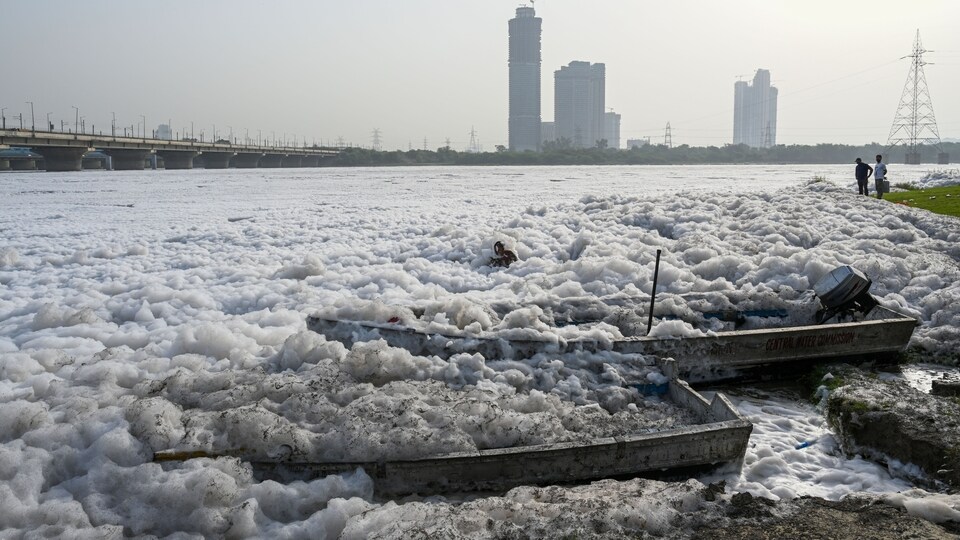
The largest of these drains, the Najafgarh drain (aka the Sahibi river) meets Yamuna near Signature bridge turning the brownish water into black dludge.

 Prefer HTon Google


Delhi’s 22 main drains contribute 76% more wastewater than previously estimated to the Yamuna as it flows through the city, according to an assessment by the Delhi Jal Board (DJB) –– a number that indicates the magnitude of challenge involved in cleaning the river.
The estimate of wastewater flow in the 22 drains that enter Yamuna along the stretch between Wazirabad and Okhla has been revised from 750.4 million gallons per day (mgd) in May 2025 to 1324.4 mgd in May 2026, Delhi government reports show. Larger drain systems such as Najafgarh, Shahdara, and Barapullah saw the highest jump ranging from two to 4.7 times the previous estimates, forcing city administrators to reassess the baseline for rejuvenation of the river. Government officials say that the revised figures, based on reassessment surveys and volumetric studies carried out last year, indicate a more realistic situation.
Also Read: Flaws in Delhi landfill ops take centre stage, MCD plans to ramp up facilities
The Najafgarh drain, previously estimated to be carrying 452.34 mgd wastewater, has been found to be dumping around 862 mgd into the river, more than the combined effluent treatment capacity (814.226 mgd) of all 37 Sewage Treatment Plants (STPs) in the Capital.
The 22-km stretch of the Yamuna from Wazirabad to Okhla in Delhi is only 2% of the river’s length but contributes the most to its overall pollution load — 76%, according to a report by the Yamuna monitoring committee in 2018.
The largest of these drains, the Najafgarh drain (aka the Sahibi river) meets Yamuna near Signature bridge turning the brownish water into black dludge. On an average, roughly one drain enters Yamuna every km in this stretch turning it into a sewage canal before it reaches the Okhla barrage. These drains, which also carry wastewater from Haryana and Uttar Pradesh, dump untreated effluents in the river stretch which also lacks minimum environmental flow, the amount of water that must flow in a river to sustain its ecological health and water quality.
According to a report submitted by Delhi to the Union government, the estimated flow has increased in at least 11 drains, although five, Najafgarh (862 mgd), Shahdara (160.8mgd), Barapullah (151.61 mgd), Delhi Gate (86.68 mgd), and Sen Nursing Home (26.35 mgd) account for 97.2% of the overall wastewater inflow. HT has seen copy of the reports.
Also Read: Delhi Jal Board to set up 47 groundwater monitoring devices
In June last year, the Delhi government, along with multiple agencies, announced it had commissioned drone surveys, mapping and studies of the drains and sub-drains to assess the quantum of untreated sewage flowing into the river as part of the Yamuna rejuvenation project. Delhi water minister Parvesh Verma said at the time that a fresh assessment of the pollution load was being conducted to examine the real sewage treatment capacity that needs to be installed.
A senior government official said that some of these 22 drains have been tapped, fully or in part, and their flow diverted to the nearest STP , But it is not technically feasible to tap larger drains such as Najafgarh and Shahdara. But the official, who asked not to be identified, added that the government was exploring ways to tap some of the 156 sub-drains that drain into Najafgarh drain, using decentralised STPs. To be sure, 220 mgd of untreated water flows into the drain from Haryana .
Bhim Singh Rawat, coordinator of the South Asia Network on Dams, Rivers and People (SANDRP), said that the foundation of planning wastewater treatment in Delhi has been flawed.
“DJB uses a rule of thumb that 80% of water it supplies returns as grey water. This does not include water residents derive from other sources such as groundwater,” he said.
“Secondly, there is an interstate issue with large increase in wastewater volume from Haryana and UP due to expansion of NCR settlements. We need a proper scientific analysis to create a baseline so that treatment facilities can be planned accordingly.”
Rawat said that STPs alone will not be able to tackle the problem and the environmental flow in the river needs to be increased through release of additional water from the Hathnikund barrage. “It has to be treated as an interstate project, with the central government steering it at every step.”
Environmental flow, or e-flow, refers to the minimum flow of water required in a river to sustain its ecological health.
The DJB and the Delhi water ministry comment did not respond to requests seeking comment.
DJB’s assessment corroborates a finding by the Comptroller and Auditor General (CAG) of India in its report on “functioning of Delhi Jal Board” between 2017 and 2022, that the utility was underestimating the overall sewage generation in the national capital and that without “realistic figures of sewage generated in Delhi, a concrete and effective plan for its treatment would elude any remediation.” That report also flagged that though the period of Phase- II (2017-21) of Sewage Master Plan ended in 2021, not a single new STP against the proposed 56 new STPs were constructed in this period.
Delhi Jal Board currently operates 37 STPs with a combined capacity to treat 814.26 mgd. These plants remain underutlized with current capacity utilisation estimated to be around 744.3 mgd. A second government official said that the central government has already fixed a target of ramping up the treatment capacity to 1,400 mgd. “We are working on increasing the existing capacity to 862 mgd (million gallons per day), through upgradation of old plants. Construction of new plants is in various stages. Work orders for 16 new decentralised STPs have been issued and ten more are at the tender stage. Larger STPs like a 100 mgd Delhi gate STP are also in planning stages,” this person added, asking not to be named.
The official also said that Delhi is hoping Haryana and Uttar Pradesh will also do their bit, instead of allowing untreated sewage to flow into the drains.