
 E-Paper



DRDO’s Tapas UAV crashes in Karnataka after technical snag
The Tapas UAV encountered a technical snag while it was undergoing an experimental flight trial and it crashed in a nearby farmland

 Prefer HTon Google


An indigenous Tapas unmanned aerial vehicle (UAV), being developed by the Defence Research and Development Organisation (DRDO), crashed near Challakere in Karnataka’ Chitradurga district on Sunday, with the DRDO attributing the incident to a technical snag. The medium altitude long endurance (MALE) UAV, a tactical platform for airborne surveillance, has thus far undergone more than 200 test flights.
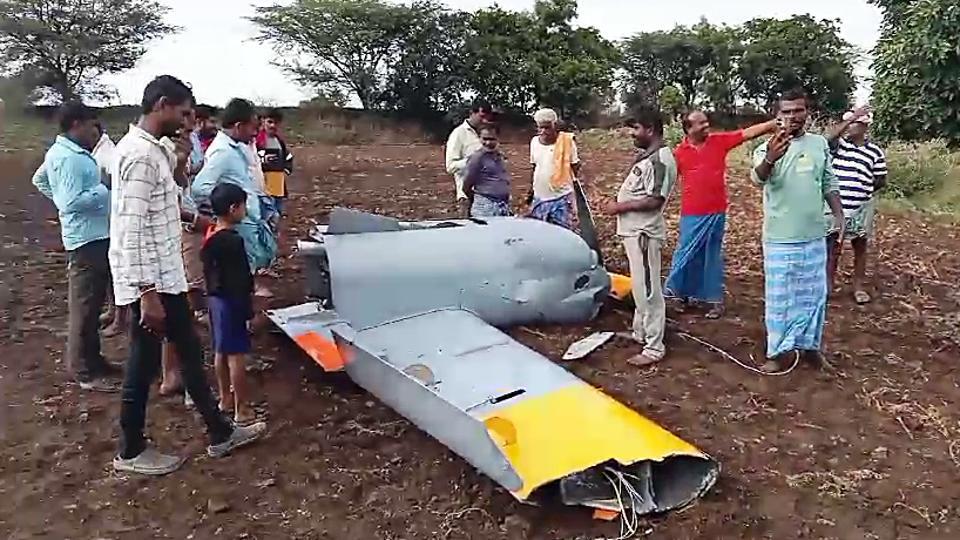
The DRDO has launched an investigation into the crash.
“The Tapas UAV was undergoing an experimental flight trial today morning from ATR (aeronautical test range) Challakere, Karnataka. During the flight, a technical snag was encountered, and the UAV crashed in a nearby farmland. The technical reason is being investigated and there is no collateral damage,” the DRDO said in a statement.
The crash comes at a time when the UAV is ready for user evaluation trials. The UAV had earlier crashed in September 2019.
The platform can operate at an altitude of 28,000 ft and has an endurance of 18 hours. It also has night flying capability. It is an indigenous solution to the tri-services intelligence, surveillance, target acquisition and reconnaissance (ISTAR) requirements, according to the DRDO. It can carry a maximum payload of 350 kg.
Its mission requirements are to provide continuous wide area coverage and yet be able to identify small targets, according to the DRDO. The MALE UAV can also be used for artillery fire corrections, and battlefield post-strike assessment.
India currently does not have any drone in the HALE (high altitude long endurance) category. The country is buying from the US 31 MQ-9B remotely piloted aircraft systems (RPAS) to boost the military’s strength and help bridge the technological gaps faced by the DRDO in developing such systems indigenously.
The defence ministry in early July issued a letter of request (LOR) to the US government for the 31 MQ-9B General Atomics HALE drones, mentioning the tri-services requirements, details of equipment and terms of the procurement. Fifteen UAVs will be for the navy, and eight each for the army and the Indian Air Force.
US firm General Atomics has offered the drones to India for $ 3,072 million. This, however, is subject to negotiations, as previously reported by HT. The estimated cost of the drones includes weapons, sensors, ground control stations, ground data terminals, ground handling equipment, spares and logistics support.
India will also negotiate a higher element of technology transfer. It is looking at doubling the element of technology transfer that is currently on offer --- from 8-9% to 15%-20%. To be assembled in India, the versatile platform will have the capability to strike targets with its on-board weapons, it will be used for intelligence, surveillance and reconnaissance; and its other roles include electronic warfare, defensive counter air and airborne early warning.


