
 E-Paper



ED opposes Kavitha’s bail plea in high court, says she will influence witnesses
ED said the influence wielded by Kavitha was reflected in how Hyderabad-based businessman retracted his November 2022 statement to the agency

 Prefer HTon Google


NEW DELHI: The Enforcement Directorate (ED) on Friday opposed Bharat Rashtra Samithi (BRS) leader K Kavitha’s appeal for bail in the money laundering case linked to the Delhi excise policy case, saying the former Telangana chief minister’s daughter would influence witnesses and destroy evidence.
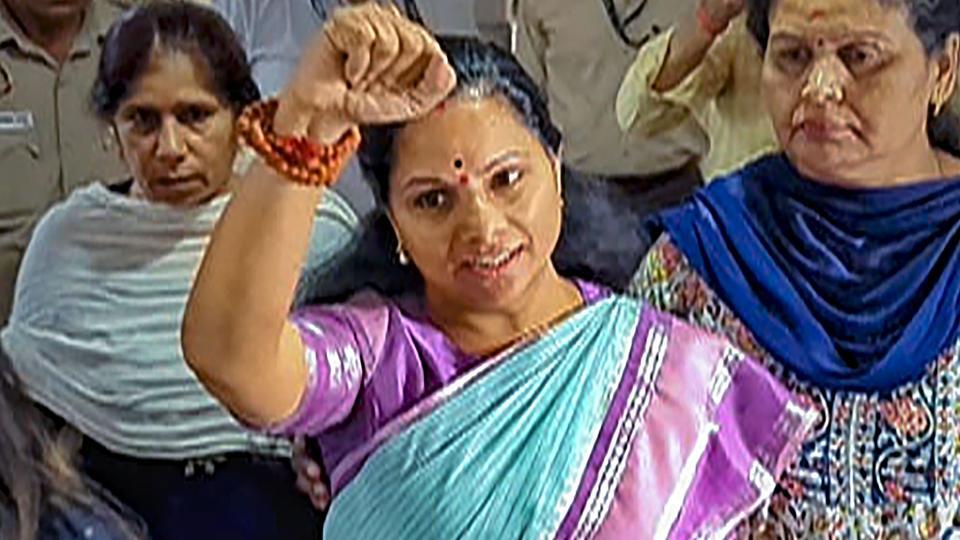
In its affidavit, ED underlined that the influence wielded by Kavitha was reflected in how Hyderabad-based businessman Arun Ramachandran Pillai retracted his November 2022 statement to the agency on the same day Kavitha was summoned by the agency on March 9, 2023.
“It is bizarre that it took 118 days to realise that he (Pillai) was coerced or was there some intervening event which led to his retraction? It is apparent that the applicant herein wields considerable influence insofar as the first summons issued to her was on 7.03.2023 for her personal appearance on 9.03.2023, which clearly prompted Arun Pillai to file an application for retraction on the same day i.e. 9.03.2023,” the federal agency told a bench of justice Swarana Kanta Sharma.
The agency also complained that Kavitha had been giving “false evidence” during her questioning, indulged in litigation to delay the probe and made unnecessary, redundant, and political statements in response to specific questions. Besides, it also accused her of deleting evidence from her mobile phone and actively participating in activities related to the proceeds of crime amounting to Rs. 292.8 crore.
Kavitha approached the high court after a city court rejected her bail application on May 6, ruling that her role “prima facie” appeared as that of a key conspirator in the collection and payment of upfront money to Aam Aadmi Party (AAP) through co-accused to get favourable provisions in the excise policy. The court also rejected her contention that she was arrested by the Central Bureau of Investigation (CBI) solely to deny her party a level playing field in the ongoing Lok Sabha elections.
In her appeal, Kavitha’s bail plea contended that her arrest on March 15 was orchestrated by members of the ruling party at the Centre with the active connivance of ED. However, ED refuted these claims, asserting that the investigation was conducted impartially and without political bias.
“Kavitha has conspired with other people and was actively involved in the payment of kickbacks to the tune of Rs. 100 cr and then in establishing the money laundering ecosystem i.e. M/s Indo Spirits through her proxy which generated proceeds of crime of Rs. 192.8 Cr. By such acts, Smt K Kavitha is involved in various processes and activities relating to proceeds of crime (POC) to the tune of Rs. 292.8 Cr,” ED’s affidavit added.
The agency also contested Kavitha’s application for bail on health grounds, arguing that the medical documents provided were outdated and did not warrant bail. Moreover, the affidavit stated that Kavitha did not raise any medical complaints during her post-arrest medical examination.
Kavitha, initially arrested by ED on March 15 and by CBI on April 11, remains in judicial custody.
The court, after hearing submissions from Kavitha’s legal team, adjourned the matter to May 27 for further deliberation.
Kejriwal was also arrested in the case by ED on March 21 and was in judicial custody until he was given interim bail on May 10 for the election campaign, and has been ordered to return to custody on June 2.
On May 17, ED filed its first charge sheet naming Delhi chief minister Arvind Kejriwal and the Aam Aadmi Party (AAP) as accused in the case. The nearly 200-page document, which is the eighth in a series of charge sheets filed by ED since November 2022, claimed that Kejriwal was directly involved in formulating the excise policy and demanded kickbacks from the South Group in exchange for awarding them favours.


