
 E-Paper



Eminent scientist Srinivasan who worked with Homi Bhabha passes away at 95
Malur Ramasam Srinivasan’s daughter, Sharda, posted on Facebook that her father suddenly took ill in Ooty on Monday night and passed away peacefully at a hospital at 4am on Tuesday

 Prefer HTon Google


Eminent scientist Malur Ramasam Srinivasan, who played a role in the development of India’s nuclear power programme and the indigenous Pressurized Heavy-water Reactor, passed away on Tuesday. He was 95.
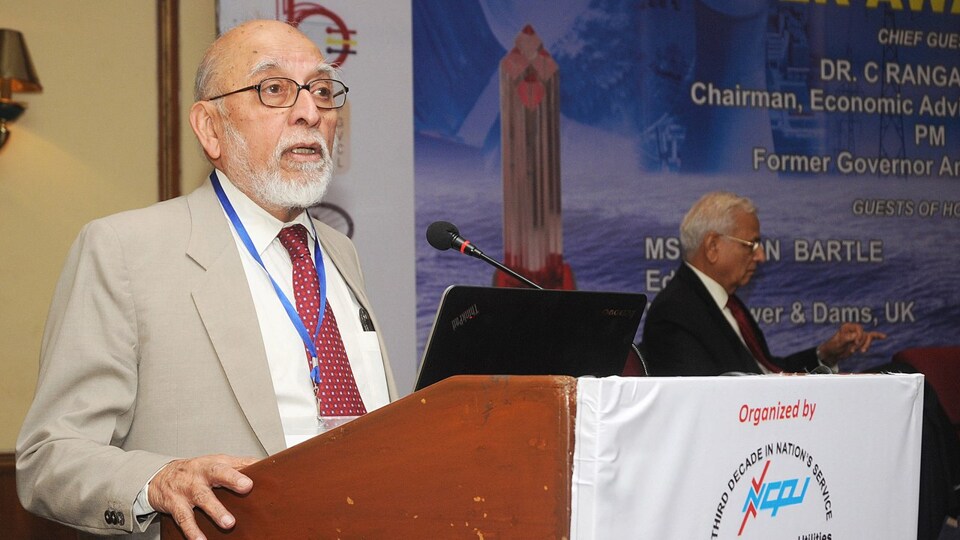
Srinivasan’s daughter, Sharda, said her father suddenly took ill in Tamil Nadu’s Ooty on Monday night and passed away peacefully at a hospital at 4am on Tuesday. In a post on Facebook, she recalled her father’s dedication to work. “Appa [Srinivasan]...you always said that work was duty and that I should not miss a day of work regardless of other things..but still this is not fair...I had just told you of our plans to have the 95th celebration of your life’s work [a] couple of days back…,” she wrote. She added her mother was with him when he passed away. “...we are going from Bangalore now.
Born in Bangalore (now Bengaluru) on January 5, 1930, Srinivasan joined the Department of Atomic Energy (DAE) in September 1955. He began his distinguished career working alongside Homi Bhabha, the father of the Indian nuclear programme, on the country’s first nuclear research reactor, Apsara, which achieved criticality in 1956.
In 1967, Srinivasan took over as the Madras Atomic Power Station’s chief project engineer. As director of DAE’s Power Projects Engineering Division in 1974 and Nuclear Power Board chairman in 1984, he oversaw the planning, execution, and operation of the country’s nuclear power projects.
In 1987, he was named the Atomic Energy Commission chairman and DAE secretary. In the same year, he became the founder-chairman of the Nuclear Power Corporation of India Limited. Eighteen nuclear power units were constructed during his tenure.
From 1990 to 1992, he was a senior advisor at the International Atomic Energy Agency, Vienna. He served as a member of the erstwhile Planning Commission from 1996 to 1998.
Srinivasan, who was among the founding members of the World Association of Nuclear Operators, had two stints at the National Security Advisory Board (from 2002 to 2004 and 2006 to 2008).
A recipient of Padma Vibhushan, India’s third-highest civilian award, Srinivasan was the third of eight siblings. He completed his schooling at the Intermediate College, Mysore (now Mysuru). He chose Sanskrit and English as his languages for study. Srinivasan completed a bachelor’s degree in mechanical engineering in 1950 from what is now the University of Visvesvaraya College of Engineering. He completed a Doctor of Philosophy in 1954 from Canada’s McGill University with gas turbine technology as his field of specialisation.


