
 E-Paper



Every organ of state, not courts alone, must render justice: CJI in I-Day speech
CJI NV Ramana, who hails from Andhra Pradesh, evoked Telugu patriot Pingali Venkayya who designed the national flag, and released a Telugu version of the book named ‘Courts of India – Past to Present’ that traces the history of the judicial system in India

 Prefer HTon Google


The deeds of every organ of the state – judiciary, legislature and executive – have to be in the spirit of the Constitution, outgoing chief justice of India NV Ramana on Monday.
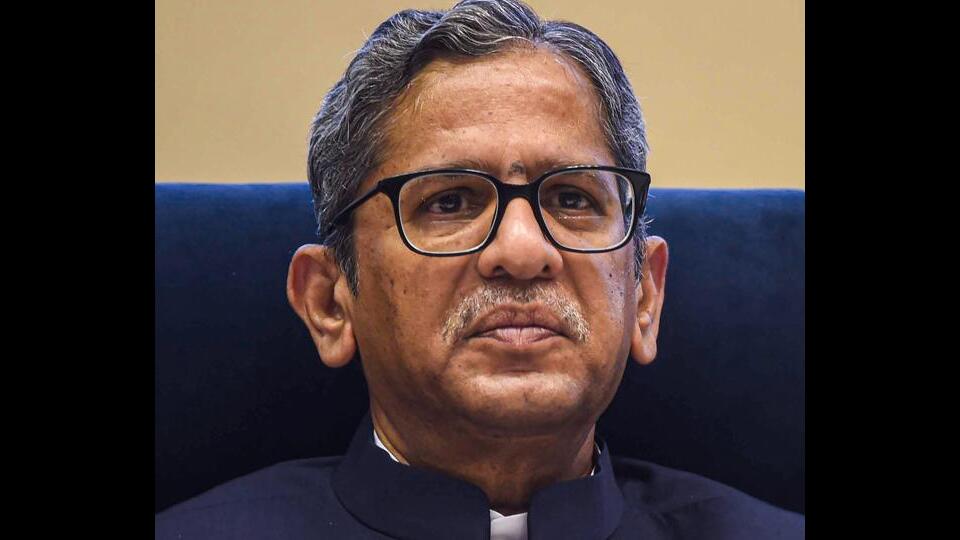
His comments came after Union law minister Kiren Rijiju spoke of the challenges the judiciary faces that are common to legislature and the executive, requiring all organs of the state to work together to solve the problems ailing the country.
“Under the Constitutional framework, each organ has been given a unique obligation. All the three organs of the State, i.e., the executive, legislature and the judiciary, are equal repositories of Constitutional trust,” CJI Ramana said.
Speaking at the Independence Day function organised at the Supreme Court by the Supreme Court Bar Association (SCBA), the CJI, who is to retire on August 26, said, “The notion that justice is only the responsibility of the Court is dispelled by Article 38 of the Indian Constitution which mandates the State to secure justice: social, economic and political. Every deed of each organ of the state has to be in the spirit of the Constitution.”
CJI Ramana, who hails from Andhra Pradesh, evoked Telugu patriot Pingali Venkayya who designed the national flag, and released a Telugu version of the book named ‘Courts of India – Past to Present’ that traces the history of the judicial system in India. The book has been translated into six other regional languages.
Also Read:Constitution meant for every citizen of India: CJI Ramana
“Our system will truly belong to the people when we honour and cherish our diversity,” the CJI said, reiterating his endeavor to advocate for the Indianisation of the judiciary. As part of this effort, the Supreme Court has over the past several years provided copies of its judgments in regional languages.
Justice Ramana said that citizens must be meaningful stakeholders in a country’s democracy, and highlighted the trust people repose in the judiciary. “The legislature may not be able to foresee the issues which might come up during the implementation (of a law),” he said, adding that by the process of interpretation of statutes, “courts have breathed life into the statutes, by making them relevant to the contemporary times”.
Talking of pendency, the issue staring the judiciary in the face with over 40 million cases pending in lower judiciary and 70,000 in Supreme Court alone, the CJI said, “The court has inherited the backlog of nearly a year on the account of Covid-19 and there were lockdowns.” It was just and natural for people to expect speedy hearing of their cases but regrettably, he added, “forces of nature were against us.”
In the last 16 months, the apex court could physically assemble for only 55 days. “I wish the situation was different and we could be more productive. I hope in the near future, the situation will become normal and courts will function to the full potential,” he said.
Union Law Minister Kiren Rijiju, who also spoke at the event, said that members of Parliament ask him why there is a pendency and, on several issues, discussed about judges on social, print and electronic media. “Taking advantage of my privilege in the House, I could also speak the way other members speak but I have to understand that I have to come back to the judiciary, I have to talk to Chief Justice, I have to interact with judges. So, I have a ‘lakshman rekha’, which I will never dare to cross.”
On pendency, Rijiju said judges of the top court decide 40-50 cases on a daily basis. “No country has this kind of workload that our judges are handling,” the law minister said, adding, “In the same manner, the legislature and executive face a unique problem”, which sometimes the judiciary fails to understand. He recalled that as a member of Parliament, one has to attend to every issue in the constituency, besides attending to legislative work and representing India and Parliament at international forums.
“It is not easy to handle this position you hold in India. It is very easy to pass comments and say legislature should do this, executive should do that and judiciary should finish all pending cases in two years’ time. It is easy to make sweeping comments… But the fact is that our country is very unique and so the challenges are also very unique,” Rijiju said.
The minister stressed upon the need for cooperation between the judiciary and the executive, as he felt, “if we don’t work together, we will not understand each other. If we don’t understand each other, we will never be able to solve the problems of this country.” “Without government’s supportive role, it is difficult for the judiciary to perform its duty in isolation.”
With justice Uday U Lalit, the CJI-designate also present at the event along with other apex court judges, the law minister said, “As the law minister, I have a very clear-cut role to play as a bridge between the judiciary and executive, and to some extent the Parliament of India. I will continue to play that role.”
CJI Ramana, who has in the past appreciated Rijiju’s constructive approach in clearing judicial appointments and supporting creation of judicial infrastructure, said that it does not matter whether the law minister has no legal practice as a lawyer. “More than legal knowledge, your experience, common sense and commitment is important. That you had sufficiently. That will take care sufficiently and help you, the judiciary and the government to uphold the rule of law.”
SCBA president Vikas Singh in his speech highlighted that the quality of lawmakers and judges are factors contributing to better administration of justice. However, with 43% of the legislators in India facing criminal cases, he stressed on the need for a law to restrict them from contesting elections.
On the appointment of judges, Singh said he is disheartened by the Collegium system of appointments as his efforts to recommend the best lawyers practicing in Supreme Court for elevation as judges has met a complete stumbling block.


